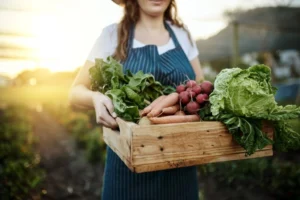
You might find yourself thinking, “I’m choosing a healthier option for myself and my household,” as you place organic apples into your shopping basket. But when you notice the higher price compared with conventional options, you may also ask, “Is organic food really worth it?”
More questions often follow — what does the “organic” label truly signify? Are we actually purchasing more sustainably grown, superior produce? Or are we paying a premium for something that’s largely similar to conventional items?
We’ll explore these points, but whether organic is worth it to you is ultimately a personal judgment. We’ll review how the organic designation is determined, how much you could save by choosing conventional produce, and strategies for incorporating organic items into your budget if you’re committed to them.
What the Organic Label Actually Means
The U.S. Department of Agriculture sets the standards for what counts as organic. To earn the USDA organic seal, products must comply with specific requirements outlined on the agency’s website.
Broadly speaking, to be labeled organic, a product must “be produced using agricultural production practices that foster resource cycling, promote ecological balance, maintain and improve soil and water quality, minimize the use of synthetic materials and conserve biodiversity.”
There are additional criteria. Certification must be overseen by a USDA NOP-authorized certifier — the entity that formally approves the status. Certain technologies, such as genetic modification, are deemed “not compatible with organic production,” according to a USDA memo, as are specific nonsynthetic substances.
Decoding the Different Labels
Not every organic label carries the same meaning. The USDA recognizes four distinct categories — 100% organic, organic, made with organic ___, and listings of specific organic ingredients. To clarify, 100% organic is the highest standard and applies to products that “contain 100% organic ingredients.” The USDA notes that “most raw, unprocessed or minimally processed farm crops” fit here. The simpler ‘organic’ label applies to products with at least “95% organic ingredients.” ‘Made with organic’ requires “at least 70% organically produced ingredients.” Specific ingredient listings identify individual components that are organic.
To make this more practical, the USDA provides a graphic that outlines what organic means by category. For fruits, vegetables and grains, organic typically indicates use of natural fertilizers, environmentally friendly pest control and practices that protect soil and water. For meat, dairy and eggs, it generally means animals had outdoor access and were not given growth hormones or antibiotics.
It’s worth noting the USDA organic seal is the “only government-backed marketing claim for organic food sold in the United States.” So other claims you encounter may not be officially validated.
The Size of the U.S. Organic Market
If you’re thinking of buying organic, you’re far from alone. An Organic Trade Association study, cited by USDA, reported that more than 80% of U.S. households purchased organic food in 2016. Sales of organic foods in the U.S. nearly doubled between 2010 and 2021, according to data from the Nutrition Business Journal.
Unsurprisingly, the majority of organic purchases are produce, comprising roughly 40% according to 2021 figures. Dairy and eggs account for the second-largest share. And despite the farm-fresh image organic food sometimes carries, 88% of organic sales occurred at conventional and natural food supermarkets and chains, per the Organic Trade Association.
However, inflation prompted some shoppers to cut back on organic purchases — 21% reported buying gourmet or organic items less often in spring 2023, Statista data shows.
Choosing Which Organic Foods Matter Most
Let’s start with some fundamentals. Is organic food better for your health? It’s difficult to draw long-term distinctions between diets that include organic versus conventional foods, but research suggests potential advantages.
Studies indicate people who consume substantial amounts of organic food appear to have lower rates of non-Hodgkin lymphoma, according to the Mayo Clinic. The clinic also notes that those who buy organic often adopt healthier lifestyles in general, which complicates attributing benefits directly to organic food. Avoiding pesticides is also advised for pregnant individuals, since exposure could pose risks to the fetus.
The Mayo Clinic adds that organic labeling doesn’t necessarily mean higher nutrient content, and both organic and conventional foods must satisfy the same safety standards. Choosing organic does reduce your exposure to pesticides, though. If you can’t go fully organic, consult the Environmental Working Group’s list of produce with the greatest and least pesticide residues.
The 2025 EWG guide indicates items such as pineapple, avocados and onions have relatively low pesticide levels, so these don’t necessarily need to be organic to minimize exposure. Higher-residue items include potatoes, blueberries, spinach and kale — foods you might prioritize buying organic if pesticide exposure concerns you.
Ways to Cut Costs on Organic Food
To answer a frequent question: is organic food pricier than conventional? Unfortunately, the data generally says yes.
An April 2025 analysis by online lending marketplace LendingTree found organic produce costs about 53% more than conventional varieties. This aligns with earlier research from the University of California, Davis, which suggested organic items price roughly 50% higher than their conventionally produced counterparts.
A USDA chart outlines the premium for organic spinach, apples and strawberries from 2015 to 2023. For example, the spinach premium fell from roughly 170% in 2015 to around 20% in 2023. Apples and strawberries also dropped — apples from about 85% to 40% and strawberries from about 65% to 30% — yet organic versions remained costlier in every instance.
If you’re determined to buy organic, though, there are practical ways to lower your spending. Consider these strategies.
1. Buy produce that’s in season
If you’re open to varying what you eat and don’t need the same items every week, favoring seasonal produce can save money. Produce bought during its natural harvest period is typically less expensive due to lower production and transportation costs. Foodwise offers a seasonality chart that helps you identify what’s in season each month.
2. Join a CSA
To get closer to your food sources, consider a CSA — Community Supported Agriculture program. Paying an annual membership typically provides a weekly share of fresh fruits and vegetables directly from local farmers. Expect to pay roughly $400 to $700 per year, according to the N.C. State Cooperative Extension. The USDA’s Local Food Directories can help you locate CSA options nearby.
3. Choose frozen organic items
Frozen organic vegetables can be a budget-friendly route to higher-quality produce. The price gap between frozen organic and frozen conventional often is smaller than the gap between fresh organic and fresh conventional items.
4. Purchase in bulk
If you have a membership at a bulk retailer like Costco, buying organic in larger quantities can yield savings. Specialty suppliers such as Food in Bulk also let you search for items and find volume discounts.
5. Grow your own
For the greatest long-term savings on organic produce, consider investing in a garden. Whether you have backyard space or share a community plot, growing vegetables can require upfront costs but pay off with larger harvests over time.
6. Check eligibility for food assistance programs
If you qualify for food assistance like SNAP, the Supplemental Nutrition Assistance Program, or use EBT via the electronic payment system, you might be able to stretch your benefits. Programs such as Double Up Food Bucks match SNAP dollars spent on fruits and vegetables, effectively doubling purchasing power.
Contributor Anna Mercer often writes about personal finance and consumer topics for Savinly. Her work has appeared in Teen Vogue, Smithsonian Magazine and the Tampa Bay Times.