Last year saw U.S. traffic deaths climb to their highest level in ten years, according to estimates from the National Safety Council. In all, American roads recorded 40,200 fatalities in 2016, a 6% increase over 2015 and the first time the toll topped 40,000 since 2007.
The council points to a roughly 3% uptick in miles driven — driven by lower fuel costs and a strengthening economy — as one contributor. Still, human error remains a major factor: distracted driving is rising (about nine fatalities daily), and impaired driving continues to be a persistent issue (roughly 28 deaths each day).
Vehicle makers are pushing hard to improve occupant protection, introducing features such as lane departure alerts, adaptive cruise systems and blind-spot monitors. Safety frontrunner Volvo even pledged that “no one should be killed or seriously injured in a new Volvo” by 2020 — though “should” is the key word in that promise.
Even with manufacturers trying to raise safety levels, the agencies that grade them are becoming more demanding. In recent years the Insurance Institute for Highway Safety (IIHS) expanded its evaluations to include active safety systems in addition to crash tests, and it introduced an award tier above its Top Safety Pick: the Top Safety Pick+.
For 2017 the IIHS tightened standards further: by scrutinizing headlight performance for the first time, the nonprofit removed several long-time honorees — including the Ford F-150 — from its Top Safety Pick roster.
That makes the pool of budget-friendly but safe new cars considerably smaller. If you’re shopping for a new vehicle on a limited budget, prioritize safety and consider models that actually attained a Top Safety Pick accolade from the IIHS this year.
What Does a Top Safety Pick Mean?
To qualify for a 2017 Top Safety Pick, a vehicle must “receive good ratings in five crashworthiness evaluations — small overlap front, moderate overlap front, side, roof strength and head restraints — plus an advanced or superior rating for front crash prevention,” per the IIHS.
To earn a 2017 Top Safety Pick+ designation, a model must meet those criteria and also achieve an “acceptable” or “good” rating for its headlights.
So which inexpensive models made the2017 IIHS list? Not surprisingly, the top five affordable picks come from smaller vehicle segments such as minicars and compact sedans.
All prices listed are manufacturer’s suggested retail price for the base model.
1. 2017 Toyota Yaris iA: $15,950

Having owned a Toyota Yaris in the past (I eventually upgraded to a Subaru Crosstrek in Hyper Blue after years of saving), I’m not shocked that the Yaris iA — a model that emerged following the phase-out of Scion (a spin-off from Scion’s demise) — tops this roster with a Top Safety Pick status.
My Yaris lacked in power and amenities, but it was economical to purchase and operate and still felt reasonably secure on the road despite its compact footprint.
Standard safety equipment includes a Low-Speed Pre-Collision system, a full set of airbags and even a basic first aid kit. The MSRP listed is for the manual-transmission version; choosing the automatic raises the price to $17,050.
2. 2017 Kia Forte: $16,600

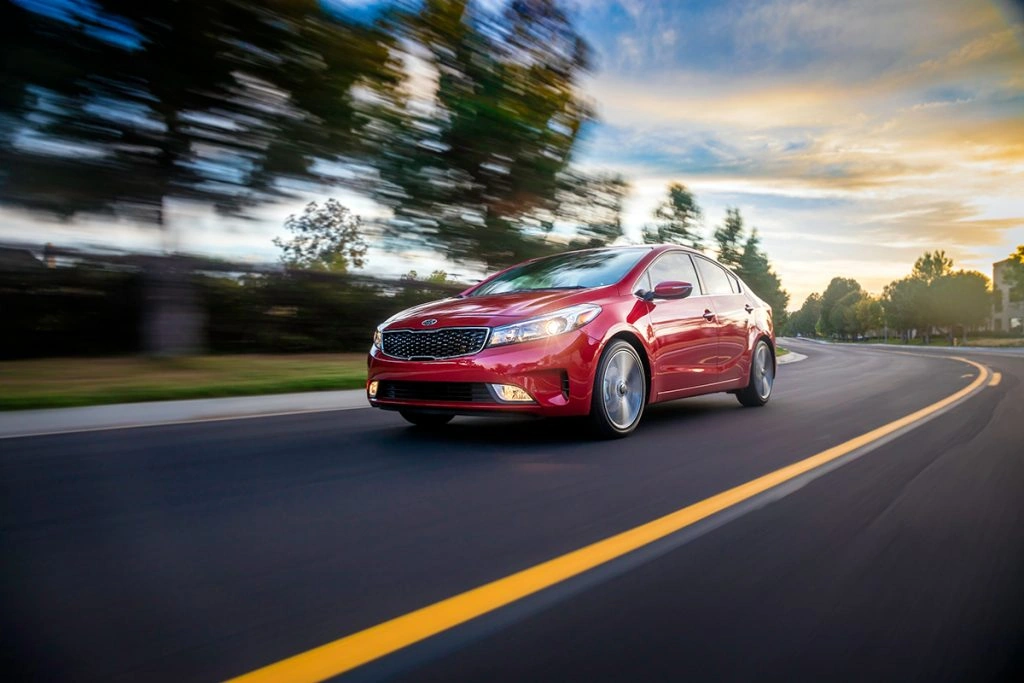
The 2017 Kia Forte may be compact, but the base model comes with an impressive array of standard safety gear that helped it earn a Top Safety Pick+ distinction. Features include Hill Start Assist Control, Vehicle Stability Management, a complete set of airbags and Kia’s Tire Pressure Monitoring System.
The MSRP shown is for the manual gearbox; upgrading to the automatic adds about $1,000 to the price.
3. 2017 Nissan Sentra: $16,990

Unassuming but competent, the Sentra performs well in protecting occupants and secured a Top Safety Pick distinction. Optional and available safety items include Nissan’s Intelligent Safety Shield suite, a RearView Monitor and Smart Auto Headlights.
The base S model at $16,990 comes standard with airbags, traction control and child-safety rear locks. That price is for the manual; the Xtronic CVT increases the MSRP to $18,090.
4. 2017 Hyundai Elantra – $17,150
The 2017 Elantra includes a comprehensive airbag package — front, side, curtain and knee airbags — as standard equipment. The Elantra achieved a Top Safety Pick+ rating and includes anti-lock brakes, stability control and an alarm system on the baseline trim.
The MSRP shown applies to the manual transmission model; selecting the automatic will cost you roughly $1,000 more.
5. 2017 Volkswagen Jetta – $17,895
I’ll confess some hesitation about buying a Volkswagen after the emissions scandal of 2015, but credit where it’s due: the Jetta is a well-styled, reasonably priced compact sedan.
With a Top Safety Pick+ honor, it scores well on safety. Standard safety highlights include Anti-Slip Regulation, Engine Braking Assist and a passenger occupant detection system.
The price listed is for the manual model; opting for the automatic tacks on an additional $1,100.
Most Affordable Top Safety Picks by Segment
If a minicompact or small sedan won’t fit your needs or family size, there are other economical models that earned Top Safety Pick recognition this year. Below are the least expensive Top Safety Picks by category (luxury classes excluded):
Minicars: 2017 Toyota Yaris iA: $15,590
Small Cars: 2017 Kia Forte: $16,600
Midsize Cars: 2017 Volkswagen Jetta: $17,895
Large Cars: 2017 Kia Cadenza: $31,990
Small SUVs: 2017 Mazda CX-3: $19,960
Large SUVs: 2017 Audi Q7: $49,000 (the only large SUV to earn a Top Safety Pick in 2017)
Minivans: 2017 Kia Sedona: $26,900 (one of two minivans on the Top Safety Pick list for 2017)
Large Pickups: 2017 Honda Ridgeline: $29,475 (the only large pickup awarded a Top Safety Pick for 2017)
Daniel Carter, an automotive editor based in Nashville, has covered cars for several years. He currently owns a Hyper Blue 2017 Subaru Crosstrek and is fond of it, though he admits he might swap it for a Tesla someday.