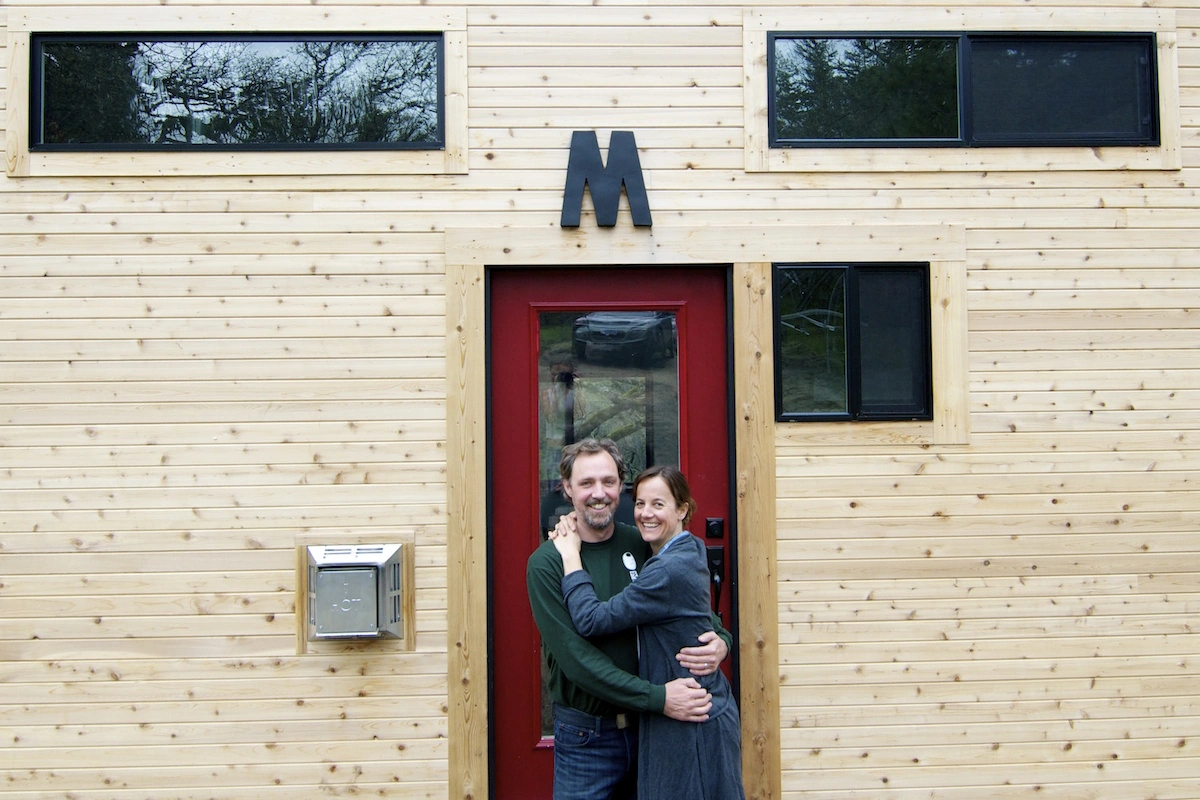
Several years back, Andrew and Gabriella Morrison and their two children lived in a 2,200-square-foot residence in Ashland, Oregon.
Andrew calls it the ideal house on the ideal street in the ideal town — the quintessential American dream.
From the outside, the family seemed to have it all. But behind closed doors, they were feeling mounting pressure from their finances.
“We began to notice the financial and energetic toll of living there and how much effort it took to keep up,” Andrew says.
So the four of them chose to shrink their lifestyle — dramatically.
Finding Tiny Homes — Well Before HGTV Made Them Popular

The Morrisons’ choice to leave their seemingly flawless suburban life happened quickly. Andrew describes it as an “aha” instant.
Amid their hectic routines, Gabriella received an email whose signature read “Tiny House Blog.” She’d never heard of tiny houses before, so she immediately looked it up online.
“It was literally like dominoes,” she says. “We fell down the rabbit hole and never turned back.”
Within half an hour of digging into the tiny-house way of life, Gabriella says everything clicked about why they were struggling and what had to change.
The Great Purge: Letting Go of 80% of Their Stuff

Gabriella discovered that the typical U.S. household contains roughly 300,000 items — everything from thumbtacks to armoires.
That’s a staggering amount. So the family devised what they called a “365-day rule.” Any time someone opened a room with a drawer or cabinet, every single object was emptied out.
For each piece, they asked, “Have we used this in the past year?”
If yes, they could choose to keep it. If no, it went into an accumulating heap in their two-car garage.
After a couple months, that heap climbed to about two feet high. Once an item landed in the pile, they revisited whether to keep it, sell it, or donate it.
“The more we did it, the easier it became and the more excited we got,” Gabriella says.
When the pile was reduced to heirlooms and childhood mementos, the family paused. They packed those items into a small storage box to revisit a few years down the road.
Their go-to solution for many of those pieces? Photograph or digitize them. For instance, they transferred old photos to CDs and snapped pictures of trophies.
Then they let them go.
Ultimately, the family eliminated about 80% of their possessions.
Including their house.
Even though it had been their dream home, the family was eager for a fresh journey: living in pop-up style along the Mexican coast.
Shifting Into a Pop-Up Camper to Explore Tiny Limits
After shedding material goods, the family decided to experiment with the tiny lifestyle by spending nearly five months in a pop-up camper on the beaches of Baja, Mexico.
The couple maintained their business, Straw Bale, which promotes construction using straw bales.
Their son, Paiute, was at boarding school, so one fewer person occupied the new living quarters.
But it wasn’t all carefree beach days (though there were many). Gabriella recalls feeling “shocked and unsettled” during that first month in the camper.
The emotional withdrawals from fewer electronics and fewer possessions hit Andrew and Gabriella harder than expected — even their homeschooled daughter, Terra, who was 11 at the time, felt it.
“Previously, our lives involved a ton of work — 10 hours a day, 7 days a week — and being glued to screens, answering calls, and checking emails,” Gabriella explains. “Then for our daughter, it was social media. Kids start young these days.”
At one point, the trio was so uncomfortable they nearly packed up and returned home.
But around day 30 of their experiment, Andrew woke up and “some switch flipped,” Gabriella says. “He suddenly saw the amazing paradise we were in and the incredible chance in front of us.”
Gabriella and their daughter soon experienced the same shift.
Today, the Morrisons regard it as the greatest experience they’ve had.
Back to Oregon to Plant Small Roots

After five months, the Morrisons returned to Ashland to look for the right parcel of land for a permanent tiny home.
Although the ZIP code carried a high price, the family decided to remain where they’d built their life.
But they refused to take on debt. So they were patient.
That wait stretched into two years, during which they rented the smallest house they could find. Even then, it still felt too large. Andrew and Gabriella ended up living in the walk-in closet — roughly the size of a queen mattress.
“It served as our bedroom, our library, and our hanging clothes closet,” Andrew says. “But even that felt huge. We couldn’t locate anything small enough for us.”
Gabriella adds: “We weren’t comfortable in a big space anymore.”
Eventually, Andrew and Gabriella found what they wanted: five acres in the Rogue Valley, tucked among the mountains. A creek even ran through the property.
Although there were hurdles, like lack of septic approval and tricky access to the build site, Andrew’s background as a builder gave him confidence, and he embraced the task.
The Challenges of Building a Tiny Home During Harsh Winter

Andrew and Gabriella moved back into their pop-up camper to begin erecting their tiny dream home on the land they’d purchased.
Rather than commuting the 30 minutes from town each day, they figured living on-site would be more productive.
But it was frigid.
“Let me tell you: living in a pop-tent trailer in Oregon winter isn’t like living in one on a Mexican beach,” Andrew says. “It got cold. We saw snow. We had no running water. It was definitely a mistake.”
The pair moved back to town to stay with a friend and continued construction while Paiute and Terra were at boarding school.
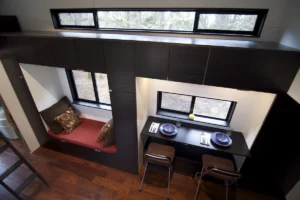
It took Andrew about four months to finish the 207-square-foot tiny house — plus an additional 110 square feet in a sleeping loft.
How Much Can You Save by Living Tiny?

The biggest benefit? Their financial stress is gone.
Gabriella figures that in roughly two more years they’ll have their tiny home paid off with the money they’ve conserved by not carrying a big mortgage.
Utilities have dropped, too. Heating 207 square feet costs far less than heating 2,200 square feet. They’re also essentially off-grid: solar provides free power and water comes from a well.
Their monthly outlays are reduced to internet, phone, and garbage. Propane for heat is billed twice yearly.
They’ve noticed savings on groceries as well.
Their refrigerator is about half the size of a standard American fridge. Without deep hidden corners, food doesn’t get lost and forgotten; everything is visible and consumed.
Andrew and Gabriella are also more mindful about spending. Neither were compulsive shoppers, but impulse purchases did happen. Now, there’s simply no space for extras.
They’ve even stopped grabbing freebies. Andrew recounts opting out of the “free” half of a BOGO pants deal. He had to tell the cashier he lived in a tiny home and didn’t have room for another pair of pants.
They laugh about it. “It’s shifted our mindset so that even if something is free, if you don’t need it, don’t take it,” Andrew says.
Gabriella estimates they’ve cut at least $300 from their monthly spending just by living smaller. That’s $3,600 a year — at minimum, she stresses.
“We had a choice about how to use our money, and if we hadn’t experienced minimalist living, I’m certain we would have invested that cash into a much larger house,” Gabriella says.
“Then we’d be facing a half-million-dollar mortgage payment for the next 30 years.”
Rather than sinking into debt, the pair developed a business around their passion: Tiny House Build. Living the lifestyle full-time, they provide resources and run workshops for others wanting to create their own tiny homes.
Carson Kohler (@CarsonKohler) is a staff writer at Savinly.