
Two decades ago, travelers didn’t need to worry about squeezing everything into a backpack to dodge baggage charges. Packing for air travel was much simpler. When you bought an airline ticket back then, you typically got a checked bag plus a couple of carry-ons included.
Times have changed dramatically.
The first shift came with checked bag charges — carriers began introducing them in the mid-to-late 2000s to help offset surging fuel costs.
In response, many flyers started fitting all their gear into carry-ons.
More From Savinly:The Dumbest Things We Keep Spending Too Much Money On (And How to Stop)
Over the past decade, low-cost carriers such as Spirit Airlines, Frontier and others shook up the industry by underpricing legacy airlines. They offer rock-bottom base fares but tack on charges for almost everything, including overhead bin access.
Big carriers like American, Delta and United reacted by rolling out “basic economy” fares that lower the ticket price while stripping away what they now label as “extras.”
The consequence: many tickets only include a single free “personal item” that must fit beneath the seat in front of you.
That’s why a backpack can be your best compromise — letting you buy cheap tickets and avoid add-on charges while still bringing what you need onboard.
But if you’replanning a getawayand want to pack everything into a backpack, there are several things you should keep in mind.
Why Choose Only a Backpack for Your Trip?
Why would any rational traveler cram all their belongings into a single backpack for a long-distance journey?
It’s straightforward: it can cut travel costs substantially.
More From Savinly:You’re Probably Paying Too Much for Insurance. This Tool Could Save You $500.
Bag Fees Really Add Up
Although most U.S. airlines still allow a complimentary personal item that fits under the seat, many fare classes no longer include a free full-size carry-on that goes in the overhead bin.
If you have one of those restricted fares and you need something larger than a personal item, you’ll be charged a fee.
Those charges can be $30, $50, $70 or more — sometimes matching or even exceeding checked bag costs. And on round-trip itineraries you’ll pay those fees both ways — outbound and return.
Enter the backpack.
If everything you require fits into that small bag (and you follow TSA rules), you stand to save a meaningful sum.
More From Savinly:These Companies Will Give You Food and Other Products For Free
How to Pack a Backpack for Flying
Cutting down to a single bag can protect your vacation budget — and lighten your load while navigating airports.
Whether it’s right for you depends on several considerations.
More From Savinly:Here’s How to Start Saving Money — Even If You Don’t Have Room in Your Budget
Check Airline Policies on Carry-ons
Before you spend hours planning ultra-efficient packing, confirm whether your fare actually excludes a full-size carry-on. Don’t go to the trouble if it’s unnecessary.
You’ll commonly see carry-on fees from budget U.S. carriers. Besides Spirit and Frontier, Allegiant and Avelo are examples of domestic low-cost airlines with such policies.
There are also budget carriers flying between the U.S. and Europe or Latin America that use similar fee structures.
Among larger carriers, United and JetBlue stand out for imposing full carry-on restrictions on basic economy passengers. JetBlue labels these fares “Blue Basic.”
Note that American and Delta now permit basic economy passengers to use the overhead bin without extra charge — so you might not need to pack minimally if flying those airlines.
Confirm the Trip Suits Backpack Travel
Squishing everything into a bag that qualifies as a “personal item” isn’t always realistic, so weigh your needs for the whole journey.
United, for example, describes a personal item as 9 inches by 10 inches by 17 inches. Generally, we’re talking about backpacks, purses and laptop or shoulder bags.
Short weekend trips and overnight stays are the most natural candidates for backpack-only travel; the fewer days you’re gone, the less you’ll need to bring.
Also factor in weather and planned activities. A ski weekend in Colorado likely requires bulky gear, while a beach weekend in Florida might need little more than a swimsuit, a couple of tees, shorts, a toiletry kit, a rain jacket and underwear.
Maximize Space When Packing
From straps to weight balance, selecting the right backpack is essential. Choose a standard-size pack that can slide under most airline seats — not your oversized hiking pack built to hold a sleeping bag.
The goal is efficiency and handy access.
Pack Lightweight Clothes and T-Shirts
You won’t be carrying heavy equipment. Focus on volume. Choose medium-weight garments and travel basics suited for a brief trip.
Lightweight and multi-use clothing helps you make the most of limited space. If you can wear a pair of shorts for two days, that frees room for other items.
Use Packing Cubes
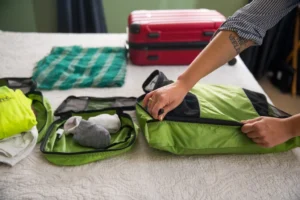
Packing thoughtfully matters. A set of packing cubes can optimize space and keep your bag organized during the trip.
For example, one cube can hold fresh clothes and another can corral dirty items.
Keep Frequently Needed Items Accessible
You’ll want certain items handy during the flight. If you have headphones, a tablet, a book or other things you’ll reach for after takeoff, store them where they can be removed easily — like front pockets — without disrupting your clothing or other contents.
Mind Weight Distribution
Balanced packing makes the bag easier on your back. Distribute the load evenly.
And one firm guideline: keep the bag under 50 pounds to avoid potential overweight penalties.
Stick to TSA’s 3-1-1 Liquids Rule
Security screening will dictate your toiletry choices.
Follow TSA’s 3-1-1: liquids, gels, creams and pastes must be 3.4 ounces (100 milliliters) or less, fit inside a single quart-sized, resealable bag, and you’re limited to one such bag per passenger.
If you’d rather not pay for bottled water after security, bring an empty disposable bottle and stash it in a backpack pocket or clip it on with a carabiner for convenience.
If you can’t meet these requirements, be prepared to budget for a checked bag.
More From Savinly:117 Places That Will Give You Free Stuff on Your Birthday
When a Backpack-Only Approach Won’t Work
Packing only a backpack isn’t feasible for every trip, especially when traveling with family or groups. Here are tips to make the backpack plan workable even if you need to pay for one or two larger bags.
Families: Check One Bag and Carry Multiple Backpacks
This can be more practical for longer vacations or larger parties. Have one person bring and pay for a checked bag or full-sized carry-on. The larger bag can be shared while everyone else uses backpacks.
It’s an efficient tactic for families to take advantage of low fares while minimizing extra fees multiplied across multiple travelers and flights.
If You Need to Sit Together, Consider Paying for a Full-Fare Ticket
Remember that if your fare blocks a free carry-on, it often also prevents complimentary seat selection — that’s common with basic economy and many low-cost carrier rules.
That can leave you separated from family or travel companions.
If you end up paying for seat assignments or baggage at the airport, you might have been better off buying a full-fare ticket initially — something to weigh the next time you book.
Other Ways to Reduce Airline Expenses
Avoiding baggage fees isn’t the only method to save on airfare. Besides elite frequent-flyer status, certain airline credit cards waive baggage fees and seat-selection restrictions and include other travel perks. Sometravel credit cardsalso reimburse specific travel costs.
These cards sometimes carry higher annual fees, but they can be worthwhile if you regularly fly with the same airline.
More From Savinly:The 28 Best Side Hustles: Our Top Picks to Help You Make More Money
Just Bring a Backpack: A Simple Way to Cut Flight Costs
We get it — shoving everything into a backpack isn’t the most convenient packing strategy. But it’s an effective way to save. It lets you take advantage of some of the lowest fares available without being hit by multiple add-on charges.
It won’t suit every journey or traveler, but when circumstances align, carrying only a backpack can trim your travel expenses by tens or even hundreds of dollars.
More from Savinly:
- Best Budget Apps for Couples in 2024
- 31 Ways to Make Money Online & From Home in 2024
- 5 Strategies to Consolidate Your Credit Card Debt
Alex Mercer covers personal finance, travel and consumer tips. Previously, Alex reported on airlines, credit cards and loyalty programs for travel-focused outlets and spent several years in local journalism. Alex lives in the Southeast and writes about practical ways to save on travel and everyday expenses.