
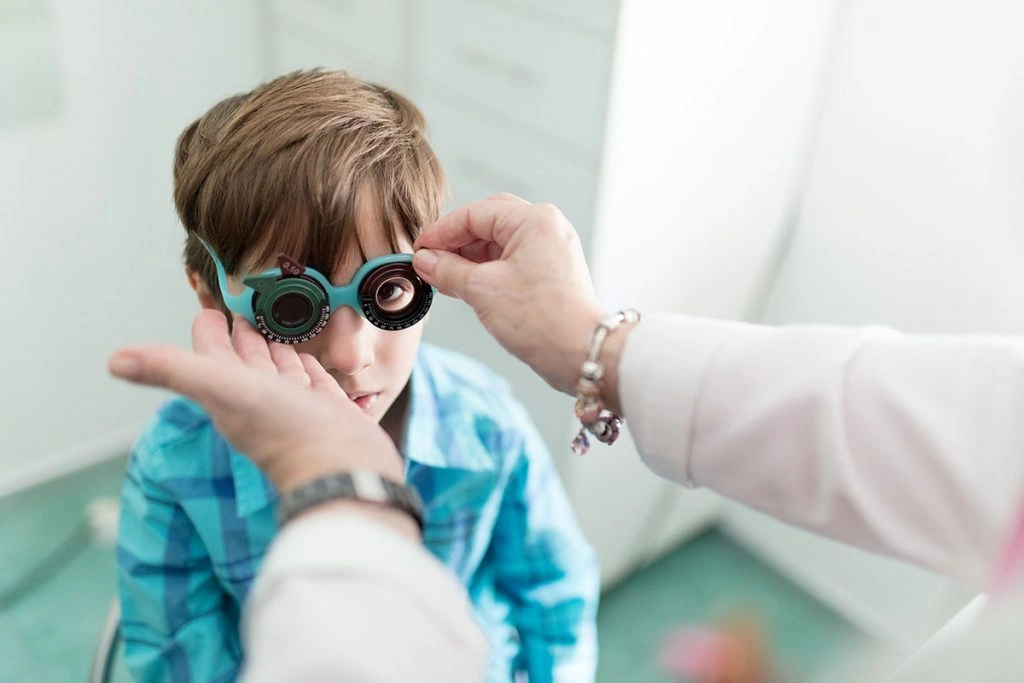
The answer to why some elementary students have trouble with reading might be right beneath — or rather, perched on — their noses.
Indeed: eyeglasses.
According to Andrea Thau, O.D., president of the American Optometric Association, one in four children has an undetected vision issue.
Although most schools provide a basic form of vision screening, Thau warns these checks can create a misleading sense of reassurance, causing parents to assume their kids have been properly evaluated when significant problems may have been missed.
“Prioritizing a comprehensive eye examination this year is one of the single best investments you can make in your child’s learning and general wellbeing,” she said. “A full eye exam is the only way to accurately identify and treat vision and eye-health concerns.”
How a Pair of Glasses Can Change Things
In 2014, researchers at Johns Hopkins University in Baltimore looked into whether something as straightforward as eyeglasses could explain the reading gap between students from low-income families and those from more affluent households.
After screening several hundred second- and third-graders and providing glasses to children who met the study’s “uniquely liberal prescribing standard,” the team followed the students’ academic progress for a year.
Even with a relatively modest sample size, Politico reports, the findings were notable, as reading ability rose substantially among children who received the new glasses.
In 2016, the Baltimore City Health Department, the Johns Hopkins Wilmer Eye Institute, the Johns Hopkins School of Education, national non-profit Vision To Learn and eyewear retailer Warby Parker launched an initiative called Vision for Baltimore, a three-year effort intended to screen 60,000 students at 150 schools for vision problems.
By mid-August, the program had screened almost 18,000 children and distributed nearly 2,000 pairs of glasses.
“We all recognize the need,” says Austin Beutner, chairman and founder of Vision To Learn. “There’s a lot more to be done, not only in Baltimore.”
Where to Get Eye Exams and Glasses for Your Child
Vision for Baltimore intends to support Baltimore-area schools through the summer of 2019.
Much of the project’s funding comes from the city’s health department, while research partners rely on donations and grants. Organizers hope to expand the effort to serve additional communities, but scaling up could take time.
Until the program grows or a similar one starts in your area, parents and caregivers can tap into these options now to obtain the resources (chiefly, eyeglasses) that can help their children thrive academically.
- Sight for Students, a Vision Service Plan initiative, offers complimentary eye exams and glasses to children from low-income, uninsured households. It partners with community organizations and VSP doctors to deliver services. You can find a mobile eye-care clinic near you and register if you qualify.
- In many states, Medicaid covers routine vision care for children. Check your state’s specific rules to see what’s included.
- The Children’s Health Insurance Program (CHIP) is a joint state-federal program that provides affordable health coverage for kids in families who earn too much for Medicaid but can’t afford private insurance. In most states, CHIP enrollees qualify for free eye exams. Search for your state’s Children’s Health Insurance Program to learn available options.
- New Eyes and Vision USA are volunteer-driven groups that provide free eye exams and glasses to low-income or uninsured people. Both require applicants to work through a social service agency to receive vouchers for glasses and exams. You can learn more about applying through an agency here.
- This site runs a promotion for free frames and prescription lenses. You’ll pay for upgrades and a modest “optician fee,” but you can often get a new pair of glasses for your child for just a few dollars.
- Similarly, retailers like EyeBuyDirect or Zenni Optical let you buy children’s frames and prescription lenses for as little as $12. They frequently run coupons and promo codes to reduce costs further.
Also, for guidance on supporting your child’s overall wellbeing, consider resources on healthy habits for kids that can complement vision care and boost school success.
Grace Schweizer is a junior writer at Savinly.