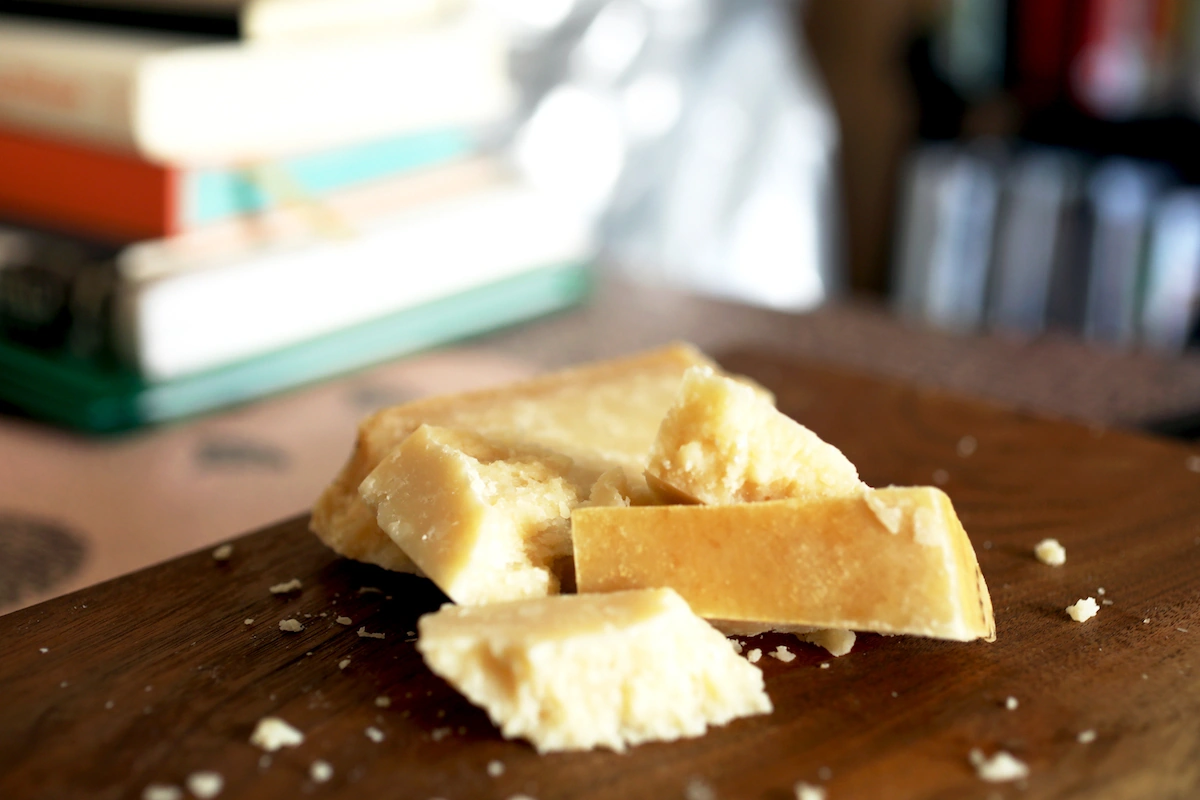
No, I wasn’t raised in a cave. In fact, my childhood included a lot of pasta.
I’m simply a casualty of America’s permissive labeling rules — and chances are, you might be too.
Here’s what’s going on.
Your Cheese Could Be Pretending. Here’s Why
“Parmigiano-Reggiano” — the authentic Parmesan as it’s known in Italy — “may contain only three straightforward ingredients: milk (from the Parma/Reggio area and produced less than 20 hours before cheesemaking), salt, and rennet (a natural enzyme from calf stomach).”
That’s how Larry Olmsted describes it in his piece for Forbes, where he begins to unpack the widespread food deception he examines in depth in his engrossing book, “Real Food/Fake Food.”
Abroad, products must satisfy strict standards to earn the right to use place-specific names like Parmigiano-Reggiano or Champagne.
It’s not solely about geography. Regulators also dictate fine production details — occasionally down to which breeds of cattle can supply the milk or, as Olmsted notes, the maximum distance between the herd and the cheese facility.
These rules are rooted in tradition, preserving methods that have been followed for centuries or millennia.
That means when you buy these items in their countries of origin, you get a lot of reliable information about what’s inside. The name itself signals a standard of quality.
In the U.S., however, companies can slap venerable names on products without adhering to traditional methods. Our labeling system tends to favor manufacturers, prioritizing marketability over precision. That’s one reason why many commonly used label words, like “natural,” are essentially meaningless.
In “Real Food/Fake Food,” Olmsted exposes how these labeling gaps have deprived Americans of the finest versions of many familiar foods — honey, olive oil, balsamic vinegar, and more.
Take perhaps the most recognizable “Parmesan” in America: Kraft’s pre-grated, green-can variety.
That product contains additives, such as cellulose powder and potassium sorbate, which Olmsted points out are “completely illegal” in true Parmigiano-Reggiano production.
The outcome? A whole nation that doesn’t know what authentic Parmesan should taste like.
“It’s far enough removed from the real thing that Kraft was legally required to stop marketing its cheese as Parmesan in Europe.”
Why the Authentic Stuff Matters
So why care about foreign labeling laws? What’s the difference between cheese made from cows in France and cows in Wisconsin?
It’s less about the location and more about the technique — and honesty in advertising. It’s about getting what you paid for.
Here’s why spotting imposters should matter to you.
1. The Authentic Version Tastes Far Superior
If your only experience of Parmesan is the sawdust-like stuff in a green can, or if Swiss cheese means the plasticky, hole-y block from the deli, you’re missing out on what I consider a fundamental pleasure: eating genuine cheese.
Trust me. It is spectacular. TRULY spectacular.
2. It May Also Be Healthier
Maybe you’re content with Kraft American singles or shelf-stable “cheese food.”
And sure, those processed domestic products are far cheaper than artisanal cheeses. Why blow your budget for something fancy?
But if you care about both your health and your wallet, there’s another reason to opt for authenticity.
For one, that dry-grated topping you sprinkle on pasta might actually include wood shavings. (At least it’s honest about tasting like its components.)
When you buy a genuine product, you know precisely what’s in it and how it was produced.
That means you’re less likely to ingest filler materials, unexpected debris, or questionable synthetic additives.
3. You Deserve What You Paid For
Choosing inexpensive, mediocre cheese because it fits your budget is perfectly fine — I get it. If you make that choice knowingly, I’m all for it. After all, this is Savinly territory.
What bugs me is paying more for the “good stuff” and unknowingly being sold a counterfeit.
If you’re spending extra on premium cheese, you ought to be able to trust that it’s the real deal.
Otherwise, it’s money wasted — and plain false advertising. You’ve paid for an experience you never even realized you were missing. That’s infuriating.
How to Spot Genuine Gourmet Cheeses
Ready to learn how to recognize the real thing next time you’re cheese shopping?
Here’s the guide.
Parmigiano-Reggiano

I begin with Parmigiano-Reggiano because it was my own entry point into real food. And what an awakening!
It turns out Parmigiano-Reggiano has nothing to do with the junk I used on my pasta as a kid. Even that wrapped wedge of “Parmesan” at the grocery may not approach the true article.
Here’s how to find the real thing.
What to watch for:
- The words Parmigiano-Reggiano are imprinted on the rind. Authentic wheels produced in Parma, Italy bear the name stamped into the crust.Depending on the size of the piece you buy, the whole phrase might not appear on your wedge… but if the rind shows a different name or is blank, it’s not genuine Parmigiano-Reggiano. Grana Padano and Pecorino Romano are common substitutes and are good in their own right, but neither can claim Parmigiano-Reggiano’s title, “The King of Cheeses.”
Mozzarella

First off: you’re unlikely to find true buffalo mozzarella, or Mozzarella di Bufala Campana, at a typical American supermarket.
Traditionally, mozzarella — which is brighter and more acidic with a distinct taste from the processed kind in your lasagna — is made from buffalo milk in the marshlands between Rome and Naples. It’s best enjoyed fresh and near where it’s produced.
You can still do better than the shredded stuff in pizza Lunchables, though.
What to look for:
- It should come packed in water. Because of its curd structure, authentic mozzarella is kept submerged. You may find decent pre-sliced logs or vacuum-packed “pearls,” but nothing beats those luscious, floating balls.
- Avoid low-moisture, part-skim, 2% and similar variants. Those tweaks extend shelf life but often yield rubbery, string-cheese-like results instead of soft, pillowy mozzarella.
Manchego
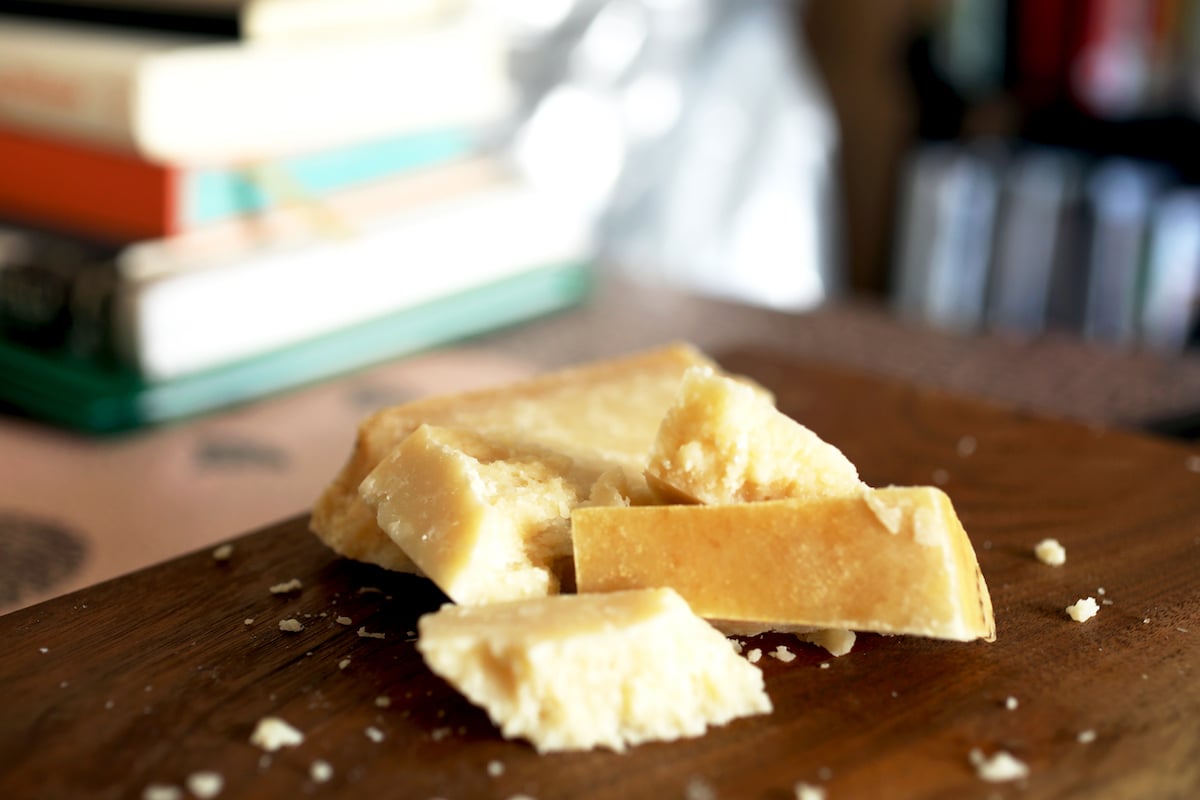
If you’ve wandered by a tapas spot in the last ten years, you’ve likely encountered this Spanish cheese’s popularity.
And it’s deserved. With flavors from toasted nuts to caramel and butterscotch, Manchego is complex, fascinating and utterly delicious — and it’s one of my favorites.
It’s also among the cheeses most often counterfeited worldwide, according to Deli Market News. Here’s how to be sure you’re getting the genuine item.
What to look for:
- True Manchego is produced only in La Mancha, Spain, from the milk of Manchega sheep. Check the label: if it’s not sheep’s milk from La Mancha, it’s not Manchego.
- The rind ranges from yellow/beige to brown and displays a herringbone pattern — a throwback to when shepherds aged cheeses in grass baskets. Pretty cool!
- Your piece should look like a wedge cut from a wheel, since these cheeses are made as wheels in their native region. Wheels carry a PDO stamp, but pre-cut portions may not always show it.
Feta

I know plenty of people who are indifferent about feta — and I’d understand if their only exposure was the supermarket variety.
Real feta is a revelation. It’s unbelievably versatile and delicious enough to enjoy by itself or with a drizzle of (real) olive oil — just like the Greeks do.
What to look for:
- Authentic feta isn’t made from cow’s milk. Traditional Greek feta is primarily sheep’s milk, sometimes blended with goat’s milk.
- It usually isn’t sold pre-crumbled. The good stuff typically comes as a solid block or a rounded wedge, indicating barrel aging. The surface should show a few small holes but not be crumbling apart.
Emmenthaler (Swiss)

Finding authentic Swiss cheese is messy and confusing — little wonder. We’ve reduced a nation’s rich cheesemaking tradition to a single label that typically signals an inferior imitation: mild, white, hole-filled “Swiss” cheese.
Most Swiss-made cheeses actually don’t have holes. The exception is Emmentaler, which inspired our “Swiss” but is far superior.
If you want an Alpine-flavored authentic experience, you’ll need to look more carefully.
What to look for:
- Seek out cheeses that explicitly state they’re from Switzerland rather than generically labeled “Swiss.” If a product is simply branded “Swiss” it’s probably not. Instead, check the origin — imported Swiss cheeses span many styles, including Gruyère, raclette, and Appenzeller. Beware of domestic Gruyère-style cheeses labeled as Gruyere, but I think the extra cost for a true imported wheel is often worth it; even the Wisconsin versions typically outshine the bland stuff you grew up with.
Brie and Camembert

Sadly, you’re unlikely to encounter genuine French Brie or Camembert without hopping on a plane.
That’s because these soft cheeses are traditionally made with raw, unpasteurized milk, and the FDA has long restricted imports of raw-milk products aged under 60 days — a rule dating back to 1949 that remains influential and often excludes these softer varieties.
Producers worldwide make Brie- and Camembert-style cheeses from pasteurized milk, and some are quite good. You may need to travel for the authentic taste, but here’s how to make sure you at least get the right texture.
What to look for:
- Soft cheeses should be soft but not overly so. Give the round a gentle squeeze: it should have some give without being — heaven forbid — mushy.
- Buy a whole round rather than a wedge. That helps preserve the creamy, runny center, whether the cheese is imported or domestically produced.
Whew! Who knew buying cheese could be so intricate?
Luckily, you’ve reached the best and simplest part: eating it.
Bon appétit!
Jamie Corbett (@jamiecorbett) has contributed to SELF, Ms. Magazine, Roads & Kingdoms, VinePair, The Write Life, Barclaycard’s Travel Blog, Santander Bank’s Prosper and Thrive and other publications. Her work focuses on food, wine, travel and frugal living.