We’ve all heard the guidance: the Centers for Disease Control recommends using face masks in public to curb the spread of the coronavirus.
Instead of spending money on disposable masks or costly retail options, consider a DIY approach.
Do Homemade Face Coverings Work Against Coronavirus?
COVID-19, the illness caused by the novel coronavirus, transmits via droplets when an infected person coughs or sneezes. There’s increasing agreement that broad mask usage helps slow transmission.
When more people wear masks, those who are asymptomatic are less likely to pass the virus to others because respiratory droplets are trapped by the mask when they cough or sneeze.
Tips for Proper Face Mask Use
For masks to be effective, experts advise wearers to avoid touching the mask frequently. The World Health Organization provides step-by-step guidance on how to correctly put on and remove masks. They recommend washing hands thoroughly before donning a mask and not repeatedly adjusting it.
The WHO also stresses that masks work best when combined with regular hand hygiene.
Although cloth masks aren’t proven to filter out viruses completely, they can reduce the spread of larger respiratory droplets. A 2010 paper found that masks made from several layers of dense fabric are better at capturing droplets. It’s also crucial that a mask fits snugly and covers both mouth and nose, forming a tight seal.
Ideally, masks—cloth included—shouldn’t be reused without laundering. Richard Peltier, an assistant professor of environmental sciences at the University of Massachusetts-Amherst, told Politifact that cloth coverings need frequent washing with warm, soapy water.
Three Simple Homemade Masks You Can Make
Below are three easy options to try:
1. No-Sew Face Mask
Supplies: cotton craft fabric, fabric glue or hot glue, two rubber bands, scissors, an iron
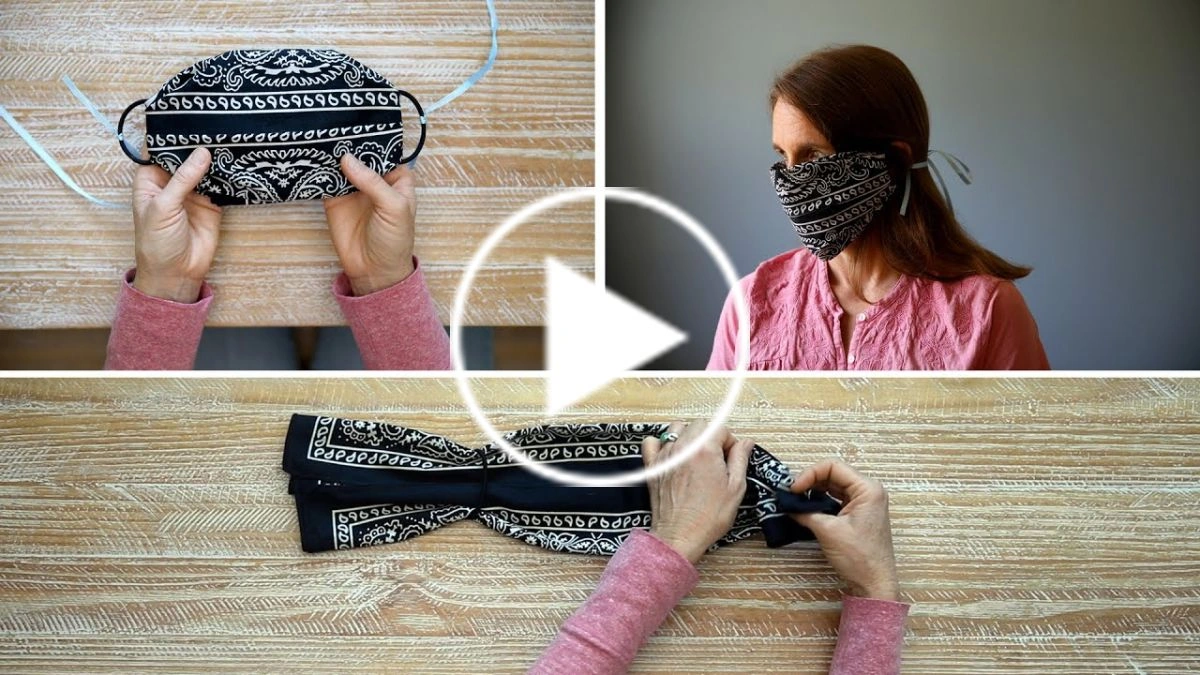
To create this mask, fold the fabric into pleats, secure the excess fabric over the rubber bands with glue, and you’re set. You may need to tweak the width so it fits your face snugly.
If you swap craft fabric and rubber bands for a bandana and hair elastics, you might not need to shop for materials at all.
2. No-Sew Knotted Face Mask
Supplies: cotton t-shirt, ruler, scissors
Here’s another clever no-sew approach, from sustainable designer Runa Ray. You’ll need an old t-shirt and virtually nothing else.
Cut the shirt into two rectangular pieces. Make a fringe along each side, tie the fringes together, and use the shirt hems as ear loops — finished.
This design also leaves an opening at the top where you can slide in a reusable filter between the two fabric layers, which is useful.
3. Sewn Fabric Face Mask (Some Sewing Required)
Supplies: cotton fabric, lightweight material for a filter layer, elastic ties, basic sewing tools
If you have sewing skills and want to flex them, this is a good project. Joann Fabric and Craft Store offers an online how-to for those aiming to produce surgical-style masks for healthcare workers or for personal and family use.
The tutorial notes that this pattern needs intermediate sewing ability. If you’re comfortable sewing but short on materials, Joann and other craft shops are offering curbside pickup for online orders.
For more homemade personal care ideas, consider checking out diy hair care tips and guides as well.
Anna Bryant is a contributor to Savinly.