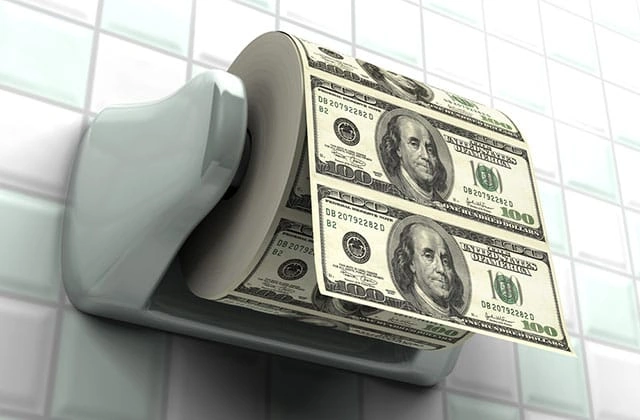
We’ve mentioned before that you essentially pay twice for the same water: once when it enters your home and again when it leaves as sewage.
While many concentrate on the consumption side — which matters — the discharge side is also a prime place to conserve water. And when you conserve water, you cut your bills.
Below are strategies to reduce toilet-related water use — and estimates of how much each tactic can lower your water and sewer costs.
1. Use Less Water in Your Toilet
Potential Savings: $45 a year
A household of four averages about five flushes per day per person — a conservative figure, assuming other one-to-three daily flushes occur at schools or workplaces.
An easy, low-cost way to reduce toilet water usage is to cut the water needed to refill the tank after each flush. Two clever devices, each under $5, can help accomplish this.
A fill cycle diverter reroutes some of the water that would normally go to the tank so it fills the bowl faster, saving up to half a gallon per flush.
A displacement device occupies tank space, reducing the volume of water required. My thrifty uncle used to tuck a brick into every toilet tank. Others use filled plastic milk jugs.
If you prefer a purpose-built option, try the Tank Bank, which clips to the tank wall and displaces about 0.8 gallons per flush.
These gadgets repay their cost quickly. Used together, they can shave roughly 1.3 gallons off each flush.
With both items, the typical family of four would cut about 26 gallons per day, or 9,490 gallons annually. Using a sewer rate of $3.59 per hundred cubic feet (HCF; 748 gallons), that equals about $45.55 in yearly savings.
2. Flush Less Often
Potential savings: $82 a year
This approach is not for everyone, but it’s free and simple.
If you have a private bathroom or everyone in your household agrees, consider the old adage “If it’s yellow, let it mellow.” In short, flush only after solid waste and let liquid waste wait.
Make it more acceptable by lowering the seat or committing to flush after everyotherliquid visit. How strictly you follow it is up to you, and even modest adherence reduces water use and bills.
Just watch toilet paper buildup to avoid clogs and keep a plunger handy. If you’re worried about guests, only use this tactic when the house isn’t hosting visitors.
Our example family of four, with five daily bathroom visits per person, could lower their flushes from 20 per day to somewhere between four and 10. Suppose they average 6.5 flushes daily. Savings depend on the toilet’s efficiency (gallons per flush vary from 1.5 to seven).
If their toilet uses 3.5 gallons per flush, their yearly flushes drop from 7,300 to 2,373 and water use from 25,550 gallons to 8,305 gallons. Using San Diego’s sewer rate of $3.59 per HCF, saving 17,245 gallons annually yields about $82.76.
3. Reuse Shower Water
Potential savings: $15 to $25 a year
What’s the first thing you do when you hop in the shower? You run the water until it warms. While you’re undressing or checking your reflection, that initial warm-up water flows straight down the drain — and you foot the bill.
The fix: Set a bucket in the shower to capture that warmup water.
Once the water is hot, remove the filled bucket and set it aside. The next time you need to flush, lift the tank lid and pour the bucket’s water into the tank before flushing.
You won’t pay for that wasted warm-up water, and you’ll also avoid paying for the water required to refill the toilet bowl.
If you already own a bucket, this strategy costs nothing. Otherwise, pick up a cheap bucket at a hardware or dollar store.
A bucket with a pour spout works best. If space is limited, consider a collapsible bucket.
Assume it takes one minute to heat your shower. An average showerhead uses 3.5 gallons per minute, so you might be surprised how much ends up in your bucket.
If you shower seven times weekly, you’ll capture about 1,274 gallons of warm-up water a year — and reuse that same volume for toilet flushes, saving another 1,274 gallons.
For savings calculations we’ll again use San Diego: the sewer rate is $3.59 per HCF. Water costs vary by usage, but we’ll apply an average of $5.82 per HCF.
You’d save about $9.91 on water and $6.11 on sewage. That totals $16.02, and if you shower more often or have an older showerhead, savings could approach $25 or even $30 yearly.
Safety note: Water-filled buckets can be a drowning risk for children and infants, so secure the bathroom door or take precautions to keep little ones safe.
4. Upgrade Your Toilet
Potential savings: $14 to $125 a year
If you’re willing to invest more for long-term savings, consider replacing your toilet with a more efficient model. Here are several options:
Dual-Flush Toilets
Dual-flush models are increasingly common and affordable. For instance, Home Depot offers options starting near $94. Manufacturers estimate annual water bill reductions of roughly $14 to $20.
Cities often provide rebates for swapping older, inefficient toilets for newer, water-saving models. Check with your local municipality about WaterWise or similar programs, and encourage them to offer incentives if they don’t.
Municipal rebates in places likeSeattlecan be $75, allowing you to recoup your cost within a year. After that, you continue to save annually.
If you want dual-flush benefits without buying a new toilet, consider a dual-flush conversion kit. Options on Amazon begin around $15, often paying back in roughly a year.
Toilet-Top Sink
If you’re not ready for a full replacement, check out the clever SinkPositive. It’s ideal for guest bathrooms, instantly adding a compact sink to the top of a toilet.
When you flush, water first runs through a faucet so you can wash your hands, then drains into the toilet tank. The water is just as clean as any sink’s supply, but it performs double duty by filling the toilet tank.
If each hand wash uses 0.5 to 1 gallon, you could save 3,650 to 7,300 gallons annually — about $28.40 to $56.80 in savings.
Composting or Waterless Toilets
These options aren’t for everyone, but they’re the greenest alternatives and typically have the lowest lifetime costs. For a deeper dive, consider reading The Humanure Handbook.
These systems are best suited to the adventurous, but they can yield savings around $125 per year.
Your Turn: Have you tried any of these tactics to lower your toilet-related water costs?
Disclosure: We maintain a weakness for fast-food bargains. Affiliate links in this article help keep the lights on. Thanks for supporting our work!
Jordan Hayes is a writer who has sharpened money-saving habits while managing household finances. He enjoys discovering practical ways to trim expenses while reducing environmental impact.
Also check out our related guide on how to save money on utilities for more household-saving tips.