Spending more time at home has pushed many people outdoors, and bicycle purchases — both conventional and electric — have surged. For numerous makers and sellers, May 2020 marked a record month even as many other sectors faltered. This recent spike simply continues the rapid rise in U.S. e-bike sales over recent years, partly because of the financial savings they provide.
Globally, e-bikes are taking the place of primary or secondary cars, trimming car payments, insurance, parking and upkeep costs.
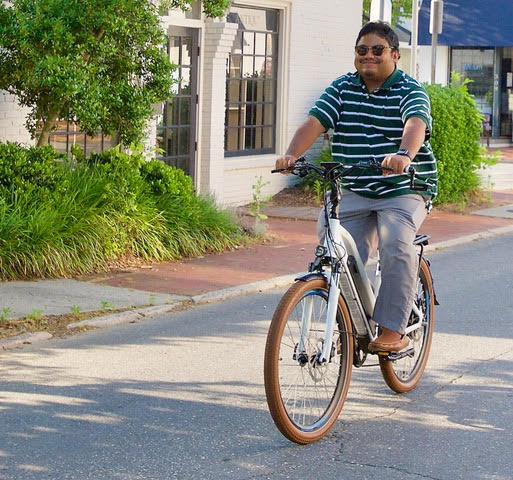
“Weather permitting, I ride my e-bike to work at least two to three times a week,” said Nazmul Sattar, a middle school teacher in Greensboro, N.C. “It’s like maybe ten to twelve miles there using roads and greenways. Depending on the time of day, sometimes I can get there even faster than driving. I’m not sweaty or anything. And honestly I’m usually much happier.”
“Buying an electric bike is an economical way for us to be environmentally friendly,” echoed Oca Rigby, a graduate student at Duke University in Durham. “Before using this bike, my husband would drop me off at work every day. Now, using an electric bike has saved us time and money.”
Below is a look at how riding an e-bike to work can lower your expenses.
How E-Bikes Operate
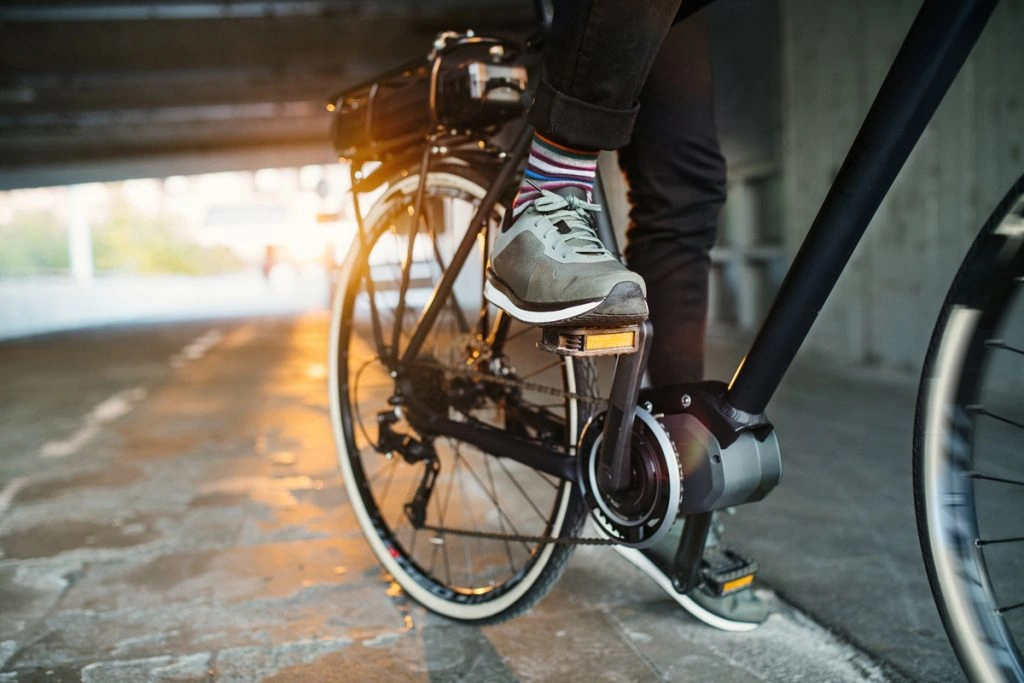
Although e-bikes come in many shapes and designs online and in stores, an electric bicycle is fundamentally a bike outfitted with three extra components: a display, a motor and a battery.
As you pedal, the display lets you choose the amount of assistance—usually from Eco to Sport to Turbo. According to that selection, the motor boosts the bike’s power and speed by roughly 125% to 300% without the rider applying more force. In practice, you can tackle steep hills or stay with commuter traffic without sweating. And it’s enjoyable.
The battery, which you charge beforehand, supplies energy to the motor.
With motor assistance, Class 1 and 2 e-bikes reach up to 20 mph, and Class 3 models can go as fast as 28 mph. (Anything faster is provided by your pedaling.) Most bikes require the rider to keep pedaling to receive the assist, but some versions include a throttle that permits acceleration to about 14 mph or more without pedaling.
“A year ago, it was estimated that one out of ten bicycles sold in the U.S. was electric and it appears that number could double by the end of the year,” said Joe Michel, owner of eBike Central, in Greensboro, one of the largest stores in the southeast. “We’ve seen monthly increases in sales in our store for the past six months. As more consumers become aware of the benefits, both economic and healthwise, of riding an e-bike, we expect that to grow exponentially.”
Given that commutes in the biggest U.S. metro regions are under 10 miles according to MarketWatch, e-bikes can easily cover these trips at speeds matching or often surpassing congested traffic. There are foldable e-bikes too, making them easy to store at work or bring onto trains and buses.
How Much Do E-Bikes Cost?
Costs vary considerably: budget, mass-market e-bikes sold online by brands like Rad Power or Juiced range from about $1,000 to $1,500, while a bespoke, high-end imported Riese-Muller can hit $10,000 or a $12,000 Specialized road e-bike might be sold through retailers.
That said, an increasing number of dependable e-bikes are available in the $1,000 to $2,500 bracket that can deliver long-term time and money savings.
A limited number of stores nationwide that specialize in e-bikes offer a broad selection, while a growing set of traditional bike shops stock several models as well.
Cost Per Mile
Electric bikes meaningfully lower transportation expenses for commuters who replace a car entirely, or even those who drive only some days.
The typical e-bike battery is in the 500W to 800W range, meaning a full charge uses about 0.4–0.8 kilowatt-hours. If you pay roughly $0.10 per kilowatt-hour, charging the battery costs between 5 and 8 cents, which often yields 25 to 80 miles of range depending on assistance level.
Compare that with the average U.S. car, which achieves around 25 mpg per the latest Bureau of Labor Statistics figures. With the current U.S. price for a gallon of regular unleaded at a low $1.82, every 25 miles traveled saves about $1.75 when using an e-bike instead of fueling a car.
Other Vehicle Expenses
While that saving alone may not convince you to park your Honda and mount an electric Yamaha, the full expense of driving to work is substantially higher.
A Strong Towns report, from an organization focused on improving city resilience, determined the real cost of a commute is about 34 cents per mile. That figure includes not just gas but oil, tires, maintenance and vehicle depreciation. So if your daily round-trip commute is 15 miles and you do that 250 days a year, that trip costs about $3,750 annually in car-related expenses.
An e-bike typically needs roughly $150 per year for upkeep like brake pads or motor servicing, if that much, Michel noted. A single battery can endure about 1,000 charge cycles before noticeably losing capacity. Each charge commonly provides 30 to 50 miles, so the rider will likely get tired before the battery does.
What About Parking?
A 2018 study by transportation analytics firm INRIX discovered the average driver spent over $3,000 annually on parking. The priciest hourly rates across the nation ranged from $8 an hour in Denver to $17 an hour in Chicago.
E-bikes can be secured to bike racks or carried into the workplace for little or no extra cost. Foldable models are particularly handy when racks aren’t available or indoor space is limited.
How About Insurance?
Car owners pay an average of $1,502 per year for auto insurance, according to Car and Driver. Motorcycle insurance averages $702 yearly per the Motorcycle Legal Foundation. Even mopeds cost around $250 a year to insure, says TheScooterist.com. Class 1, 2 and 3 e-bikes typically don’t require insurance, registration or a license.
Don’t Overlook the Health Benefits
For older cyclists or anyone recuperating from health events like heart attacks or joint replacements, e-bikes provide low-impact exercise that a standard bike might not allow. As fitness improves, riders can raise the required effort on their e-bike to increase their workout.