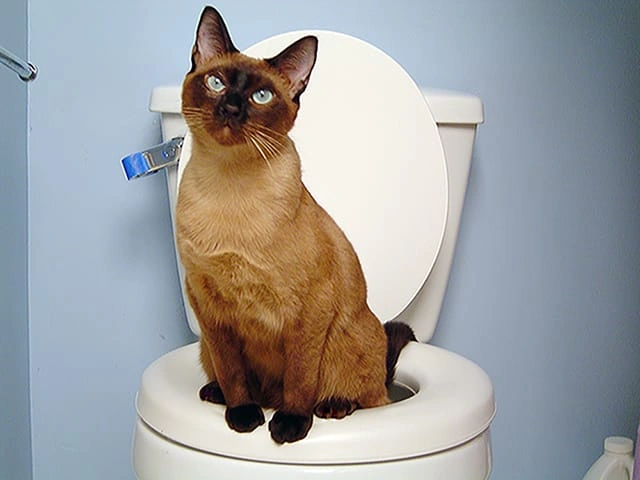
Back in 2006 Scott and Katie opted to remove the clutter andexpense of cat litterfrom their home by — are you following? —training their cats to use the human toilet.
You may have come across this before and dismissed a toilet-trained cat as a party trick or curious novelty.
But have you considered how much it could cut your expenses?
Why Train a Cat to Use the Toilet?
The typical cat owner shells out about $165 a year on litter, Kiplinger reports. Over a cat’s lifetime, that can add up to $2,000–$3,000 saved.
Beyond the money, you avoid arguments over who’s responsible for scooping. And Scott notes, “It’s a great trick to show off at gatherings.”
Before they trained their cats, Scott guesses he spent about the average on litter for Riker (Star Trek fans might appreciate the name). When the couple moved into a 1,200-square-foot townhouse, they adopted another cat.
The guideline is to keep one extra litter box than the number of cats. That meant for two felines, Scott and Katie would need to accommodate three litter boxes in their new place. They wanted a better answer.
After searching online, Katie found references to cat toilet training, though “the advice was scattered everywhere,” Scott says.
So they decided to handle the training themselves.
“It was an enjoyable project,” Scott recalls, “because we did it together. And the cats didn’t mind being filmed [for the training footage].”
Yes — Training Videos
Indeed. This crafty pair not only taught two cats to use a human toilet, they also produced and sold a DVD called “Scoop No More!” with step-by-step guidance to replicate their method.
With digital tech advancing and shipping physical media being a hassle, the DVDs are no longer sold. Instead, you canview the training for free on YouTube.
How to Toilet-Train a Cat
How do you transition a cat from a box to a toilet seat?
The method is actually straightforward.
In brief, it consists of making a faux litter box that fits inside the toilet bowl. Over time, you enlarge a central opening until the cat is balancing on the seat and eliminating straight into the toilet.
Commercial toilet-training kits use a similar technique but typically cost $20–$50. They also don’t let you tailor progress to your cat’s comfort.
“We went the DIY route because off-the-shelf products [use] preset steps [to widen the opening],” Scott explains. With their homemade approach, you can widen the hole in the mock toilet litter box at a rate that keeps your cat relaxed.
Their DIY setup runs about $30 initially in materials, many of which you may already own or can buy at a grocery or hardware store:
- Duct tape
- Padded or wooden toilet seat (recommended)
- Litter box and scoop
- Flushable cat litter
- Odor eliminator (recommended)
- Cat treats
- Step/stool (if your cat needs help reaching the toilet seat)
- Aluminum roasting pan or Sitz Bath
- Dremel (if you choose the Sitz bath technique)
What About Flushing?
Scott and Katie also bought an automatic flusher for their toilet. It’s an upfront cost of roughly $150, but it eliminates the chore of flushing after your cat and can make the bathroom more pleasant for family and guests.
The auto flusher functions like those in public restrooms: the toilet flushes when a cat (or person) uses it.
For their two cats, that adds a few extra flushes daily, but they haven’t noticed a significant rise in their water bill.
“Water’s inexpensive,” Scott notes.

How Long Does Training Take?
The key “tool” you bring to training, Scott and Katie emphasize, is patience.
“Cats aren’t accustomed to this,” he reminds us. “You’re asking them to perch over a bowl of water.”
Don’t rush your cat, and don’t get frustrated if (when) accidents occur. Instead, praise your cat for correct behavior and be ready for mishaps.
Keep your cat in a roomy bathroom or kitchen with a linoleum or wood floor that’s simpler to clean than carpet or upholstered furniture.
The couple’s pets, Jake and Riker, needed about six weeks to be fully trained.Jake learned a bit faster, Riker was slower. Some owners report success in as little as two weeks; others take up to 12.
Younger cats are generally simpler to train, particularly kittens that haven’t formed strong litter-box habits. “But cats of any age can learn, provided they’re healthy,” says Scott.
You just must be willing to observe and adapt to your particular cat.
Give It a Try
For those who, like me, assume the hardest part would be balancing on the seat, Scott reassures us, “Cats are extremely nimble.” Of course — sounds obvious now!
Strange or intimidating as it might seem, if you’re a cat owner contemplating toilet training, Scott urges you to try it.
“It’s worth it. It’s enjoyable, inexpensive to experiment with, and can save you a lot of money.”
Your Turn: Do you have a toilet-trained cat? Would you think about toilet training your cat?
Disclosure: We appreciate you allowing affiliate links in this post. It helps keep the break room stocked at Savinly.
Alex Rowan (@alexrowan) is a staff writer at Savinly. He’s contributed to multiple outlets and sprinkles humor where appropriate.