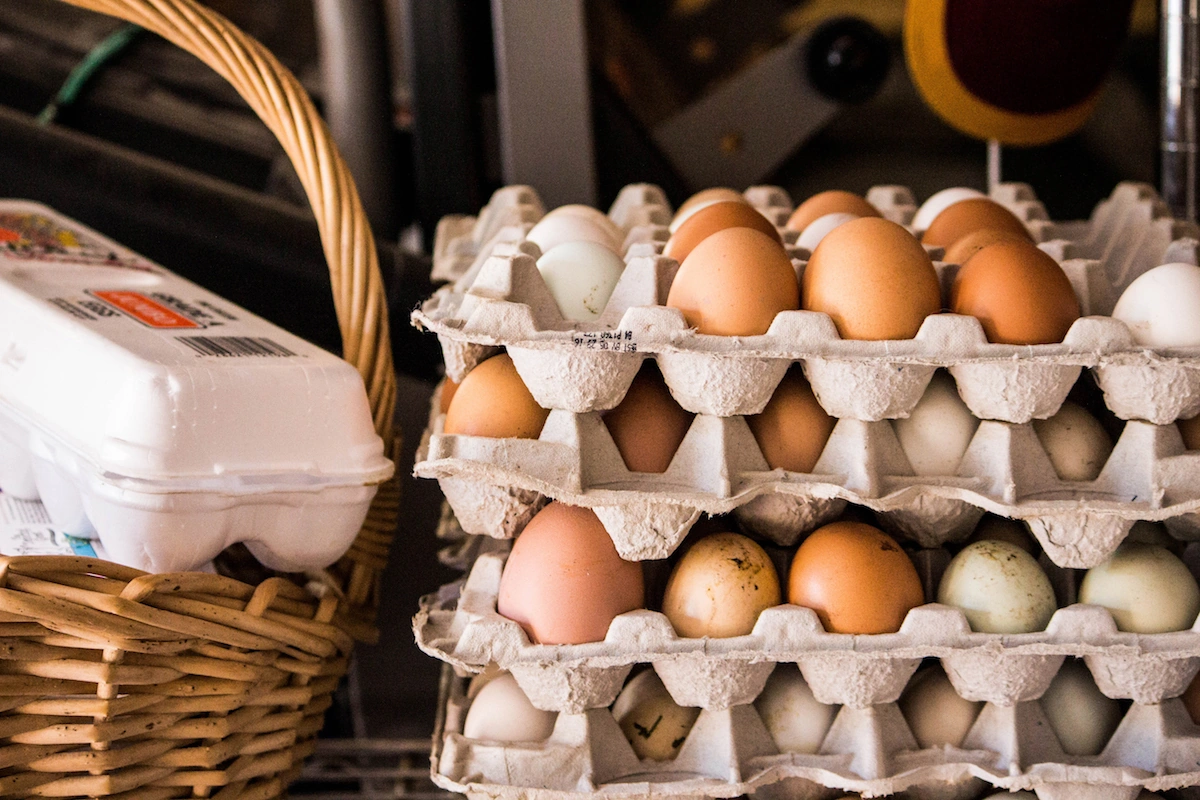
When you’re staring down the egg section at the supermarket, which carton do you reach for?
Organic? Cage-free? Brown? Whatever’s cheapest?
Just thinking about it makes my head spin.
If you’re anything like me, you want the best option for both your health and your wallet — and you’d also prefer not to support producers that keep their featherless birds in cramped conditions.
Does such an option even exist? And if it does, how do you sift through all the language on a carton to find it?
Let’s clear up the confusion around egg labels … and reveal why those cage-free cartons may not be worth the extra cost.
What Those Labels on Egg Cartons Really Tell You
First, a reality check: “95% of eggs in the U.S. come from chickens raised in something called battery cages,” reports NPR.
What does that mean?
“As many as 100,000 birds can be confined in a single warehouse, each bird with less than 67 square inches … to call its own,” explains Mother Earth News.
To visualize it, that’s slightly less space than a laptop computer.
Unable to move freely or stretch their wings, these hens spend their whole lives in that setting.
So that’s the baseline. Now let’s unpack what those extra phrases on cartons actually indicate…
Brown

We’re conditioned to assume brown foods are healthier than white ones (think brown rice, whole wheat bread), so many shoppers assume brown eggs are superior.
Unfortunately, that’s a misconception.
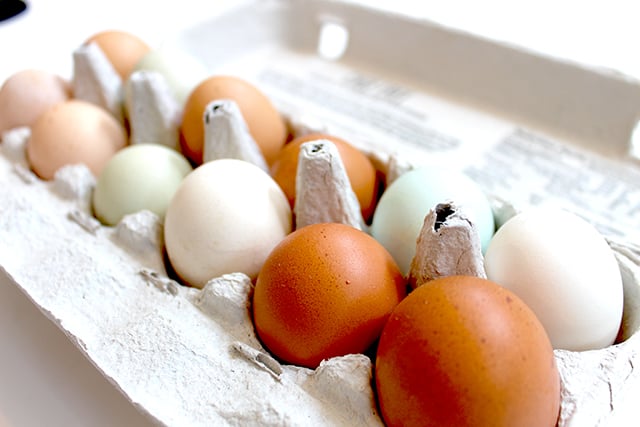
Eggs come in a variety of hues (some hens even produce lovely blue eggs!), and brown eggs aren’t nutritionally superior to white eggs.
All-Natural / Farm Fresh / Hormone-Free

These buzzwords often don’t mean much.
Using “all-natural” is a common form of greenwashing.
And regarding hormones, chickens are not given hormones — so labeling eggs “hormone-free” is essentially meaningless, NPR notes.
Vegetarian-Fed

That might sound appealing — but it’s not entirely accurate, because chickens are omnivores.
So “vegetarian-fed” hens are being given an artificial diet that may not be optimal for their well-being.
“Chickens are the furthest thing from vegetarians,” a farmer told The Washington Post. “That advertising is ridiculous. It’s like people going to the zoo and saying they only want to see the vegetarian tiger.”
Another label that doesn’t impress.
Cage-Free

Ready for a letdown? Cage-free isn’t necessarily as great as it sounds.
To clarify, I talked with Mark Kastel, founder of the Cornucopia Institute, an organization that evaluates and promotes sustainable farm policy.
Shoppers picture cage-free hens roaming “bucolic pastures” with room to move about, he explains.
“That’s just not accurate.”
Rather than tiny cages, these hens are often crammed by the thousands into multi-tiered aviaries… and frequently never step outside.
Some advocates view it as a better alternative, since hens can do natural behaviors like flapping, walking and nesting.
But others argue that poor indoor air quality, incidents of cannibalism and higher death rates mean it might not be much kinder.
Everyone agrees on one thing: cage-free systems cost about 36% more to run, and that expense gets passed to consumers.
Given that, are they worth the upcharge? I don’t think so, and neither do many experts.
“If people are buying cage free because they think they’re making a statement about humane animal practices,” Kastel says, “they’re getting shortchanged.”
Free-Range
We’re getting closer to something meaningful.
In theory, free-range implies hens wandering in a pasture; in practice, the USDA only requires that birds “have access to the outdoors.”
But having “access” is not the same as actually spending time outside, and Kastel cautions that “the term ‘free-range’ is very poorly regulated.”
He calls the practice “farming by press release,” noting that marketing might tout “free-range” even when there aren’t any birds outdoors on inspection.
Often “access” means “a few small doors leading to a screened porch with cement, dirt or a smidgen of grass,” NPR reported from his observation.
And industrial fans that vent ammonia create harsh winds at those exits, which chickens tend to avoid.
So again, shoppers can feel misled.
Organic

Ah — the magic word that often makes shoppers willing to pay more.
Organic eggs must come from “uncaged hens that are free to roam in their houses and have access to the outdoors,” per the USDA.
“The hens are fed an organic diet of feed produced without conventional pesticides or fertilizers.”
While you can be confident about what these hens eat, how much they actually go outside can still be murky, Kastel notes.
So organic is a solid baseline, but it’s not the only thing to consider.
Pasture-Raised

Right now, this label generally means what most shoppers expect: hens that spend ample time outdoors.
But note the term isn’t regulated by the FDA, so conventional producers could co-opt it in the future.
Also, pastured operations vary in standards. Many still practice beak trimming and the routine culling of male chicks.
To identify reputable farms, I recommend Cornucopia’s thorough organic egg scorecard, a six-year effort that evaluates 136 producers across 28 criteria.
Generally, pasture-raised hens tend to be healthier and happier — which also means their eggs are better for you.
According to a Mother Earth News analysis, pasture-raised eggs measure up to commercial eggs like this:
- One-third less cholesterol
- One-quarter less saturated fat
- Two-thirds more vitamin A
- Twice the omega-3 fatty acids
- Three times the vitamin E
- Seven times the beta carotene
Here’s a Simple Summary
So, Which Eggs Should I Buy?
Now that we’ve decoded egg labeling, which option should you choose?
My straightforward advice: prioritize pasture-raised eggs whenever you can.
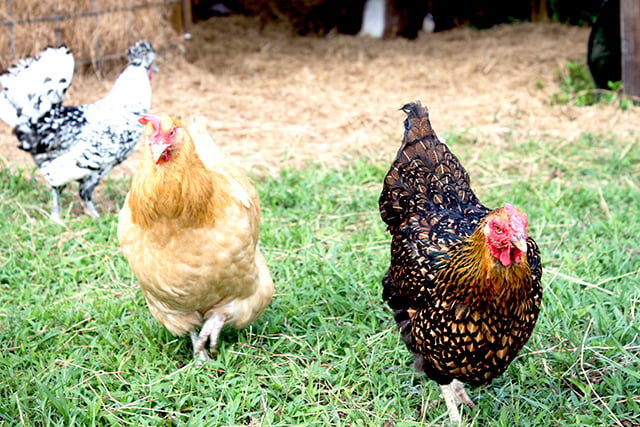
I realize they cost more, but they taste better, offer more nutrients and are far kinder to the birds that lay them. To me, they’re worth the extra money.
As Kastel emphasizes, “Food is the absolute foundation for good health.” Investing in quality often pays off over time.
To afford pricier pastured eggs, clip coupons or try money-saving grocery strategies so you can allocate funds for better eggs.
For lower-cost pastured options, check your local farmers market or use resources like Eatwild, a nationwide directory of nearby farmers and their practices.
If your supermarket doesn’t stock pasture-raised eggs, ask them to carry them — I did this at my nearby Publix and now I can buy eggs I feel good about.
Can’t swing pastured eggs right now? Then purchase the least expensive eggs available.
Jill Martin, senior writer for Savinly, is always hunting for budget-friendly culinary finds. Visit her blog or say hi on Twitter @jill_martin.