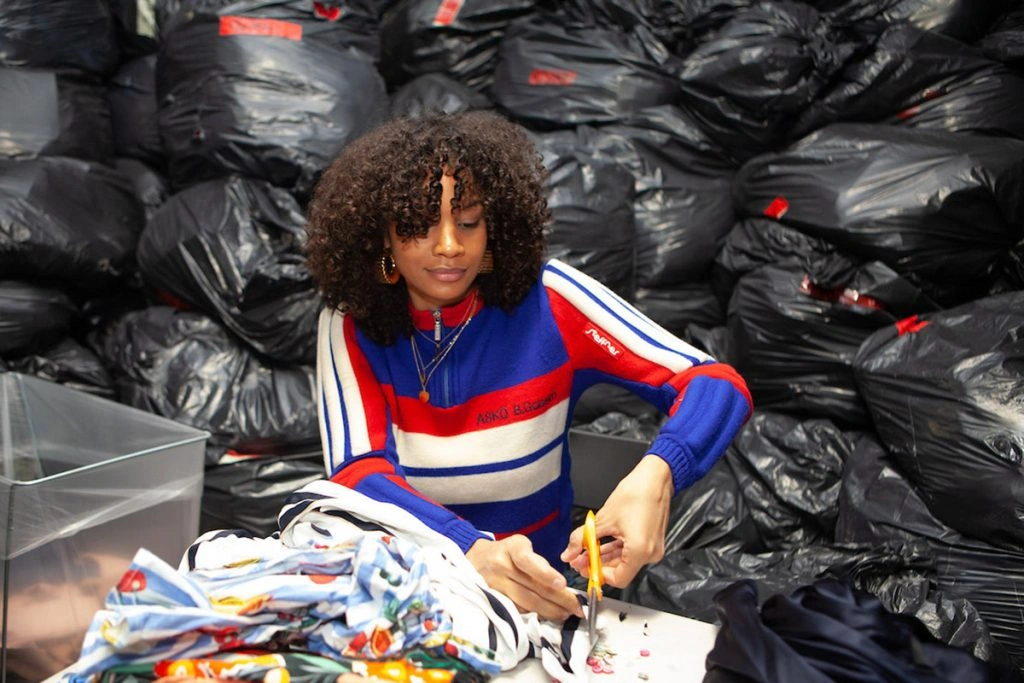
If your first instinct is to sadly rummage through your current pieces, there’s actually a better option — and it doesn’t require purchasing anything new. Welcome to the practice of upcycling.
Here’s how to upcycle garments and refresh your wardrobe without buying new items.
First, What Is Upcycling?
The word “upcycling” stems from the concept of recycling an old object, but with a twist. Upcycling isn’t merely reusing something; it involves altering that item to make it superior to its original form.
An upcycled piece frequently looks very different from its previous incarnation. Take Colorado-based designer Maggie Henricks of Create Good Company as an example. She transforms men’s dress shirts into boyfriend-style skirts. With fabrics ranging from plaids and polka dots to vivid Hawaiian prints, Henricks’ creations blend masculine and feminine style cues in intriguing ways.
Halima Garrett, who runs Threads of Habit in New Jersey, discovered upcycling through her passion for vintage apparel. Garrett had collected so many garments over time that she eventually didn’t know what to do with them. Ultimately, she decided the smartest move was to rework some of the pieces.
Though she describes her sewing abilities as “basic,” Garrett managed to turn a vintage skirt and estate-sale fabric into wrap pants. In fact, her site showcases an entire lingerie collection — every remade item includes at least one vintage lingerie component.

The best part about upcycling is that your garments become truly unique. If you want to give a friend an affordable, meaningful present, remaking an article of clothing for them is a lovely idea. You don’t even need a sewing machine; many DIY projects can be accomplished at home. That exclusivity might convince even the least sewing-savvy people to try upcycling.
For those who don’t plan to sell their upcycled items but do want to wear them, Garrett and Henricks share tips to turn a grandmother’s nightgown — or any piece you want to refashion — from dowdy to delightful.
1. Know What to Keep and What to Cut Up.
If you’re working with vintage finds or just older items in your closet, Garrett suggests evaluating what you’re about to chop before bringing scissors to your favorite jeans.
If a garment has persistent armpit stains or a hole too large to repair, feel free to cut it apart.
But if you’ve rescued a pre-1970s treasure from a thrift bin and you want to maintain its original integrity, it may be wiser to pick another piece to upcycle. The same advice applies to items with sentimental significance. Ask your mom — and yourself — before slicing up her wedding dress.
2. Start Small.
Garrett demonstrates that you can upcycle clothing without being a master seamstress. The simplest way to get into upcycled fashion is to begin with small projects. Try turning trousers into shorts or converting a long-sleeve shirt into a short-sleeve tee.
3. Use Your Wardrobe as Inspiration.
Is there something in your closet that you adore? Would you like to replicate its look? That’s an excellent starting point for upcycling. Use the cherished piece as a template for how you want another garment to fit. Or if you like an outfit’s color palette, consider applying that palette to an upcycled item. After all, imitation is flattering.
Another approach is to envision what a garment could become if it were a different style. Love the fabric of a dress but dislike its shape? Turn it into a two-piece set with a tank top and skirt. Tired of your jeans but they still fit well? Add a fabric patch to the knee for a fresh look.
4. See Your Old Clothes as Components, Not Just Single Pieces.
Henricks tends to view every item as various lengths of fabric rather than strictly a shirt, skirt, or dress. This mindset fuels her creativity.
Measuring the dimensions of a garment can help you imagine new ways to refashion it. And if one piece doesn’t provide enough material for what you want, consider merging multiple items into a single new creation.
http://
View this post on Instagram A post shared by Create Good Co. (@creategood.co)
“It’s important to think away from what it is now,” Henricks says, “and concentrate more on the textiles and patterns that are present in the material.”
5. YouTube Tutorials Are Helpful.
YouTube is often the best place to learn practical techniques. Garrett suggests searching for videos labeled “no-sew upcycle” or “minimal sewing upcycle.”
The presence of such tutorials proves that upcycling without extensive sewing is achievable. Three of Garrett’s favorite channels are Angelina of BlueprintDIY, Mimi G Style, and Shania O. Mason.
6. Be Precise When Seeking Instruction.
When planning the piece you want to remake, think about the exact changes you want to make. Do you want the top or pants to be more fitted? Want to add slits to a dress?
Having a clear mental image makes it easier to search for relevant guidance. You’ll then find tutorials that match the precise alterations you’re aiming to accomplish.
7. Once You Find Your Niche, Develop It.
Successfully reworking one type of item doesn’t mean you must expand into everything. Stay focused and explore other variations within that niche.
Henricks specializes in upcycling men’s dress shirts. She’s discovered creative uses beyond boyfriend skirts: she also makes dog collars from shirt collars and crop tops. Her work shows that sticking with a specific lane can lead to highly inventive ideas.