Before installing solar panels, Carol Marks was paying roughly $250 to $300 a month for electricity.
Her initial bill after the installation, for June — one of the hotter months in her Florida residence — was $45.
“Living in the Sunshine State and the Sunshine City, it felt like a natural move,” says Marks, co-chair of the sustainability action team for the League of Women Voters of the St. Petersburg Area. “Why not use energy that’s freely available from the sun?”
For Marks the choice to install solar was straightforward, but how can you determine whether it’s a good fit for your situation?
“Overall, it’s beneficial for consumers and the planet, but each person’s circumstances differ,” says Susan Grant, director of consumer protection and privacy at the Consumer Federation of America, a network of nonprofit consumer organizations. “It depends on your location, the home’s layout, upfront installation costs and projected savings.”
How to Save Money Going Solar

One major perk of residential solar is a federal tax credit equal to 30% of the total system cost. That allows homeowners — not renters — to reduce their federal income tax liability, effectively lowering the net price of the solar system by nearly a third.
Congress extended the incentive through 2019, but it steps down to 26% in 2020 and 22% in 2021 before phasing out. The credit could save the typical homeowner $5,000 or more (depending on system size), according to EnergySage, which offers a calculator to estimate likely savings.
Sun exposure is obviously vital. If trees, hills or adjacent structures cast heavy shade on your roof, solar panels won’t be very effective. California tops the nation in residential solar capacity, but some other states in the top 10 might be surprising.
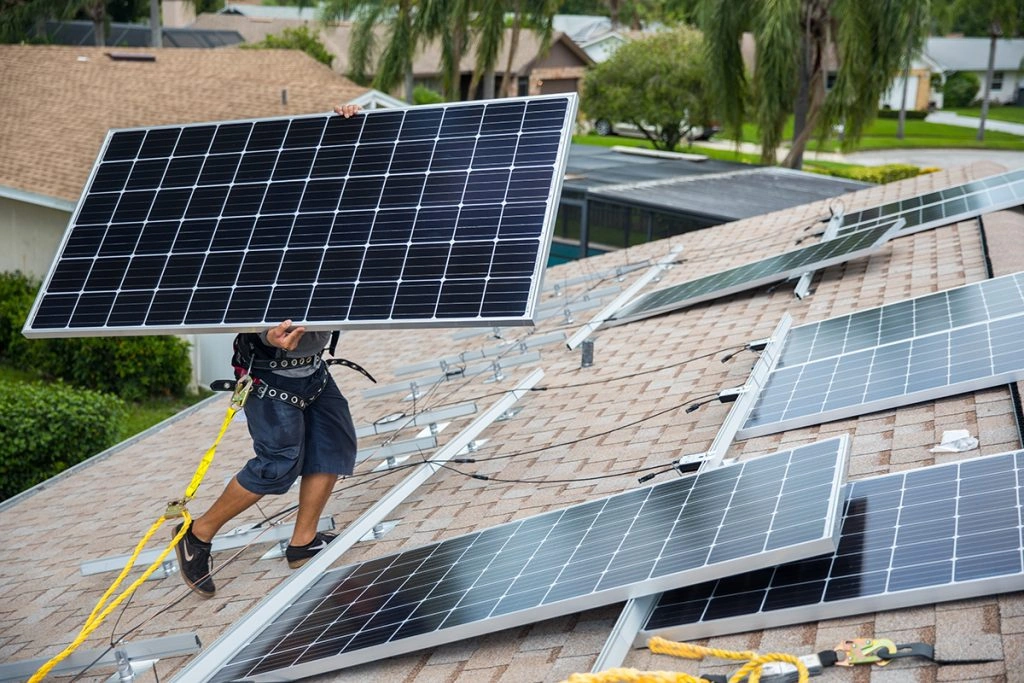
It helps to understand how panels operate. Often called photovoltaic panels, they are placed on the roof and convert sunlight into electricity. A key component of any system is an inverter, usually located in the garage; it transforms the direct current (DC) from the panels into alternating current (AC) that runs household appliances.
Occasionally panels generate more electricity than your home consumes. That surplus can be sent back to the utility in a practice called net metering. A two-way meter installed by the utility handles this and can greatly reduce your electric bill. Duke Energy, serving six states, charges a $100 interconnection fee that covers the meter, according to company spokesman Randy Wheeless.
Fees can be as high as $300 and are often bundled into the installer’s overall price, says Emma Rodvien, operations director for Solar United Neighbors, a cooperative active in eight states and the District of Columbia.
Do Your Homework

You wouldn’t buy a vehicle without researching features, comparing models and understanding costs, right? The same — and more so — is true for solar panels, which are likely to remain on your roof for at least 25 years.
“People really need to research before they let any company give them a sales pitch, and especially before they sign any contract,” Grant says. “It’s a significant commitment.”
Wendy Barsell, executive director of the Florida Solar Energy Industries Association, a trade organization, echoes that advice. Her counsel is relevant for homeowners nationwide.
Ask current solar homeowners how their systems are performing. What are the advantages and disadvantages? How long did installation take? Was the work done well? Was dealing with the utility straightforward? How much are they saving?
Get referrals from neighbors, coworkers and acquaintances. Check the company’s reputation on review sites; some consumers report confusing contracts, aggressive sales tactics and shoddy installs. The North American Board of Certified Energy Practitioners maintains a directory of certified installers, and state organizations like the Florida Solar Energy Industries Association list preferred contractors. Also verify that your state licenses the contractor; licensed installers typically carry insurance, but homeowners should confirm that.
Obtain multiple quotes, ask many questions and avoid being rushed into a decision. We’re discussing a purchase that averages $18,840 for a 6 kW system and $31,400 for a 10 kW system, according to EnergySage. “Get proposals from different firms that might use varying approaches, brands and methodologies,” Barsell advises.
Understand your needs. System sizing depends on your energy use, available sunny roof area and budget, according to Solar United Neighbors. Larger systems generate more power but cost more.
Don’t sign any contract unless you fully grasp every term, including your estimated return and break-even timeline. If your utility rates are high, you’ll recoup costs faster, notes the Solar Energy Industries Association.
Decide on your payment method — purchase, lease or a solar power purchase agreement, in which you buy the electricity but not the equipment. Consumer Reports recommends paying cash if you can; that avoids financing charges and lets you claim the full federal tax credit. Also consider bids from smaller installers as well as larger companies, which can be pricier, a recent government report found.
If a loan is necessary, compare offers from credit unions and banks — some have specific solar loan products — before accepting financing from your installer. Other alternatives include a clean-energy mortgage via Fannie Mae. Property Assessed Clean Energy (PACE) programs exist in more than 20 states, but groups like the Mortgage Bankers Association caution that homeowners could risk their homes if they default on payments.
“There are many factors to weigh,” Grant says. “That’s why states require disclosure documents for consumers. Solar is worthwhile, but it’s complicated and people need to know what they’re signing up for.”
Investigate state-level incentives. Rebates, low-interest loans and grants may be available.
How old is your roof? Solar panels typically last about 25 years. If your roof is nearing the end of its life or is damaged, it may be wiser to replace it before installing panels.
How long will you live in the home? While some studies suggest solar can raise a home’s value, the impact becomes clear only at sale. Many experts suggest staying in the home until the panels have paid for themselves.
Know your warranty. Most high-quality panels and system components like power optimizers come with 25-year warranties, says Garrett Savadel, a system designer at Brilliant Harvest, a Sarasota, Florida installer. Inverters typically carry about a 12-year warranty (sometimes as little as five years), though extended warranties up to 25 years are available for a fee. A good inverter can cost $2,000 to $7,000 installed, depending on size — with parts alone running $1,000 to $2,000.
Ask about upkeep. Some companies recommend regular panel washing and sell that service. Savadel notes that rain often removes routine dirt and bird droppings. In dry, dusty states like Arizona, New Mexico and parts of California, occasional professional cleaning may be necessary.
Confirm that your homeowner’s insurance will cover solar panels. Not every insurer does.
What if the Power Goes Out?

It’s a common misconception that having solar guarantees continuous power during grid outages caused by storms or other incidents. That’s not true. In such cases you need a generator or a battery backup to keep electricity flowing.
While panel prices have fallen more than 70% since 2010, according to the Solar Energy Industries Association, battery systems remain expensive — often $10,000 to $15,000 including installation, Solar United Neighbors says. “Adding battery storage to a solar array can raise costs so much that the utility bill savings become minimal,” their site warns.
For homeowners who value resilience and can afford it, batteries are a reasonable option. They operate like this: when sunlight is available your panels produce electricity that charges the battery, storing power for later use. Unlike generators, batteries don’t require fuel.
Marks, the Florida retiree, decided to add a battery. She and her husband also drive an electric car; for them, environmental impact matters at least as much as saving on bills.
“We’re going to keep working to cut our carbon footprint and supply our own power,” she says.
Anna Moreno is a former editor at Savinly.