Dental care can add up fast.
The American Dental Association estimates the average person spends roughly $430 annually on dental services. Imagine how quickly that climbs for a household of four!
Whether you love a bargain or struggle to afford care, here are nine practical tips from insiders to help you save money while keeping your smile healthy.
- Request a price reduction
- Enroll in a dental discount program
- Look into free or low-cost clinics
- Re-evaluate your dental coverage
- Compare providers
- Find student clinicians at dental schools
- See specialists only when required
- Obtain a second opinion
- Prioritize prevention
1. Request a Price Reduction
Love your dentist but want to pay less? Ask if a discount is possible or try negotiating the bill.
Some practices offer a modest cut (often around 5%) for patients who pay in cash instead of using a card.
If you’re facing real financial strain, most dentists are understanding and willing to help. Talk to your dentist or the billing team if you’ve lost employment or are dealing with a serious medical issue.
They may lower fees, arrange a sliding scale, or set up a payment plan that spreads out costs.
If payment is required when you’re seen, charging the visit to a card might be your most practical route.
Consider a financing option like CareCredit, which functions similarly to a healthcare-focused credit card and sometimes offers 0% APR deals depending on your credit.
Also ask about referral discounts or small reductions for leaving an online review.
2. Enroll in a Dental Discount Program
Dental savings plans are not insurance, but they can still reduce what you pay for care.
Here’s the basic model.
You pay an annual fee for the savings plan you choose. In return, you typically receive discounts of 10% to 60% on many dental services — including unexpected procedures like root canals.
Discount networks, such as those offered at DentalPlans.com, charge membership fees that usually fall between $80 and $200 per year. For example, plans in Orlando averaged $135 to $170 annually.
The program partners with dentists who agree to reduced rates, and you pay the discounted amount directly to the provider.
You’ll still cover costs out of pocket, but ideally at a much lower price than without the plan.
Do the math to decide whether a dental savings plan makes financial sense for you or if other discounts would be more economical.
3. Look Into Free or Low-Cost Clinics
Community health centers funded by the federal government offer free or reduced-fee dental services to low-income individuals.
Many clinics use sliding scale fees or flexible payment arrangements.
Services are typically available to those earning up to 200% of the federal poverty level.
Because waiting lists can be lengthy, contact your local clinic as soon as possible.
Use this tool to locate a nearby community health center.
4. Re-evaluate Your Dental Coverage
If you’re employed at a medium or large company, employer-sponsored dental plans are often inexpensive monthly additions.
But if you buy coverage on your own or have limited benefits at work, dental insurance can be pricey.
You may qualify for a premium tax credit through HealthCare.gov if your income falls between 100% and 400% of the federal poverty level, which could reduce monthly costs substantially.
That range translates to about $13,590 to $54,360 for an individual and $27,750 to $111,000 for a family of four (based on 2022 figures).
The credit is only available when you purchase insurance through the HealthCare.gov marketplace.
Outside employer coverage or a federal subsidy, buying dental insurance privately may cost more than it’s worth.
In some cases, dropping dental insurance could be the smarter choice. You might pay more in premiums over a year than you would for the dental care you actually need.
Ask your dentist for an itemized list of the services you typically receive — cleanings, X-rays, exams — and compare the total against annual premiums. If paying cash is cheaper, set that same premium amount aside in a savings or HSA account to cover future visits.
Going without dental insurance is most feasible if you don’t have a long history of major dental procedures.
5. Compare Providers
Many towns have numerous dentists vying for patients. To attract clients, practices sometimes offer significant incentives — from free whitening and exams to complimentary X-rays.
Look for deals on sites like:
- Valpak.com
- Groupon
- LivingSocial
Also watch for local flyers, signs, and community newsletters advertising special offers.
6. Find Student Clinicians at a Dental School
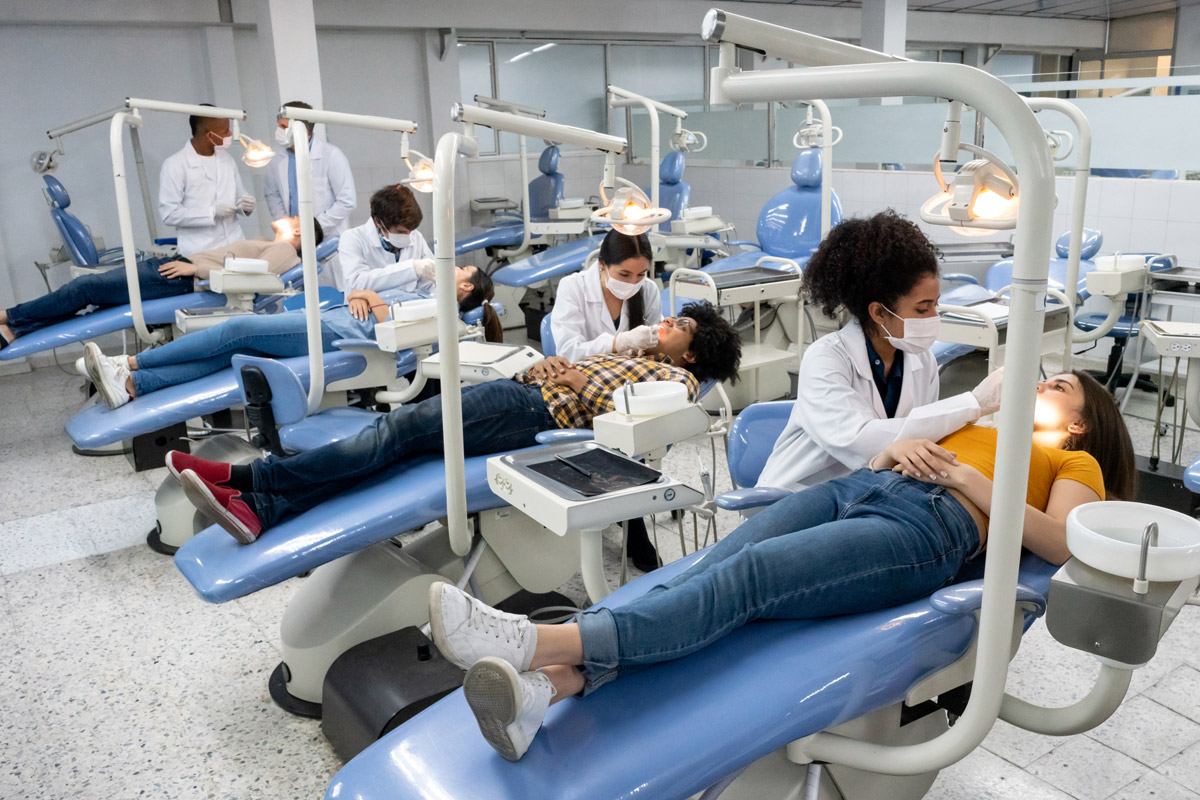
Dental and hygiene programs at universities offer quality care at a fraction of private-practice prices.
You can save considerably by having a dental hygiene student perform your cleaning. Many student-run clinics provide the cleaning included with the exam at little to no cost.
Volunteer patients generally receive a cleaning, X-rays, an oral cancer screening, fluoride application, and an evaluation by a licensed dentist — often for a very low fee.
Search for a nearby program via this directory of dental hygiene programs or browse the list of dental schools.
Students are typically motivated to provide good care, and licensed instructors supervise every procedure, so the quality remains high.
Keep in mind appointments may take longer because students are learning as they work.
7. See Specialists Only When Required
Specialists bring valuable expertise — and much higher bills.
Many patients unnecessarily opt for specialist care when a competent general dentist could handle the issue at a lower cost.
If you’re still taking your teen to a pediatric dentist for routine fillings, or if you’re considering an oral surgeon for wisdom-tooth removal, compare prices. A general dentist may be able to perform the same procedure more affordably.
For extractions and certain surgeries, seek a dentist who performs the work in-office to avoid specialist fees when appropriate.
8. Obtain a Second Opinion
If you leave an appointment with an expensive proposed treatment, don’t hesitate to seek another opinion.
There are usually alternative ways to address dental problems. Call another provider to compare recommendations.
Ask for a free consultation to avoid paying for a full repeat exam, and bring your current X-rays so you won’t be charged for duplicate imaging.
9. Prioritize Prevention
A cavity that never develops is always cheaper than even the least expensive filling.
Beyond treatment costs, dental visits can cost you time. The Centers for Disease Control and Prevention notes Americans miss millions of work and school hours annually for dental care.
Time away from work can add up to a major expense.
Protect your teeth now to avoid future bills. In addition to regular brushing and flossing, consider other preventive measures.
Applying a dental sealant — especially for children — can prevent roughly 60% of decay at about one-third the price of filling a cavity.
Xylitol gums and mints help curb cavity-causing bacteria, and a night guard can protect teeth from grinding-related wear.
Look after your oral health and you’ll keep more money in your wallet.
Alex Mercer is a Certified Educator in Personal Finance and a senior writer for Savinly.Jenna Lopez, a registered dental hygienist, contributed to this piece.