Or… I used to be. Or… maybe I still am, but at the moment I’m abstaining? Either way, I had a major coffee issue, and I recently quit cold turkey.
Let me explain just how major this was.
I couldn’t begin my day without coffee. I don’t mean it in a quaint, novelty-mug sort of way. I mean it in a glazed-over, snarling Don’t even speak to me until I’ve had my coffee way.
It made road trips a hassle. It dominated my morning rituals. It required emergency runs to the store — often with a detour for Starbucks “to hold me over.”
My partner, who doesn’t drink coffee and somehow enjoys life’s pleasures in measured doses, didn’t think this would last.
He supported me when I said I’d try a week without. When I put the coffee maker in our Goodwill box after three days, he suggested we wait and see. When I hit two weeks coffee-free, he was floored.
By five weeks, we donated the coffee maker, and I haven’t glanced back.
How Much Money Will I Save by Ditching Coffee?

I’ve made it about two months now without coffee, or caffeine from any source.
Cutting out this anchor that my day was tied to is a huge relief, to put it mildly. Losing the mood swings and insomnia has made me generally happier.
Plus, I get that smug sense of superiority over everyone whose days are still run by the black-eyed beast.
Best of all for a Savinly reader: I’m saving alotof money.
My addiction was straightforward: I brewed coffee at home and drank it black. I was going through about a pound a week (plus the occasional free cup or a few from the office kitchen).
I wasn’t devoted to a specialty label or roast, but I also wasn’t drinking the cheapest stuff. I leaned toward Dunkin Donuts or beans from my neighborhood grocery that cost a few dollars more per pound.
To keep things simple, let’s assume I always relied on Dunkin.
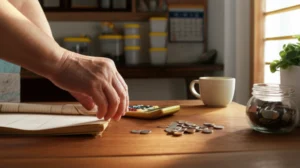
A one-pound bag of Dunkin’s Original Blend runs $8.99. At one bag per week for 52 weeks a year, that’s $467.48 annually before tax.
That produced roughly two 16-ounce cups of coffee daily.
When I flew — about five trips last year — I’d buy a Grande Fresh Brewed Coffee at the airport Starbucks each way. At $2.10 a pop, that’s an additional $21 for 10 travel coffees.
Because black drip is easy to prepare at home and free in the office, I didn’t consistently purchase coffee out. But about once a month, I’d grab a cup at Dunkin, Starbucks or a local cafe for whatever justification I could invent.
At roughly $2 each, that’s another $24 a year in discretionary coffees.
Some weeks cost far more — like when I was in New York and bought a large iced coffee from Dunkin Donuts every morning and several afternoons (and one late night). But the numbers above are the baseline, so I’ll stick with them.
That means I spent $512.48 on coffee last year that Iwon’tbe spending this year.
Oh my word — that’s an entire extra getaway. (Don’t believe me? Check out my $300 road trip for two.)
brb… perusing Priceline and sleeping better.
What if you don’t brew coffee at home every morning? Let’s estimate how much you could save if you kick other coffee habits.
Daily Convenience-Store Coffee
If you opt for thecheapest gas-station coffee— which we found to be Wawa — you can buy a 16-ounce drip for $1.45 each day.
If you pick up a cup every workday (five days a week) and take two weeks off in the year, you’d shell out $362.50 annually — for only one cup a day.
With my two-cup-a-day pattern, that would be $750 a year. And, let’s be honest, addicts like us rarely skip weekends or vacation days, so it’d be closer to $1,058.50.
That’s two vacations.
Daily Coffee Shop Drinks
If you like a coffee or espresso beverage made with flair, tats and unsolicited commentary on art, you’re probably paying much more to get your daily fix from a cafe.
If you purchase a $4 latte each workday, for example, your coffee habit would cost about $1,000 a year.
You can see why the most frugal among us train ourselves to accept simple drip.
If you can’t resist the pastry case and cave every time you stop in, your spending climbs even higher.
The average ticket at Starbucks is $7.67. Do that every workday, and you’ll accrue $1,917.50.
Three vacations!
How I Quit Coffee (Spoiler: No Magic Trick)

So, you want to take three extra trips this year. Or invest $1,900. Or start an emergency cushion.
But coffee is genuinely tough to give up. It tastes delightful. It’s comforting to hold. It smells like cozy memories. It makes your brain work when you think it can’t.
If you want to quit to save hundreds yearly or avoid thousands of snarky remarks, I wish I could say I found an easy trick.
I didn’t.
Nothing I did is revolutionary, but here’s what helped me get through it.
1. Time and tapering. Although I’d hardly missed a single day of coffee in about six years, I began scaling back long before I stopped completely.
I stopped drinking coffee at midnight after some near panic episodes two years ago.
I cut myself off by 5 p.m. when I started a nine-to-five job just over a year ago and gradually moved that boundary earlier to around 2 p.m. until I could sleep soundly.
I began brewing milder coffee at home when the strength of office brew started making me jittery.
By the time I decided to quit, I was down to two moderate-strength cups daily.
2. Pain reliever. This may not apply to everyone, but my body rebelled against the caffeine withdrawal. A few hours into day one, a vise gripped my temples with a headache I was certain would make my eyes pop out.
Luckily, caffeine withdrawal is one of the shorter, simpler withdrawals. I relied on extra-strength acetaminophen to soothe headaches for the first two days, then I was fine.
3. Nutritious food and movement.Once the headaches subsided, I still had to contend with a drowsy feeling from the lack of caffeine. My brain needed to relearn how to run on genuine energy.
That mostly took time, but initially I combated it by eating energy-supporting foods like protein, whole grains and leafy greens when I felt sluggish.
I’m no exercise fanatic, but when withdrawal made me groggy, a brisk walk around the office or a longer outdoor stroll usually did the trick.
4. Herbal tea.I know — coffee folk roll their eyes at herbal tea people. Perched on those high horses of self-control and balanced living. Uhg.
But, alas, I’m an herbal tea person now.
The last obstacle to quitting coffee was beating the ritual. Weekend mornings with a warm cup and a book. Afternoons with treats that beg for something hot to wash them down.
Herbal tea fills that gap. It’s not habit-forming, and it’s far cheaper than coffee.
Also, I’m enjoying the perspective from up here on the high horse.
Your Turn: Are you trying to give up coffee? What do you find hardest?
Dana B. is a staff writer at Savinly. She’s contributed to HuffPost, Entrepreneur.com and Writer’s Digest, sprinkling humor wherever it’s warranted (and sometimes where it’s not).
If you’re looking to cut costs in other places to cover your caffeine cravings, consider less costly options like cheap or free coffee to bridge the gap.