If you’re feeling cramped in your current place and thinking about upgrading to something larger, it’s alarming to see how expensive even a bit more space has become. The median sale price of a home rose 24.8% year over year in June, according to Redfin, the national real estate brokerage.
But disappointed prospective buyers who feel priced out of the market can make simple adjustments to their existing home to increase usable space and feel less confined.
Below are several strategies for carving out additional areas in your present house or condo so you can enjoy it more while you wait for the market to cool. You might even conclude that home sweet home is fine after all.

5 Ways to Stretch Your Space
Here are practical ideas to expand usable square footage and create distinct zones for much less than adding an addition or renting a bigger apartment.
1. Turn an emptied closet into a workspace
Clearing out a closet makes an ideal spot for a remote-learning or work-from-home nook where all supplies remain in one spot and are easy to reach. Quick steps to repurpose a closet:
- Remove most shelving, leaving perhaps just the top shelf for storage.
- Have your child choose a paint color and paint the interior together.
- Measure the closet’s width and depth, then have a scrap countertop or plywood cut at Lowe’s, Home Depot, or a local cabinet shop. This typically runs $50 to $100 depending on size and material.
- Attach wooden slats or 2x4s around the closet perimeter about 30 inches above the floor for support.
- Set the desktop onto the supports.
- Add a bulletin board, plastic file holders, a stapler and a cup for markers and pencils. Let your child personalize their “classroom” with photos or printouts of favorite characters.
2. Clear out junk to find hidden space
If a closet or spare room is stuffed with a broken vacuum, an unused exercise bike draped in clothes, or boxes of forgotten items, clearing it out can free up space for people instead of stuff.
Call a junk removal service like 1-800-GOT-JUNK? Their minimum charge is $129 to haul and dispose of about what fits in a pickup bed. Local independent junk haulers often provide competitive rates as well. Or do the haul yourself and donate usable items to a charity thrift store.
3. A sheet and a few screws can make a private nook
When Beau Brown was a high-school senior during the pandemic’s first year, he did school at home with two siblings and parents also working remotely. Feeling squeezed, he created his own little retreat — a simple trick that can create a cozy hideaway for kids of any age.
“He literally took a flat king sheet and drilled screws through it into one corner of the living room,” his mother, Alyssa Brown, said. “He fashioned this little triangular room of his own.”
The sheet acted as one wall while the existing walls formed the rest of a triangular space that fit a comfy chair, side table and a fan. The fan helped mask noise from the rest of the three-bedroom apartment. He also used headphones with his Xbox to minimize sound.
This “corner room” could also accommodate a play area, a Lego table or an easel in a living room or kitchen, giving a child some privacy and keeping toys out of view in the main space.
4. Use Ikea solutions to divide and organize
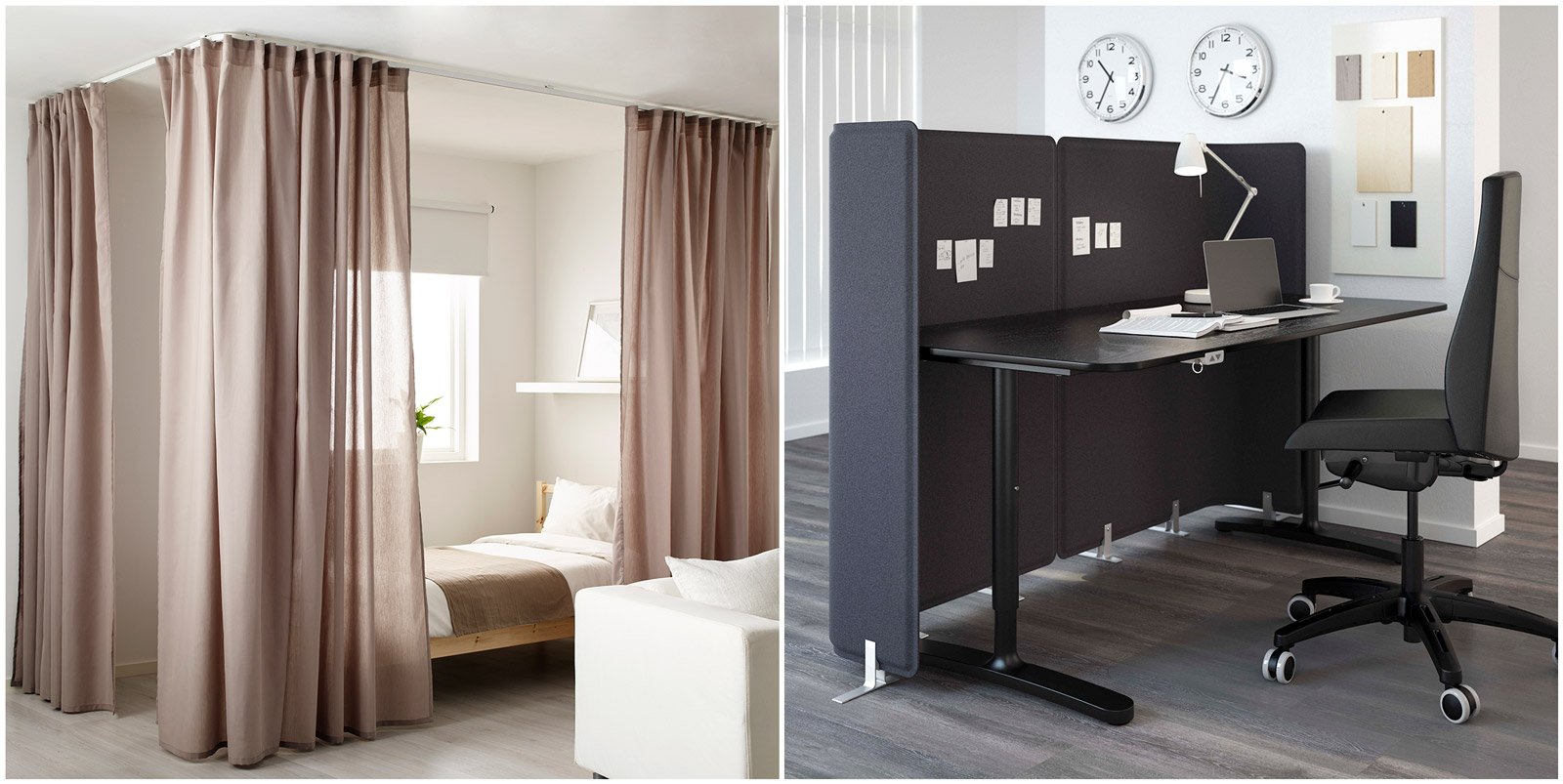
Ikea carries several items, typically $59 to $149, that can create room divisions or convert a corner into a desk or sleeping area.
Shelving units can be anchored on one side to a wall and extended into the room to split it into two zones. A KALLAX unit, roughly five feet tall and three feet wide, costs about $70. Two of these form a substantial divider in a shared kids’ bedroom or can section off a living-room corner for an office.
“The VIGDA corner room divider is simple to assemble using the provided instructions,” an Ikea representative said. The VIGDA uses a ceiling-mounted track with curtains hanging to the floor. It’s priced at $46 while Ikea curtain sets start at $12.99.
“The MICKE Corner Workstation can be positioned anywhere in the room. With shelving and a magnetic board, you can personalize this workstation to suit your needs,” the Ikea spokesperson added. It costs $149 and can be arranged to form two walls around a corner with a small opening to enter the desk-and-shelf area.
“The BEKANT screen offers privacy and helps absorb sound to divide a room,” she noted. It sells for $119 and measures 59 inches high by 32 inches wide.
5. Reimagine and rearrange existing rooms
A screened porch, sunroom or dining room can often be repurposed as a bedroom or classroom when everyone’s home. Eat at the kitchen table or a coffee table, and convert the dining room into one or two spaces for sleeping, schooling or working.
When I divorced several years ago, I sold our four-bedroom house and rented a two-bedroom in a charming neighborhood with a large yard. With two daughters away at college and a high-school-aged son splitting time between parents, I didn’t really need more than two bedrooms.
Still, it was difficult seeing my daughters leave the home they grew up in and having all their “stuff” packed into boxes in the attic. (“Stuff” meaning photos, embroidered pillows, framed records, twinkly lights, artwork, music boxes, stuffed animals, an old bubble-gum machine, etc. It’s the “stuff” that makes a room feel like yours.)
I considered adding air conditioning to the garage, which had two sizable windows, but that proved too costly. I thought about turning the dining room into their bedroom, but that would block access to the kitchen.
In the end, I made the master bedroom theirs. I slept there about 10% of the time since they were rarely home, but it was filled with their belongings and clothing.
I moved my dresser into the dining room and put my clothes in the hallway closet. For a summer when the girls were home, I slept on the living-room sofa or on a pull-out in the screened porch.
The rest of the house reflected my style, but they still had a bedroom to call their own and a space that felt like theirs.
Katherine Snow Smith is a senior writer at Savinly.