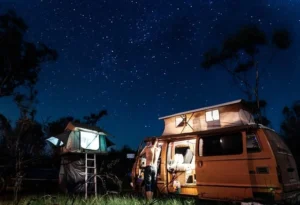
Comedian Dave Stone earned near-mythic status among comedy followers early in his career — and not solely because of his jokes. He’s undeniably funny, a captivating storyteller with a Southern drawl and a serious passion for food.
But one thing eclipsed his other talents in road-comic legend: He became known as the guy who lived in a van.
Dave Stone’s Van Life
Birmingham, I’ve slept in my van 15 straight nights just to bring u the gift of laughter so maybe come to this stupid show or whatever idgaf pic.twitter.com/OlB4iZp0c2— dave stone (@davestonecomedy) September 28, 2016
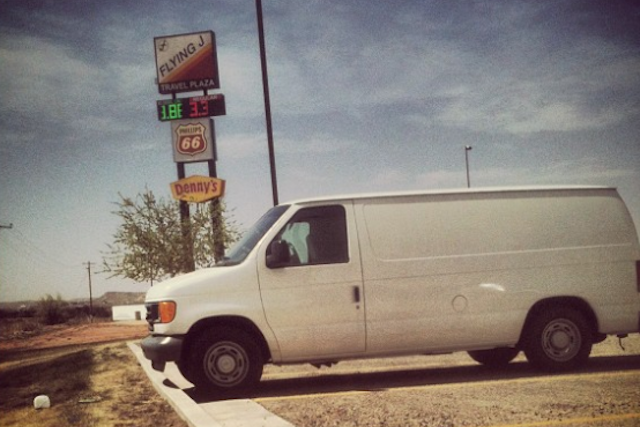
From 2012 to 2014, Stone subsisted in Los Angeles and crisscrossed the U.S. for some 80,000 miles, all within the 54 square feet of a 2006 Ford cargo van.
Interest peaked in 2012 when Stone and his van were profiled in an installment of the documentary web series “Modern Comedian.” At that time he’d been van-dwelling for roughly six months.
“Looking back on it, I felt pretty chipper at that point,” he told me recently.
“I always wondered what the documentary would have looked like towards the end … because after two and a half years, it was definitelytime.”
He’s been out of the van and “living like a normal human” for over two years now, yet he’s kept his frugal, creative streak in pursuit of comedy.
I caught him nine days into a four-week tour — somewhere between Denver and Omaha — to ask what he thinks about the experience now.
Raised in Canton, Georgia, Stone launched his comedy career in the growing Atlanta scene.
His drive is evident in the varied jobs he did before going full-time in comedy: five years as a radio DJ, tour-managing “some rock bands,” running a landscaping business, among others.
Before relocating to L.A., Stone worked as a feature comedian — the paid middle act performing between the emcee and the headliner at clubs.
The gigs pay, but not much — and they had him on the road for up to 10 weeks at a stretch.
Though making comedy his livelihood was a milestone, he decided that to get serious he needed to move where the industry lives.
“A bunch of my Atlanta friends were heading to New York, and you’d think I’d follow, but I felt like I needed to plant my own flag,” Stone says.
He also preferred California’s climate and overall “quality of life” to New York’s and had little experience on the West Coast.
“I thought, why not give that a shot,” he says.
Yet, living and touring on feature-comedian wages made the move challenging. After deciding to relocate, he spent roughly 18 months “trying to get to L.A.” — mostly saving money.
He needed a nest egg to move across the country and settle in a new city, and that proved difficult.
Buying and Converting a Van

Then the van idea struck.
Before heading west in early 2012, he rented a room at a friend’s place.
“Although it was a regular-sized bedroom, I spent all my time in this tiny 50-square-foot zone with my mattress, a chair, a table and my computer,” he recalls.
It dawned on him: “All of this small living space could fit inside a cargo van.”
Since he was already traveling a lot, “the light bulb got even brighter.” He realized he could merge his compact living area with his vehicle and slash expenses.
That gave him a way to get to L.A. Over the next few months he bought a 2006 Ford cargo van for roughly $7,000 and set to work converting it into a livable area.
Armed with some carpentry know-how, basic tools and many YouTube tutorials, Stone handled the conversion himself. The van wasn’t already fitted for living, so he started from zero.
He spent under $1,000 and countless hours to make the van habitable. It needed more than just a mattress tossed inside.
First up was insulation. California nights can be chillier than people expect. Traveling frequently also meant confronting varied climates.
To frame his 54-square-foot mobile home, he cut plywood for walls and a ceiling, attached insulation and covered it with carpet.
He fashioned a bed frame to hold a mattress he trimmed to fit the van’s 71-inch width. At 5-foot-9, he managed to squeeze in.
The setup was minimal: “Modern Comedian” shows an old chair, a closet rod for clothes, a battery fan, curtains sewn by his mother and plastic drawers labeled “food,” “not food” and “stuff.”
Life on Tour in the Van
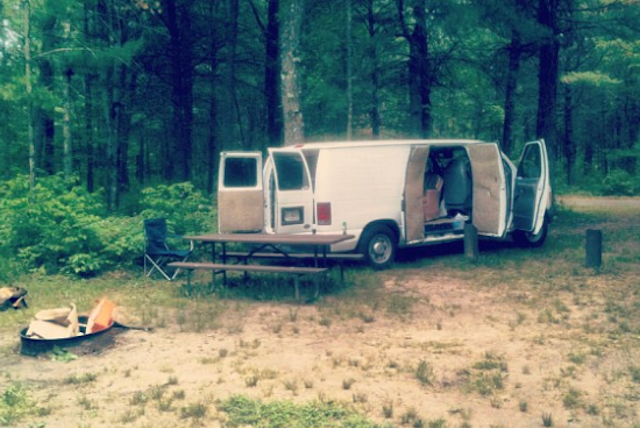
If you’re thinking of doing something similar — and many comedians have after hearing his tale — remember one big lifestyle detail: Stone spends roughly half his time touring away from the city.
About half those nights on the road he stays in a hotel or a club-provided condo while performing.
If you’ve experienced stretches of broke travel, you’ll know that’s not a massive consolation — but it does offer relief many drifters don’t get.
He also books a lot of DIY gigs at local spots outside comedy clubs. In those cases, he gets no lodging and sleeps in the van.
“I refused to shell out the money myself, because the point of the van was not just to save on rent but hotels too.”
He spends three or four nights a week, for roughly half the year, in the van. At about $60 per night for bargain hotels, and without free lodging half the time, sleeping in the van saved him an estimated $5,000 annually.
In return, he’d pay $10–$12 to shower at a truck stop when needed.
“It feels weird to pay for a shower,” he admits, “but when you need one, it’s money well spent.”
When parking lots or truck stops aren’t options, he’d pay $8–$10 to camp overnight. The night before our call he’d stayed at Lake McConaughy, Nebraska.
Kentucky A photo posted by dave stone (@_davestone) on Sep 25, 2016 at 6:55am PDT
Given comedians around the country who would gladly host him, I asked: why not stay with friends? “I have and still do have a great network,” he says.
But, “This is my idea, my journey, my loophole to avoid rent, so I’m going to tough it out and not be a burden.”
Touring frequently also made holding a day job nearly impossible.
You picture aspiring comics in L.A. scrabbling by waitressing or slinging coffee, and initially Stone took a “little kitchen job” when he arrived. But multi-week tours meant the job didn’t survive.
“It’s tough to tell your boss, ‘Hey, I need the next five weeks off to travel the country,’” Stone explains.
Living in the van allowed him to rely on comedy even when income was low.
During town stretches — usually about six weeks — he’d earn extra cash doing odd jobs like dog-walking or handyman gigs found on Craigslist.
He could also make around $40 in a day as a TV extra, often as part of a game-show audience.
How Much Does Van Life Cost?
Setting touring aside for a moment:
If your aim is to save money when moving to a new city, is van living the answer? Here’s how it worked for Stone during his L.A. stretches.
The upside: savings were dramatic. Over 28 months in the van he avoided rent and utilities for an L.A. apartment.
Compared with his current share-of-rent — about $700 monthly plus $100 in utilities — that’s roughly $22,400 saved in just over two years.
With the van, he pared expenses down to three essentials, totaling under $300 a month by his estimate:
Cell phone, $90 — He signed up for unlimited data with T-Mobile, critical when his phone was usually his only connection and entertainment.
Gym membership, $30 — A monthly L.A. Fitness membership served as a second home. “That was the best $30 a month I had ever spent,” he said. “It’s where I did all my bathroom stuff every day.”
Car insurance — He paid a standard policy without disclosing the van’s use as living quarters.
“I don’t know how the insurer would feel about someone using a vehicle as a dwelling,” he admits. “I kept it to myself because I figured it would affect the premium.”
He also made payments on the van until clearing the $4,000 loan about a year before leaving it behind.
Food and Cooking

“One of the toughest — maybe the toughest — parts was not being able to cook,” Stone says. “No cooking at all.”
Apart from occasional condo or hotel stays, he largely stuck to van life for about 18 months straight.
He didn’t initially couch surf except for the occasional pet-sit or house-sit, so his world was limited to the sparse amenities he installed.
Stone didn’t have a deep-cycle battery, a common van/RV power source. That meant no hot plate or microwave for cooking.
“That was extra cash and hassle I didn’t have, so I went totally bare bones,” he explains.
His “kitchen” was a cooler and one “food” drawer of dry goods, which severely limited meal quality and cost-efficiency.
“I spent about the same as a typical person on groceries, but I didn’t get to eat anything particularly good,” he says.
One look at his Instagram shows a foodie sensibility — you’ll likely crave barbecue after scrolling.
“I don’t want to brag, but I’m proud of my cooking,” he told me. “There are definitely things I do well — biscuits and fried chicken wings are on that list.”
Admit when you’re wrong. Be kind to animals. Make biscuits. A photo posted by dave stone (@_davestone) on Jul 25, 2016 at 8:09am PDT
His culinary chops may be typical for a Georgia native, but rare among road comics who rarely have kitchen access.
Not staying in hotels and lacking a kitchen meant Stone missed one of his greatest pleasures for two years.
“I ate like a third-grader: turkey sandwiches, peanut butter sandwiches, crackers and junk,” he laments.
Or he ate fast food: “Two-for-a-dollar tacos at Jack in the Box and that kind of thing.”
After about 18 months, fellow comic Kyle Kinane — now Stone’s co-host on the “Boogie Monster” podcast — forced him into house-sitting while Kinane was away.
The chance to cook soared Stone’s excitement; he “went nuts” in Kinane’s kitchen and made all sorts of dishes, sometimes to hilarious extremes — “sometimes he’d come home and there’d be chili on the ceiling,” he jokes.
Safety Concerns

A key practical problem when your home is a vehicle: where to park?
“There’s definitely an art to finding a good parking spot in Los Angeles,” Stone says.
You want to dodge tickets and avoid paying meters or garages. Where you park also affects safety, a big concern living so vulnerably.
Even with few valuables, “If someone knows a guy lives in a van, there’s going to be something of value — a phone, a laptop, whatever,” he notes.
Finding balance is tricky.
For safety you avoid sketchy areas, though blending in is easier there. For stealth you can’t park in affluent neighborhoods either — Beverly Hills might look safe, but you’d stand out and risk calls to police.
There are nuances you can’t learn from tutorials.
He felt the cargo van offered an edge over conversion vans or RVs because it looked like a work vehicle, not a home. Passersby saw a typical parked utility van, so fewer people suspected someone lived inside.
That helped keep nosy neighbors and cops at bay, and reduced break-in attempts — though he did experience two tries over his 2½ years.
For times when stealth failed, he kept a machete near the door to scare off intruders. Thankfully, he never had to use it.
Was It Worth the Savings?

When I asked about downsides, Stone cautioned, “I’m hesitant to speak too harshly because it was a self-imposed hardship. I chose it.”
Still, his resolve to endure the van that long impressed me. Even the small inconveniences he mentioned convinced me I couldn’t have done it.
Not being able to stand up.
Not having a shower or bathroom at will.
Not cooking what you want.
The toughest part, he says, was for 28 months “never, ever being 100% relaxed and secure.”
“You know that feeling after a long day when you come home, eat dinner, watch TV, lock the door and feel secure? In the van you don’t get that.”
At any time someone could attempt a break-in, a cop could knock, or you could be towed for illegal parking.
“Always metaphorically sleeping with one eye open wears you down,” Stone says.
Still, he believes it paid off.
He’d talk about van life on stage, and afterward people would approach him. He remembers a middle-aged man with a family and a comfortable life telling him, “I’m so jealous,” which Stone found ironic.
“I get it. It’s the freedom,” he says.
At 39 he had no spouse or kids, no mortgage and no nine-to-five — “being 100% untethered” was liberating.
“I had stresses others don’t have, like ‘where do I go to the bathroom today?’ But not having big bills, a mortgage or debt was freeing,” he explains.
Getting Out of the Van

Early in 2014 Stone finally moved into an apartment in L.A.
A “small break” came when a production company tapped him for the documentary “Gutbuster.”
“They wanted a comedian who needed to lose weight,” Stone told LA Weekly. “Just the Average Joe. I’m very, very average.”
Although rent — $1,100 a month — was pricier, he lived alone for a while after leaving the van. He later moved in with roommates to economize, but he’d needed that solitary reset.
“After two and a half years it felt like being in prison,” he says of the transition back to apartment life. “I had to re-acclimate, and living alone felt easier for that.”
Would He Do It Again?

When he bought the van, Stone told himself it would be six to nine months.
That timeframe seemed doable. But the reality stretched to 2½ years.
“If you’d said at the start it would be two and a half years, I might not have jumped in so eagerly,” he says.
He endured three to four times longer than expected. Despite hardships, he now speaks fondly of the period.
“There were nights you lie in a van staring at the ceiling wondering what you’re doing. But then you realize your monthly bills are $300 while others sometimes have ten times that.”
Lower fixed costs meant he didn’t need a day job in L.A., could keep touring and grow his fanbase — with gradual payoff.
While living in the van he appeared in “Modern Comedian,” was selected for Just for Laughs Montreal’s New Faces showcase, debuted on “The Late Late Show with Craig Ferguson,” and competed on season 8 of NBC’s “Last Comic Standing.”
He also filmed “Gutbuster” and released a Comedy Dynamics album, “Hogwash,” after moving out.
He still tours intensely — now as a headliner, which helps earnings — but tragedy struck when a drunk driver hit him head-on last August and totaled the cargo van. He walked away unharmed, but the van was destroyed.
“Seeing it totaled was heartbreaking. That van had sentimental value,” he says.
Undeterred, he replaced it with a minivan outfitted with an air mattress and sleeping bag for touring. It’s not the same, but it works for shorter stints away from home.
Your Turn: Would you consider living in a van to cut rent?
Dana Sitar (@danasitar) is now a staff writer at Savinly. She’s written for Huffington Post, Entrepreneur.com and Writer’s Digest, and tends to inject humor where she can.
If you’re intrigued by tiny, mobile living or want tips on downsizing, also check out living in a tiny house for related ideas and inspiration.