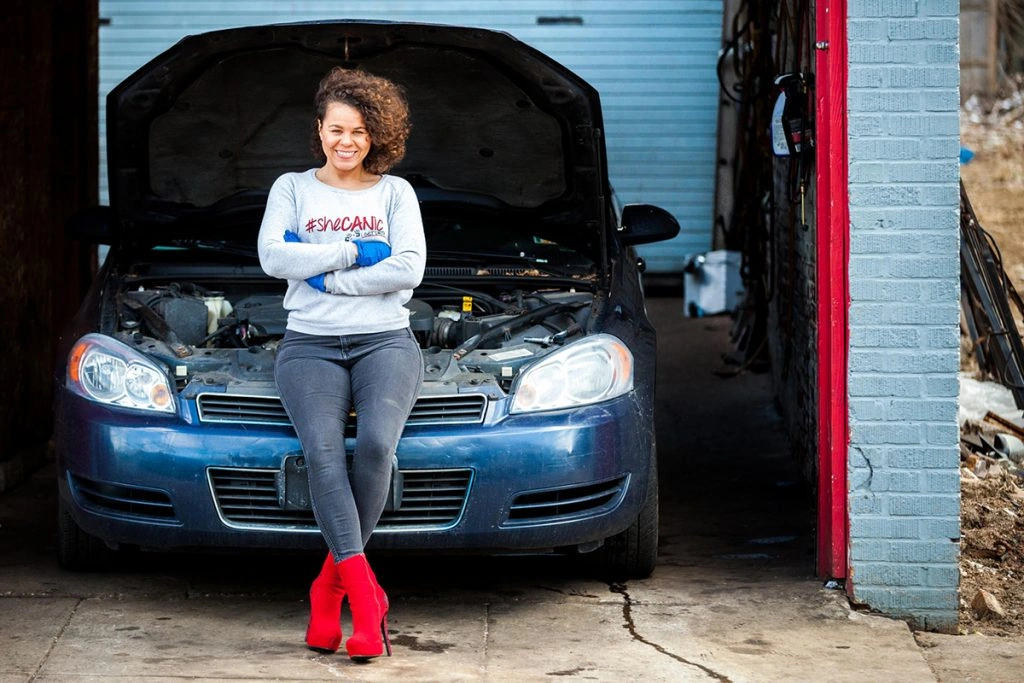
Patrice Banks once felt she needed a man by her side whenever she took her vehicle to a shop or shopped for a new car.
“[It] wasn’t a very empowering position, considering I’m an engineer,” she says. “I’m in a male-dominated field, I’m smart, but yet I was an auto airhead.”
After talking with other women, Banks discovered she wasn’t the only one feeling that way. Far too many had similar experiences. She decided to act — not just for herself but for other women as well.
So Banks returned to school to train as an automotive technician. She left her engineering role at a Fortune 500 firm and launched an auto repair shop in Upper Darby, Pennsylvania — just outside Philadelphia — in January 2017.
The business — Girls Auto Clinic — is staffed by women and caters to a female clientele. Banks also runs a salon — Clutch Beauty Bar — next door, where customers can have their hair or nails done while their cars are being serviced.
Banks is focused on shifting the culture in the automotive world and equipping women with car know-how. She offers free car care workshops at her shop monthly from April through November and authored the “Girls Auto Clinic Glove Box Guide,” which instructs women on car upkeep, buying a vehicle and locating a trustworthy mechanic.
Banks understands not every woman wants to get under the hood, but she insists women should grasp the fundamentals of car maintenance. After all, a vehicle is an investment that can cost tens of thousands of dollars. You want it reliably moving you from point A to point B — not slowly deteriorating toward the junkyard.
Forget the Old Oil Change Rules
Banks says the single most important thing car owners can do is have their oil changed when it’s due.
“Do you want to spend $40 for an oil change or $3,000 for a new engine?” she asks.
Following traditional advice, many assume oil changes are required every 3,000 miles or every three months. But that’s not always true, Banks notes.
“A lot of cars can go 5,000 [or] 10,000 miles between oil changes,” she says. “It is based on your owner’s manual.”
For those who haven’t opened the owner’s manual recently — or ever — Banks points out that it contains a maintenance schedule detailing when your vehicle needs routine service, such as tune-ups, filter swaps, tire rotations and oil changes.
An oil change is among the least costly auto-related expenses you’ll likely face, she says.
So How Much Will This Cost?
Costs for automotive work can vary greatly based on factors like your vehicle’s make and where you live, Banks says.
Still, she suggests grouping shop work into three tiers. The least expensive tasks are things like oil changes, tire rotations and replacing windshield wipers. Banks says these basic maintenance jobs might run under $50, but they’re services that need doing most often — at least once every year or two.
Light repairs and more involved upkeep — such as fluid flushes or replacing brakes and tires — sit in the midrange, Banks explains. Expect to pay between $100 and $300 per job, and you’ll likely need these services every two to five years.
Major repairs are the priciest. The older a car gets, the more likely it will require significant repairs. A 2018 Ally Financial survey of more than 2,000 Americans found that 80% of people who needed a major auto repair in the past five years paid $500 or more.
“When a car gets to be what I call in its second life, like 100,000 miles or over — what I call over the hill — that’s when it’s all fair game; anything and everything that could break will break,” Banks says. “I tell women everything on a car will fail. It will fail eventually. You have to expect it.”
If your car is financed, Banks advises paying off the loan before the vehicle reaches 100,000 miles. Then start putting money aside for repairs. Expect repair bills in addition to the routine maintenance you’ll still need, she says.
Build Your Savings and Find a Good Mechanic

Planning ahead is the best defense against being blindsided by a large car expense. Banks suggests budgeting about $1,000 a year in repairs if your car has more than 100,000 miles. She recommends saving around $100 each month.
Another key component of smart car ownership is having a mechanic you trust. Clear communication between techs and customers is central to how Banks operates at Girls Auto Clinic.
“Mechanics … diagnose things by hearing, feeling, seeing and smelling,” she says. “So if we can hear, feel, see and smell it, so can you.
“One of the things that I suggest that [customers] do, whether they come to us or any other mechanic, is to say, ‘Show me.’ We take people out into the shop and we show them what we’re seeing,” she says. “We have them listen to what we hear… We have them try to smell what we smell. We have them feel what we feel.”
Good communication helps clients avoid feeling exploited, Banks adds.
She admits that some car owners are reluctant to visit a shop because they fear being pressured into buying services and products that increase their bill. Chain shops and dealerships often upsell, Banks says.
She addresses this by being open with customers about what needs immediate attention and what can wait a few months. If money is tight, be honest about your budget and ask which repairs can be postponed.
Banks says she used to be a “get-in-the-car, turn-the-ignition-and-go type of girl,” but with knowledge and self-assurance, she’s no longer clueless about cars.
And when her car needs work, she doesn’t need to call a man to help.
Nicole Dow is a senior writer at Savinly. This story was originally published in October 2018.