While penny-pinching isn’t mandatory for our team, it’s tough not to pick up thrifty habits when your job revolves around them every day.
I was therefore intrigued to hear our lead developer, Branndon Coelho, came up with an inventive approach to cut fuel costs for his commute after he and his family moved to join our St. Petersburg, Florida, office.
Getting Used to a Different Commute
Prior to the relocation, Coelho worked for himself from home in Southern California. He was fortunate enough to avoid the dreaded daily drive.
Coelho, his wife and their two small daughters crossed the country in a 2006 Dodge Ram Diesel Dually. They didn’t bring any other car to the city, where Coelho would face about a five-mile trip each way to the downtown workplace.
The truck is massive, long and wide, and “has that diesel sound,” he notes. It isn’t well suited to city driving or parking.
Coelho’s wife stays home with the children while he’s at work. She doesn’t drive much during the day, but they like having a vehicle available at home if she needs it.
They needed a clever workaround.
Save Cash, Time and Hassle With an Electric Bike

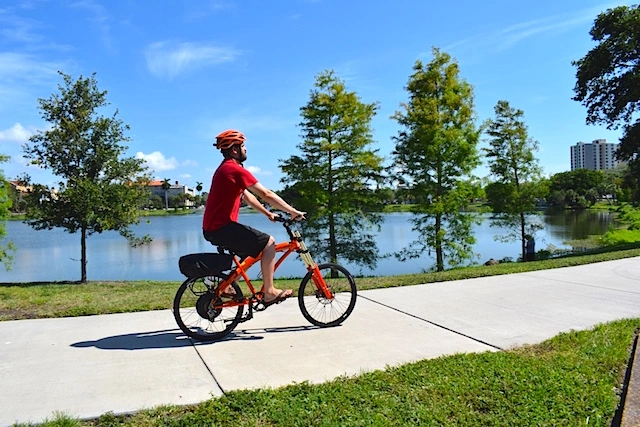
Coelho’s solution to his transportation dilemma isn’t wildly surprising at first glance: He purchased a bicycle.
What might be more unexpected? It’s an electric bike.
Many health- and eco-minded commuters will leave the car behind for the cheaper, non-polluting, easy-to-park bicycle. But Coelho is the first person I’ve encountered who opted for an electric bicycle.
To be honest, I hadn’t realized such a thing existed until now.
Why a throttle instead of good, old-fashioned leg power?
“It’s too far, and I’m not in shape,” Coelho admits.
But the choice goes beyond a simple dislike of daily exertion. “With the summer heat here (in Florida), I know I’m not going to be pedaling for five miles.”
“And I don’t want to take the truck, because it’s huge and polluting and costs money in gas, and (I have to find) parking,” he explains.
“An electric bike is basically the easiest way to get here.”
Fitting a battery-powered motor to the traditional bike lets Coelho enjoy the financial and environmental perks of cycling — without sweating through his clothes in Florida’s already oppressive 90-degree summer humidity.
And the bike beats a car in sheer convenience.
“When I just want to go to the donut shop, and I have the choice between driving the truck [and] cruising on the bike, it’s convenient to just hop on the bike and go,” he says.
He even hauls a small trailer behind the bike so he can take his daughters along for short rides.
How Much Can an Electric Bike Actually Save You?

Since he didn’t have a previous daily commute to compare, the bike’s effect on Coelho’s budget isn’t cut-and-dry.
Still, it’s clear he’s spending less than he would if he drove the truck or bought a second car.
Suppose he bought a second vehicle: an average car that gets 24 miles per gallon.
For a five-mile commute each way, at today’s $2.22 per gallonnational average gas price, he’s saving $18.50 per month on fuel alone.
If he avoided meters and parked a car in a nearby $3/day lot, that’s another $60 per month.
Even if he hunted down free parking, the relief would be psychological — bringing the bike into the office is way less of a chore than locating the ideal spot for a car.
He also didn’t have to buy insurance or register the bike like he would for a second vehicle.
To register a car purchased in Florida, he’d pay roughly $130 initially, then around $30 annually to renew.
He pays $95 per month to insure the truck and would expect about the same for another vehicle.
So, he stands to save up to $2,212 in his first year commuting with the electric bike.
And that total doesn’t include the price of buying a second car.
What’s the Price of an Electric Bike?
As you’d expect, an electric bike costs more than a plain bicycle — but it’s far less expensive than a car.
Coelho shelled out $2,000 up front for his used bike. He found new models priced between $3,000 and $7,000.
“I don’t think I’m getting a $7,000 bike,” he says firmly. “Even $3,000 for a bike sounds like a lot, but when I use it to replace my work vehicle,” it’s easier to justify, he notes.
On a tight budget after the cross-country move, the pre-owned bike matched his family’s finances.
“If I bought a car in that range, it would be a lousy car,” he says, “and, if I have a choice between a nice bike and a bad car, I’ll take the nice bike.”
The bike is also cheaper and simpler to maintain than a beat-up car would be.
In the nearly eight months he’s owned it, Coelho has spent about $640 on bike upkeep. The largest expense was a $500 replacement battery.
“If I could do it again,” he says, “I’d probably have gotten one with some kind of factory warranty,” which would have spared him that $500 hit.
Because electric bikes reach high speeds — Coelho’s can hit up to 28 miles per hour without pedaling — rough roads jolt the bike more than a conventional model. A factory warranty would have trimmed costs by covering typical maintenance this added stress brings, often for two years.
He’s also invested around $200 customizing the bike: a comfier seat, fenders to cut down on splatter in wet weather, and differently positioned handlebars.
If he sold the bike now, Coelho guesses he could fetch about $1,700.

And naturally, because the bike runs on electricity, he needs to charge it. He doesn’t notice any change in his home power bill from charging, but estimates it costs roughly $1–$2 per month.
What About Rainy Days?
A bicycle works great when the weather cooperates. And a pedal-optional electric bike is fine even during oppressive heat.
But what happens when it rains? It does that a lot in Florida.
“I’ve ridden in the rain, and I just bring my rain gear,” Coelho says.
“I figure I’ll ride during the summer and during the rain, and I’ll ride in everything. As long as I have the proper gear, there’s no reason not to,” he adds.
With roughly 248 sunny days per year, St. Petersburg makes an electric bike an appealing choice.
Even its 97 days with measurable precipitation are typically mild: It never snows, and most rainy days only see short downpours.
If you live somewhere that gets snow and freezing temps, you’ll likely face the same challenges on an electric bike as you would with a pedal bike. While Coelho benefits in the heat by not pedaling, you probably won’t see similar comfort in the cold.
In those circumstances, you might weatherproof your bike — and yourself — for winter use, or employ an older electric model as your winter bike.
Other Things to Think About Before Buying an Electric Bike
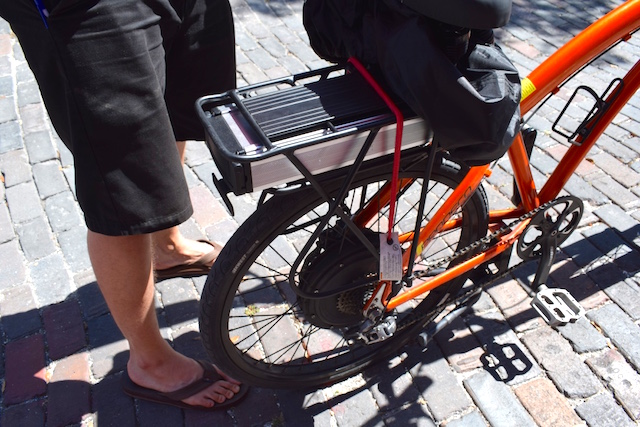
Coelho noted a few downsides to the bike.
While he prefers it to driving a car or a traditional bike, he pointed out, “A lot of electric bikes look like electric bikes, because you can see the battery, so they’re a higher theft target.”
You need a key to start the bike, but a determined thief could hot-wire it or sell it as-is, like any stolen vehicle.
Finally, the bike is battery-powered, so you must keep it charged. Is that troublesome?
Coelho says not at all.
A port on the battery’s side lets him charge the bike “just like plugging in a laptop.” He says some models require removing the battery to charge, which would be a little less convenient.
The battery should deliver between 15 and 25 miles per charge, so Coelho can make the round trip to work each day without worry.
Another perk of the electric bike over a car: If the battery dies or fails mid-ride, you’re not stranded — it still functions as a bicycle.
No need to call for a jump or pay for a tow. Just pedal!
Your Turn: Would you swap your car for an electric bike to save money?
Dana Sitar (@danasitar) is a staff writer at Savinly. She’s contributed to Huffington Post, Entrepreneur.com, Writer’s Digest and more, slipping in humor where it fits (and sometimes where it doesn’t).