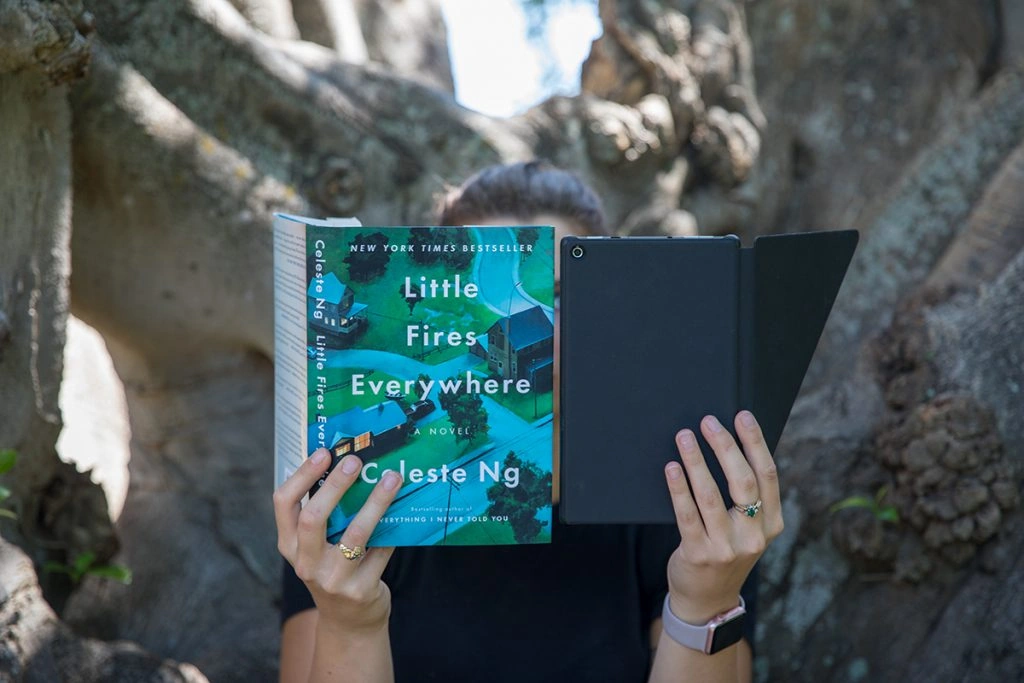
People always confuse my sister and me for twins. Some folks even swear we’re the same person. (I have so many tales.) But unlike most people, we notice a bunch of differences. One big distinction is our reading preferences. I’m devoted to tactile paper books with pages to flip and margins to scribble in, while she prefers e-readers that can store hundreds of titles.
During one of our many debates about e-books versus physical books, a thought occurred to me. We usually evaluate e-books by convenience, but what about cost?
Are physical books truly less expensive than e-books?
Fueled by a bit of sibling competition, I dove into digital bookstores and came away with a price comparison of e-books and print books to help you pick the smartest option for your budget and reading habits.
My Method
For this comparison, I examined 16 prominent online retailers and six widely read books.
For purchasing e-books, I checked Amazon’s Kindle store, Apple’s iBooks, Barnes & Noble’s NOOK store, Google Play Books and Kobo. For borrowing or free e-book access, I investigated OverDrive, Project Gutenberg and Hoopla.
There are many other places to buy e-books, of course, but when it comes to pricing, these tend to be among the most competitive.
For physical copies, I looked at Amazon, AbeBooks, Barnes & Noble, Alibris, Better World Books, Thriftbooks and Book Depository, and I also considered my local library’s offerings.
For each seller, I compared prices on six titles: “Ready Player One” by Ernest Cline, “Educated: A Memoir” by Tara Westover, “Little Fires Everywhere” by Celeste Ng, “The Sun and Her Flowers” by Rupi Kaur, “Fahrenheit 451” by Ray Bradbury and “Frankenstein” by Mary Shelley.
Along with spanning several genres, each selection appears on either the New York Times Best Sellers list or the Amazon Best Sellers list.
What I Found

Before diving into detailed price breakdowns, I’ll reveal the top-shelf winner: it’s a tie.
Overall, neither e-books nor physical books are universally less expensive. Out of the six books I checked, e-books were the cheapest three times, and print editions were the least expensive the other three times. I was a bit taken aback myself.
E-Books Show Price Uniformity
Here’s an interesting trend. E-book pricing tends to be steadier than print. The e-book market is fiercely competitive, especially because formats often aren’t interchangeable across devices (though some reports suggest it can be done).
For example, all five e-book retailers listed “Ready Player One” at $9.99, “Educated: A Memoir” at $12.99, “Little Fires Everywhere” at $13.99 and “Fahrenheit 451” at $11.99.
Print Prices Fluctuate
Physical book prices are much more variable. Not a single print-book vendor matched prices on the same title, and in several cases the differences reached about $5.
However, for the three titles where physical copies were cheaper, their costs were notably lower than the digital versions. For instance, “Little Fires Everywhere” sold for $13.99 as an e-book but was available for $7.96 (new with free shipping) as a paperback from Book Depository.
E-Books Can Offer Better Deals
This won’t surprise many readers: e-books eliminate shipping fees and avoid the roughly 8 percent added cost associated with producing a print book. Those savings often let e-book prices remain competitive, especially for new releases.
“Educated: A Memoir,” for instance, was $12.99 digitally but could cost twice as much for a new physical copy.
The same is true of public-domain works. While old print editions might start at a cent plus shipping for used copies, e-book platforms can offer those same works for free.
For “Frankenstein,” several e-book providers offered free editions, whereas the cheapest used physical copy I located was $3.98 with free delivery.
Watch for Hidden Print Costs
Used physical books can appear deceptively cheap online. Initially, they may look far less expensive than both new prints and e-books, but once you include shipping,used books can end up costing as much or more than brand-new copies.
That said, it’s not a universal rule—used books can still be bargains—so don’t dismiss them outright. Just shop carefully.
Remember Your Library
Libraries are often underrated. Yes, their newest titles might be limited or have long waitlists, but you’d be amazed at the treasures they hold.
And you don’t always need to visit a branch. Many library systems provide digital resources like Hoopla, Project Gutenberg and OverDrive. With Hoopla and a valid library card, you can borrow “The Sun and Her Flowers,” for instance, free for 21 days.
If you don’t already have one, get a library card!
Also Worth Mentioning…

You might wonder why I left out flea markets and thrift shops. The reason: their inventory and pricing swing so widely that it’s tough to generalize.
Instead, if you go the e-book path, check out treasure troves like the Kindle Owner’s Lending Library, Prime Reading, BookBub or Better World Books’ Bargain Bin. And for a related read, consider you paid for your digital media but do you own it.
Wherever you shop, hunt for bargain sections in the site, app or store.
Note: Like thrift-store digging, searching discount sections takes time and patience. The payoff is usually worth it, though.
The Bottom Line
Because the results tie, I can’t definitively state that print books are cheaper than e-books or the other way around. What you can do is choose the option that fits your reading habits best.
If your reading list consists mostly of very new releases or century-old public-domain titles, e-books are likely your best financial bet. New releases aren’t immediately available used, and public-domain works are often free digitally.
If you tend to read a mix of recent and moderately old books, physical copies may be more economical. With some diligence, you can find fantastic deals on used and discounted print titles. E-books are handy, sure, but with a little effort, print editions can be easier on your wallet.
If you’re an omnivorous reader who enjoys everything from vintage to contemporary, use both formats. Invest in an e-reader or e-reader apps and take advantage of the best deals from each world.
The decision is yours. Which path will you choose?