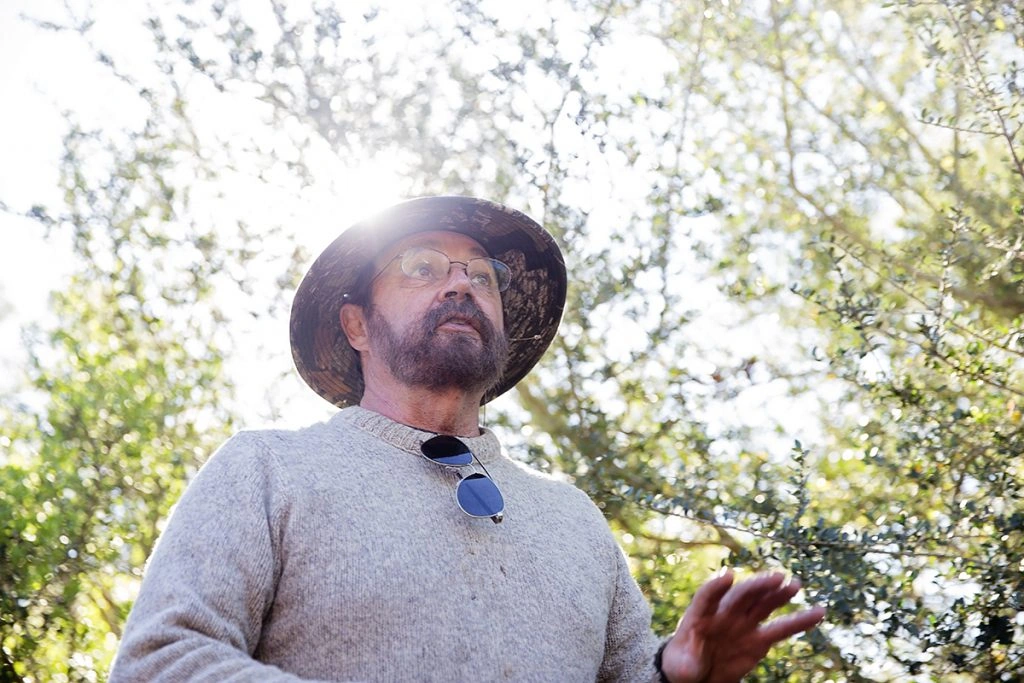
Where many people see mere weeds, Deane Jordan envisions a meal.
For more than a decade, Jordan — better known as “Green Deane” — has dedicated himself to showing people how to scout suburban yards and public parks for their next plate.
Without formal credentials, Jordan has risen to become one of the leading voices on foraging in the U.S., largely through his “Eat the Weeds (and other things, too)” website and YouTube videos, where he has amassed more than 53,000 followers.
“I’d call him an expert,” says Peggy Lantz, 82, a Florida Master Naturalist who co-authored the book “Florida’s Incredible Wild Edibles” and speaks on foraging. “He recognizes plants I don’t. I respect him.”
Jordan shares his wild-food knowledge online, at herbal gatherings and in weekend field classes in parks around Florida, driving his home state in a black Mazda Miata with the license plate “FORAGER.”
“Foraging personalizes pollution,” Jordan says. “It’s one thing to know railroad tracks are contaminated; it’s another to spot a fruit-laden tree near the tracks and realize you can’t eat the fruit because of years of heavy pollution.”
Perceiving Things Differently

On a bright Sunday in March, Jordan, 67, guides almost two dozen budding wild-food hunters, from youngsters to elders, through a park in Largo, Florida, highlighting edible plants and pointing out the poisonous ones to avoid.
His present work reconnects him with his upbringing in rural Maine, where he drank tea made from wild juniper berries and learned to forage by watching his mother and grandmother collect dandelion greens in the woods.
At about age 7 or 8, Jordan had a revelation: Why purchase raspberries at the store when you can pick them for free in the wild?
“Food is all around us,” Jordan says. “My role is to help you recognize it.”
Foraging, inherently, demands patience, endurance and careful observation, and Jordan demonstrates all three throughout the more-than-four-hour sessions he leads.
That day he hasn’t eaten for over 20 hours, yet he shows no weariness as he shepherds the group around the park south of Clearwater, frequently reaching for a twig or crouching to dig up a plant and offer students a sample.
He keeps fit by cycling up to 120 miles a week, generally on three fast days he observes — he says for weight control and other health perks — lifting weights and walking roughly eight miles weekly.
Jordan follows his own counsel. He aims to consume something wild every day and limits most carbs, though he confesses to sometimes breaking a fast with a Starbucks brownie.
Bryan Detweiler has attended Green Deane’s outings for four years. He commends Jordan’s humor, storytelling and depth of knowledge about the history and uses of the plants they find.
“I pick up a ton of new things every time I take the class,” says Detweiler, 48, who lives on a 25-foot sailboat in Sarasota Bay and forages greens for salads. “He’s simply fascinating.”
Returning to His Beginnings

After a tough run through high school, disengaged, Jordan graduated near the bottom of his class in 1969. Told he was no longer welcome at home, he joined the Army and was posted first to Colorado and then to Japan, where he played bass and tuba in a military band.
He completed his service in 1972, and three years later earned a bachelor’s degree in music education, summa cum laude, from what is now the University of Southern Maine, where he was part of Mensa International, a society for people with high IQs.
Tired of icy New England winters, Jordan relocated to Central Florida in 1977 after visiting an uncle on the Space Coast. He now resides in an Orlando suburb with his cats, Oliver “Ollie” Whitecat and Couscous.
Along the route to becoming a foraging authority, Jordan did graduate work in communications at the University of Central Florida, performed as a bassist and singer in a big band, worked as a newspaper reporter covering crime and courts, was accepted to law school (though he never enrolled) and later moved into corporate writing.
In 2006, Jordan was let go from a job he found ethically troubling: crafting sales presentations.
The loss hit him hard financially — he lost his home and savings — but it liberated him to chase his childhood passion and align his life with his values. He had already sharpened his skills in the early 1990s studying with the late Dick Deuerling, Lantz’s co-author on “Florida’s Incredible Wild Edibles.”
Soon after the layoff, he began leading foraging tours full time.
“I’d been pushed out of the rat race, decided not to return, and treated it like an opening,” Jordan says. “For me, that turned into writing and teaching about edible wild plants.”
Paving His Own Way

The self-described introvert’s office is now the outdoors, and his work attire is blue jeans and a T-shirt or sweatshirt, weather permitting. He opens his classes with a short autobiographical routine, calling himself “an accidental bachelor,” and peppers lessons with jokes and anecdotes about plants and his life.
“My mother was a terrible cook, so I learned to cook to survive. She thought I was a Greek god; every dinner was a burnt sacrifice,” Jordan jokes as he warns students to boil pokeweed leaves twice before eating to prevent poisoning.
On the walk, he rattles off a list of people and things he dislikes: botanists, Latin instructors and daylight saving time, which he opts not to observe. He also refuses to text or talk on the phone.
“I march to a different drum,” he says.
His crowd doesn’t seem to mind. They’re busy absorbing information when Jordan switches to professorial mode, identifying so many edible species that novice foragers begin to blur the differences after a few hours.
There’s the yaupon holly, its leaves packed with caffeine and antioxidants. Nearby is the Eastern redbud, whose pink blossoms can be baked into muffins (a recipe is on eattheweeds.com) and whose pea-like pods may turn bitter with age — “just like people, just like me,” he quips.
“This tree smells like your grandmother — or maybe your great-grandmother,” he says of a camphor tree, an invasive species the group encounters in the woods.
Foraging Across the Country
Native peoples gathered plants for food, medicine and shelter. In recent years, the practice has also infiltrated trendy restaurants in cities like New York, Baltimore and Austin, Texas, where seaweed, wild mushrooms and pine needles share dining space with halibut, asparagus and shoestring potatoes.
At the famed Chez Panisse in Berkeley, California, patrons may pay up to $125 for dishes that include wild nettle soup with thyme or grilled black sea bass with wild fennel purée.
The late wild-food proponent Euell Gibbons, author of “Stalking the Wild Asparagus” and a Grape-Nuts pitchman, brought foraging to public attention in the 1960s and 1970s.
Although not universally mainstream, it has enjoyed a revival among enthusiasts from Portland, Maine, to Santa Monica, California, and in cities including Philadelphia, London and Toronto.
People drawn to foraging often are survivalists, distrust the industrial food chain or simply want to feel more connected to the land, Jordan and other specialists say.
“It pairs well with reconnecting to nature,” says Robert Kluson, an agriculture and natural-resources extension agent with the University of Florida’s Institute of Food and Agricultural Sciences in Sarasota County, Florida.
Affection for the Earth

Jordan makes a modest living, charging $30 for a four-hour trek. Still, he’ll sometimes give a free spot to someone in need and linger afterward to answer questions or pose for photos with admirers. His DVDs sell for $15, but he posts videos for free on his site and YouTube, where he has a global audience.
“I don’t earn a fortune, but I sleep well,” he says. “Work should carry a moral dimension.”
Grateful fans are supporting him via a GoFundMe page he set up to improve his website and write a book.
“The information you provide, gratis, and the time you spend sharing it, is priceless,” one donor writes. “Thank you for your devotion, education, and willingness to share!”
“I’ve loved your articles and videos for years and your classes were fantastic,” writes another. “I wish I could give more. Thank you!”
The praise points to a form of success not measured by paychecks or titles. For Jordan, spreading his passion for nature and teaching people to harvest genuine food from their neighborhoods is a richer reward than an office with a corner window.
“I can walk the same trail I did 60 years ago and find wild raspberries growing in the very spot,” he says. “No doubt, Native Americans felt a similar bond to the land they inhabited for millennia. It’s an old companion. There’s psychological solace in attaching yourself to something steadier than people.”
Jordan also recommends practical ways to preserve your harvest, including freezing vegetables and fruits for later use.
Elena Martin is an editor at Savinly.