That is, until something goes wrong.
Shifting gears feels a little off, you know? Or a tire goes flat out of the blue.
It’s tempting to stash the bike in the garage and wish it would repair itself. Sitting through YouTube tutorials and trying to decode DIY fixes is tougher.
Bike shops can work miracles on your once-reliable ride, but their fees can be steep. A routine tune-up can cost between $50 and $150. Private mechanic lessons can teach you how to do fixes on your own later, but they often run $65 or more per hour.
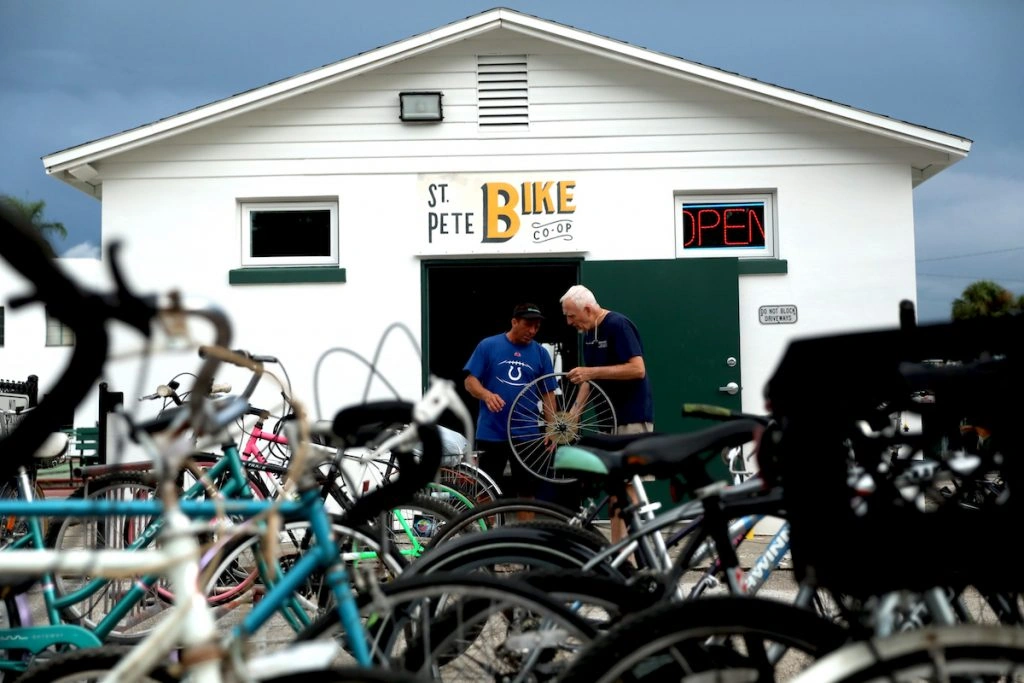
The St. Petersburg Bike Co-Op provides bike education and budget-friendly maintenance options in St. Petersburg, Florida. The nonprofit operates out of an old storage facility owned by the City of St. Petersburg and is staffed by volunteers who open the space a couple of evenings each week.
Members contribute $40 to $100 annually on a pay-what-you-can scale, but anyone can drop in once and pay a $5 to $10 fee to use the shop and its equipment.
Similar co-ops are found nationwide — in cities, suburbs and college towns.
While a big advantage is access to experienced mechanics who will answer questions and coach you through repairs, the real benefit for annual members is the tool access. You use them, tidy up afterward and ride off into the sunset. If you need a component, there’s likely a used spare tucked away that you can buy at a steep discount.
We stopped by to see what a co-op night looks like.
–

No one greets each other with handshakes at the St. Petersburg Bike Co-op. There’s too much grease, too much sweat. And everyone’s holding something — an oily rag, a wrench or an entire wheel. The co-op opens for just five hours a week. The evening flies by.
–
The co-op launched with a fundraiser in 2013 that raised $1,000 to purchase its first set of tools. Local bike shops donate used parts that might get another life. Sometimes folks show up carrying boxes of bike components.
“A lot of these bikes would otherwise end up in a dumpster or the landfill,” founder and president Carrie Waite says, surveying a mismatched lineup of vintage and modern bikes rolled out of the shed for co-op night. “It’s rewarding to repurpose them and give them new life.”
–
Christy Foust, a St. Petersburg resident, commutes by bike around town and plans to take it on a cross-Canada trip in a few months. She’s been dropping by the co-op over spring and summer to get ready, tuning up her nearly 40-year-old bike with help from volunteer mechanics like Daniel Mrgan, vice president and another co-op founder.

Mrgan says tales like Foust’s are common at the co-op. “People decide they want to get fit or they plan a special ride,” he explains.
He remembered two young women who had commandeered their fathers’ old bikes and intended to ride across the country together before moving away for new jobs. “When they told me this,” Mrgan smiles and shakes his head, “I thought they were hopeless.” But within a couple of months, they were on their way.
–
Leader and volunteer mechanic Chris Sheppard lights up recalling a father-daughter pair who stopped by before the daughter headed to college. Her bike needed a safety check; his needed a flat repaired.
Sheppard guided her through the repair steps, quizzing her on different tools and preparing her for the kinds of fixes she might need to make while at school.
“They both left smiling,” Sheppard said. “She left far more confident” and with one less worry as she left for college.
–
“The kids are the best. They get really invested,” Waite says as she watches Sebastian Blanquet, son of longtime volunteer Sal, assist volunteer Jessica Jacobs in installing a set of pedals. “The do-it-yourself ethos really speaks to them.”
–

Sheppard talks with Gregory Nista, walking him through the process of truing, or straightening, his bike wheel.
“Getting the wheels true can be a puzzle,” Sheppard says as he slowly spins the wheel toward him, bending slightly and squinting to spot any misalignment.
Meanwhile, Nista readies the next step, darting around the shed to fetch tools and a tube to put into his tire.
Sheppard notes that wheels and tires typically need the most attention, since they carry the rider’s weight and face road hazards. But working on a bike is gratifying, he says. “It exercises your mind,” Sheppard nods. “It helps you become self-reliant.”

Nista understands the importance of self-reliance. He calls himself “upper homeless,” a transient who depends on his bike to travel to temporary jobs from the PeopleReady staffing office a few miles away.
“My bike is everything,” Nista says. “I ride it everywhere.” He’s pedaled to Tallahassee and back multiple times, taking a roughly 350-mile route through several Florida towns. “I can save some money and hit the road,” he says — as long as his bike is working.
For locals curious about community resources and urban living, see love living st pete for more neighborhood perspective and related features.
Heather Comparetto (IG: heatheretto) is a photographer at Savinly. She’s shown her work internationally, adores the ocean, and enjoys coffee and tacos (though not together).