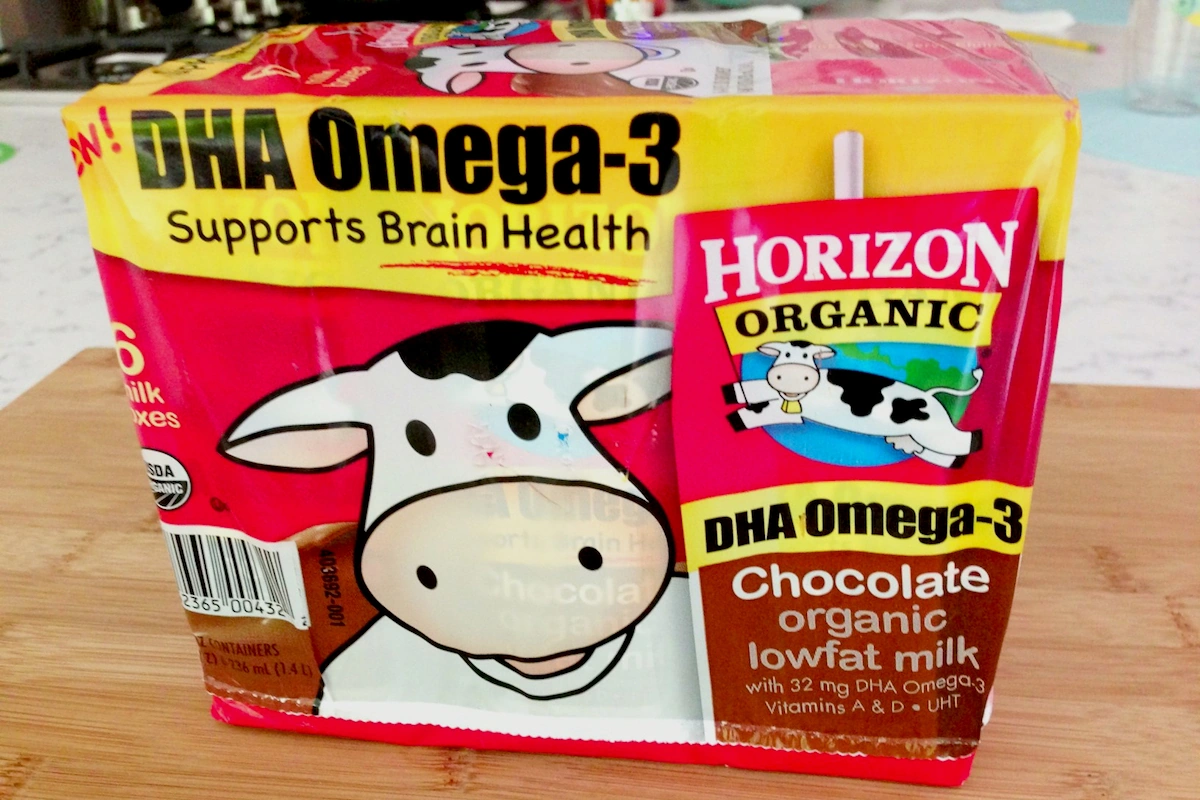
You’ve likely noticed the large black type on a gold ribbon across the red cartons of Horizon organic milk declaring: “DHA OMEGA-3 Supports Brain Health.”
I don’t know about you, but I’m keen on keeping my brain cells in good shape. So when the specialty milk costs roughly 30 cents more than the standard organic variety — which itself can be about twice the price of conventional milk in some cases — I can see the appeal.
And clearly, many of you agree. Horizon’s organic milk fortified with DHA pulled in roughly $250 million in sales, representing about 14% of all organic milk purchased, per The Washington Post.
But have you ever wondered why this milk is pitched as being so much better for your brain than a typical half-gallon of organic milk?
You might have assumed that a subset of Horizon’s organic dairies use some unique, natural farming method to boost DHA. Or perhaps you accepted that there are enhancements but believed those extras were organic as well.
Either way, that would be a mistaken assumption.
USDA Allows Non‑Organic Additives in Products Labeled “Organic”
The ingredient that’s touted as improving brain health is actually a manufactured oil with a mild fishlike flavor. It’s produced in large industrial steel fermenters reaching several stories high from an algae called Schizochytrium, which grows off the Southern California coast.
According to The Washington Post, the U.S. Department of Agriculture has largely allowed Horizon and other brands to put the “USDA Organic” emblem on cartons even though they use this industrially made oil, and this practice has been tolerated for at least ten years.
Understandably, Horizon and similar companies probably welcome this, but consumer advocates argue that items containing synthetic or factory-derived ingredients shouldn’t carry an organic label.
“We don’t believe that [the oil] belongs in organic foods,” Charlotte Vallaeys, senior policy analyst at Consumer Reports, told The Washington Post. “When an organic milk carton says it contains higher levels of beneficial nutrients, like omega-3 fats, consumers expect that to come from responsible farming practices … not from additives manufactured in a plant.”
This is a significant point of contention because the “USDA Organic” badge frequently commands a notable price premium.
For the moment, the USDA appears to be leaning toward the manufacturers rather than the consumer advocates when defining what qualifies as organic. That leaves it to you to decide whether the added expense for organic Horizon milk — and similar organic-labeled goods — is justified.
Maya Ortega is a staff reporter at Savinly. She’s started to rethink whether paying more for organic groceries is truly worthwhile.