We’re fascinated by this long-standing question: Is it a good idea to give kids an allowance?
It’s a significant dilemma and one that can feel odd for many parents to confront.
Does an allowance teach youngsters about finances, or does it pamper them by rewarding behavior they ought to do anyway?
Parents hold a range of views on the topic, and there’s no single correct response for everyone. Still, we enjoy hashing it out!
Should Children Receive an Allowance? Did You Get One?
We polled Savinly staff about their childhood experiences — and how they view those choices years on.
And, perhaps most importantly: What did you have to do to earn it?
Here’s what we shared:
Kyle, Founder and Owner
My sisters and I had a modest allowance until we turned 14, after which we were expected to find jobs.
It was probably around $5 a week, but we could earn extra through what we called the “quarter challenge.”
Each month we started with an equal jar of quarters. If we neglected to tidy our room one day or missed a chore, Mom would take a quarter from our jar.
The child with the most quarters at month’s end received a $25 savings bond.
Sarah, Executive Assistant to the CEO
I didn’t get a weekly allowance, but I was rewarded for grades.
Beginning in middle school, I received $50 for every A on my report card.
In high school, my parents got even more generous. Along with the $50 per A, they also put $500 toward a car, which they saved until I was ready to buy one.
Jamie, Junior Writer
My parents paid me an amount I’ll keep to myself (you might judge me) for every A on my transcript.
I’d like to think I would’ve been a straight-A student regardless, but that extra incentive probably helped shape my strong drive for goals.
Kathleen, Editor
I received a small weekly stipend for wiping down the kitchen table and putting away clean dishes.
I don’t recall doing it for long, likely because I picked up jobs at my elementary school (a “waitress” role during weekly bingo nights) and in the church office (selling scrip — think gift certificates) before landing my first high school job.
Susan, Senior Writer
I didn’t get a regular allowance growing up.
Chores and earning good grades were expected parts of living under our roof, though I could take on extra gigs for cash.
I sold items at a farmers market in elementary school, began babysitting at 12 and got my first real job at an ice cream shop at 14.
If I have children, I’d probably take a similar approach.
Working outside the home taught me valuable lessons: the worth of money, time management and the importance of hard work.
Matt, Assistant Editor
My brother and I received $5 per week for taking out the trash, sorting recycling and thoroughly cleaning our rooms and bathroom every Saturday — dusting, vacuuming, etc.
It might sound a bit generous, but it wasn’t just shoving dirty clothes into a closet and arranging the pillows.
Kids deserve an allowance. Mine will get one.
Think about it: Do you really want to do all that while they enjoy themselves? No chance.
Also, they’ll soon tire of the constant upkeep and actually keep things tidy. It teaches them about earning money, being organized and the value of effort.
Heather C., Visual Editor
I simply pilfered cash from my parents.
True story. Probably not the best example here.
Alexis, Executive Editor
I don’t recall receiving an allowance.
I think my parents felt household chores were obligations — not tasks to be paid for.
They encouraged us to take on small jobs here and there for spending money, so that’s how I got mine. I did a lot of babysitting (we had to save half of what we earned) and my brother mowed many lawns in the neighborhood.
My sister and I also ran a makeshift “summer camp” for neighborhood kids — basically group outdoor babysitting so parents could get a break.
Erin, Bookkeeper/HR Specialist
Our daughters (8 and 4) don’t receive an allowance right now.
I do want them to, but I feel they need to have some respect for money first — and our 8-year-old isn’t there yet.
We were lax in teaching her financial responsibility. She’s slowly grasping that money isn’t unlimited, but not quite ready for me to hand over cash on a weekly basis.
There’s a lot of discussion involved!
Dana, Staff Writer
My sister and I were paid $3 a week each for a few years.
We rotated chores weekly: either wash dishes every night or handle laundry and a few miscellaneous cleaning tasks for the week.
After a while, my mom stopped the allowance, reasoning we’d skip the chores if there wasn’t money on the line.
Being kids, making money wasn’t high on our priority list.
She decided we needed to understand that helping at home was something expected, regardless of monetary incentive.
By the time I needed spending money, I began babysitting.
Heather v., Senior Editor
My sister and I didn’t receive allowances or pay for chores.
My parents’ view was that as family members, we should contribute in age-appropriate ways, like setting the table as little ones or washing dishes as we matured.
I recall many money conversations — comparing deals, sales and which brand or size offered the best value.
We also did odd jobs, and I got a paper route at 11. My sister and I pooled the earnings to save for our grade 7 exchange trip to Quebec.
Vishal, Director of Business Development
I did receive an allowance: $5 a month starting at age 8.
I earned it by doing chores: taking out trash, helping my mom with groceries (mostly carrying them in), feeding the cat and being polite to my sister.
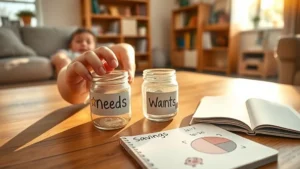
For every allowance and other cash gifts, I had to donate one-third to charity, save one-third and spend the final third as I pleased (usually on candy).
The memory stands out because I planned candy buys based on that one-third. Since I treasured the treats, I’d bring them to school as an after-lunch snack.
Before long, I discovered candy had a different value on the playground, and I became the candy supplier for my third- through fifth-grade classes.
Hadley, Account Manager
Growing up, I received $20 a week as long as I did everything my mother asked.
Tasks included dusting all surfaces in my room, walking our two dogs after school, sorting laundry into my basket, doing homework right after school and before soccer practice, cleaning my dishes, and doing odd yard or household jobs.
If I behaved — which I was pretty good at as a kid — she might tack on an extra $10 or $20.
Ellen, Advertising Operations Manager
I didn’t get an allowance when I was young.
Nearly all my friends did, and I remember being pretty envious.
Legend has it I devised a daring scheme at age 6 to offset the lack of parental payouts.
I’m the youngest of four with a very sentimental mother who saved everything, including our baby teeth. I figured, “If my parents won’t pay, maybe the Tooth Fairy will.”
I raided Mom’s collection and stuffed my pillow with all the teeth, hoping for a hefty Tooth Fairy reward.
It went unnoticed for a week until Mom found the grisly stash while changing the sheets.
If and when I have kids, I’ll definitely give them an allowance. They’ll also get bonuses for particularly imaginative or oddball problem-solving.
Also, I will not keep their baby teeth.
Your Turn: Did you get an allowance growing up? What did it teach you — and does it influence whether you’ll give your children an allowance?
Dana S. (@danasitar) is a staff writer at Savinly. She’s contributed to HuffPost, Entrepreneur and Writer’s Digest, among others, and is currently looking for someone willing to pay her to clean her room as an adult.