“It’s 200 million years old,” he told me on the phone. “It’s as healthy and stable as you could hope for.”
Then he mentioned the cost: about $1.43 per ounce.
“What do you charge for regular salt?” I asked.
I heard him rummage around the shop for a moment. “We don’t really stock that here,” he said, hunting for the price tag on a box of kosher salt he keeps “just in case someone actually wants it.”
I can’t blame him for not carrying “regular salt”: Schaefer works at Savory Spice, a specialty franchise in downtown St. Petersburg that sells roughly nine different salts. He’s also a senior at Northeast High School’s Culinary Academy.
He knows his way around a kitchen. Me? Not so much.
I recently found myself flummoxed in the grocery store’s salt aisle trying to sort out the differences between iodized salt, kosher salt, table salt and the half-dozen varieties with that raincoat girl on the label.
Aren’t they all basically the same? What’s best for everyday cooking? Which salt gets me the most value?
That was all I wanted. One straightforward answer.
Turns out, it’s not that simple.
Table Salt: What’s It Best For?

Short answer: pretty much everything.
Let’s jump in backwards and begin with dessert. For baking, ordinary table salt (iodized or not) is all you need. Table salt is about 97% pure, contains an anti-caking agent and dissolves predictably into whatever batter or dough you’re whipping up.
Iodized salt is fine, but don’t lose sleep over it. The habit of iodizing salt dates back to the 1920s, but our diets are more varied now than during the Dust Bowl era. If you eat a range of foods and take a multivitamin, you likely don’t need iodized salt. (As always, check with your doctor if you have concerns.)
Otherwise, if table salt is all you’ve got in the pantry, you’re covered for most everyday cooking.
“If you’re not a foodie, you’re really not missing out on much,” Schaefer said.
Cost: About 5.7 cents per ounce — or even less. Walmart lists Morton’s Iodized Salt at roughly $1.48 per canister, while Amazon Fresh has an incredibly low price of $0.89 for the same 26-ounce container, which works out to about 3 cents per ounce.
When to buy it: Right away. Keep table salt in the kitchen at all times. It won’t let you down.
Kosher Salt: Not Really About Religion

Nowadays, “kosher salt” is more of a traditional label than a religious indicator. Since salt is a mineral, pure salt is inherently kosher.
Quick history note: The phrase “kosher salt” actually stems from “koshering salt,” used historically to draw blood from meat after slaughter. Finer table salt would just be absorbed, so this coarser salt was preferred and became known as “kosher salt.”
Some kosher salt packages display a kosher symbol if a kosher certification group verifies that nothing else is mixed into the salt.
Kosher salt is handy when you need an amount you learned from grandma but can’t quite measure: a pinch, a dash, “just sprinkle some and taste.”
But your grandma, with all her approximate measuring, might have a point: food blog The Kitchn points out that kosher salt grain size and shape can differ by brand, so it’s tricky to get exact measurements.
“Since salts can be in such varying shapes, weight is the best determination,” Christine Gallary writes. “However, most recipes don’t call for a weight of salt, just volume, and most homes don’t have kitchen scales that are capable of weighing out such small amounts anyway.”
When working with larger, flakier salts, add a little at a time. Taste as you go and don’t obsess over precise measurements.
Cost: About 5.4 cents per ounce.
When to buy it: If you like to tinker with recipes, or you enjoy sprinkling visible grains of salt on a finished plate. Also handy for rimming margarita glasses.
Sea Salt: Literally From the Ocean

Sea salt, as you might expect, is harvested from the ocean — its crystals form in shallow seawater ponds rather than being extracted from mines. It’s available in coarse or fine grains, but the coarse kind is most often used as a visible finishing sprinkle on prepared foods.
Sea salt tends to have a pronounced flavor and is frequently highlighted on items like chocolate, potato chips, or even some ice cream varieties.
Fun fact: Sea salt might also be labeled “bay salt” or “solar salt.”
Cost: Around 8 to 10 cents per ounce. You can find sea salt in 26-ounce containers at the supermarket or in smaller grinders. “Fleur de Sel” is arguably the gold standard of finishing sea salts, but it’ll set you back about $3 per ounce. It’s typically used at the end of cooking.
When to buy it: If you’re a salt enthusiast and want to enhance your recipes.
Finishing Salts: Use Them As Directed

Finishing salts do exactly what their name implies: they add a final burst of flavor to a dish. They also bring visual flair.
Schaefer points to black Hawaiian salt, which acquires its dark hue by interacting with clay in the sand. You wouldn’t want to throw it in mid-cook because the black color will spread through the pan. Instead, sprinkle it just before serving — for example, atop an alfredo where the dark flecks will pop.
Cost: About $1.90 per ounce for black Hawaiian salt. Prices differ based on rarity and how difficult a salt is to harvest. Persian blue salt, rare and striking, runs about $3.50 per ounce.
When to buy it: If you’re feeling bold and spot a variety that intrigues you, or if you want your plates to look like something from the Food Network.
Pink Himalayan Salt: Exotic, Yet Accessible

Iron oxide gives pink Himalayan salt, mined in Pakistan, its signature rosy tint. This salt is said to contain slightly less sodium than table salt and trace amounts of minerals like calcium and magnesium.
Pink Himalayan salt is also credited with wellness benefits, so if you haven’t seen pink salt in a grocery store you may have encountered it at natural-health or home-decor shops. Experts are doubtful about the health claims of salt lamps, though enthusiasts may try to persuade you otherwise.
But for cooking, Schaefer insists you should try this salt.
“It’s all we use at home,” he says. “And we’ve noticed we use less of it than normal because it tastes saltier.”
Cost: Between 35 cents and $1 per ounce. Its popularity makes pink Himalayan salt widely available and competitively priced, though it’s still a bit of a treat.
When to buy it: When you want to sample something trendy and follow foodie fashions.
The Bottom Line on Picking Salt
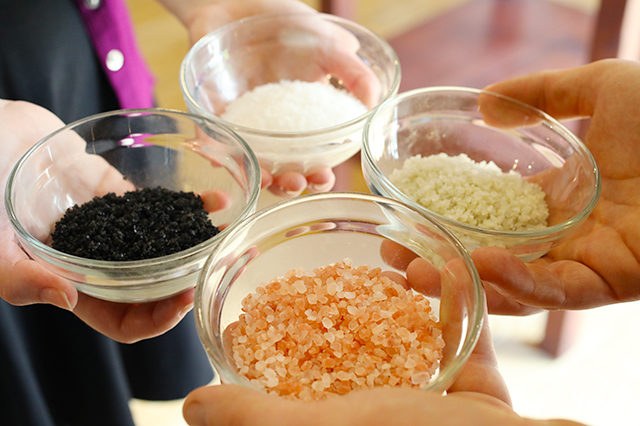
Keep a multipurpose table salt in your cupboard, and pick up kosher salt if you want a coarser option available.
After that, play around based on your preferences.
“If you really enjoy food and experimenting with flavors, it’s practically necessary to try various salts,” Schaefer says. “The differences are subtle, but you definitely notice how things taste.”
If there’s a specialty spice shop near you, consider popping in and asking questions. Specialty stores usually carry more options and offer smaller quantities of those salts.
You won’t be forced to buy bulk if you only need a teaspoon or two for a recipe — you can pick up a two- or four-ounce sample to test.
Your turn: Have you ever treated yourself to specialty salts for the kitchen? Which variety did you prefer?
Disclosure: Cheers to the affiliate links in this piece. (Yes, we’re toasting with a margarita rimmed in salt.)