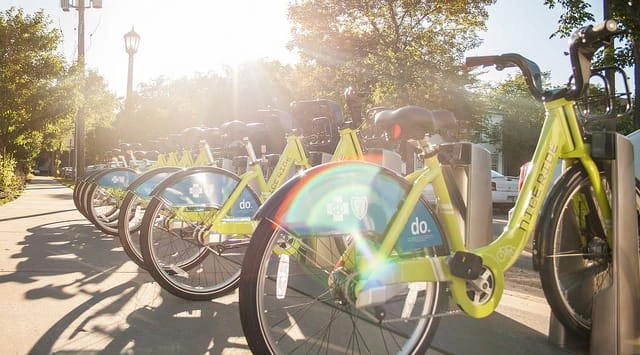
Bike-share systems have sprung up across the nation, from New York City to Madison, Wisconsin. The concept is to nudge people toward bicycling instead of other transport modes, especially for brief trips.
Generally, you sign up with a credit card and then simply check out a bicycle from any station in your city. When you finish riding, return the bike to a designated dock, lock it, and walk away.
They certainly seem handy, but can bike-share programs actually save you money? We looked at four different services to understand how the costs stack up.
B-Cycle (Madison, Wisconsin)
If you walk up to one of Madison’s B-Cycle racks without registering, you’ll pay $3 for the first 30 minutes and $3 for each additional 30-minute block.
Or, you can join as a member and get unlimited 30-minute rides for $5 a day, $7.99 a month, or $65 a year.If your trips exceed 30 minutes, an extra $3 is charged per 30-minute interval. The daily cap is $75.
Is It Worth It?
If you take frequent short rides (under 30 minutes), the annual membership probably offers the best value. You can ride as often as you like for a year for less than half the cost of buying a basic bicycle.
If you plan to do a lot of long-distance cycling, it’s financially smarter to skip this program and buy your own dependable bike.
And if you know Wisconsin weather, you’re likely thinking about winter. If you only want to ride in the warm months,consider a four-month membership for roughly $32.
This service gives a bonus some riders might appreciate: because it logs GPS and other data, your account shows an estimate of calories burned on your trip.
One rider found the bikes practical for occasional commuting but experienced a few hiccups, such as system glitches. Still, he reported the bicycles were well maintained.
B-Cycle (Nashville, Tennessee)
Nashville’s B-Cycle is comparable to Madison’s but uses a different pricing setup.
You must buy a membership to use this system, but a 24-hour pass costs only $5. A week-long pass is $10, a month is $15, and an annual membership is $50.
With membership, the first 60 minutes of every ride are free. If you go longer, the next 30 minutes costs $1.50, up to a daily maximum of $45.
Is It Worth It?
If you frequently take rides under 60 minutes, the yearly membership is likely your best option. It would take two or three years of membership fees to equal the cost of a basic new bike.
Citi Bike (New York City)
Everything tends to be pricier in New York City. (To illustrate, if you earn $50,000 in Nashville, you’d need to make over $123,000 for a similar lifestyle in Manhattan.) Bike-sharing costs follow the same pattern.
Citi Bike offers several membership choices, including an annual pass for $149 (which gives unlimited 45-minute trips) plus shorter-term options.
The 24-hour pass is $9.95 and the seven-day pass is $25. During those memberships, you get unlimited 30-minute rides.
The system encourages shorter trips and discourages long ones, charging up to $12 per 30-minute block for short-term members who ride beyond 90 minutes.
For short-term members, rides of 30–60 minutes cost $4, trips of 60–90 minutes cost $9, and it’s $12 for each 30-minute period after that.
Annual members are charged $2.50 for rides between 45–75 minutes, $9 for 75–105 minutes, and $9 per 30-minute period thereafter.
Is It Worth It?
Many people think so. Crain’s reports that New Yorkers and tourists take about 34,000 Citi Bike trips daily.
One New Yorker, who initially hesitated to buy a Citi Bike membership, quickly realized it paid off.
In just 17 days he took 42 trips on the bikes. If he had bought a single subway or local bus fare for each of those rides, he would have paid $115.50!

The cheapest subway or local bus trip in New York City costs $2.75. A seven-day unlimited MetroCard is $31 and a 30-day unlimited is $116.50. You could buy nearly a yearof Citi Bike membership for about the price of one month’s MetroCard.
(Again, you’ll want to think about how winter affects your inclination to cycle.)
DecoBike (San Diego, California)
With nice weather most of the year, San Diego is an ideal place to ride. DecoBike partners with the city and has 1,800 bikes around town.
The plan offers standard memberships with unlimited 30-minute rides for $99–$125 per year or $20 per month (three-month minimum). Deluxe memberships give unlimited 60-minute rides for $199 a year or $30 a month (three-month minimum).
You can also get unlimited 30-minute rides for $35 a week or $50 for a month. Hourly rentals are $5 per 30 minutes, $7 for an hour, or $12 for two hours. Each extra 30-minute period costs $5.
Is It Worth It?
With this offering, an annual membership is roughly on par with buying a comparable bike. If you ride often, purchasing your own bike may be the smarter financial move, while occasional riders may prefer the convenience of bike-share.
Critics say the program competes with local rental shops and that some docks aren’t positioned optimally for commuters. But the program is still young, so it may iron out those issues over time.
Will Bike Sharing Save You Money?
If you want an occasional ride, any of these bike-share options are a great way to exercise and enjoy the outdoors. When visiting a city, using a bike to get around is also an affordable and fun choice.
However, if you’re commuting daily by bike, owning your own usually makes more sense for dependability (you’ll always have access) and cost.
You can buy a basic new cruiser for about $130. Craigslist and garage sales are good places to find used bikes — just ensure they’ve been serviced and are in safe condition before riding.
Your Turn: Would you give one of these bike-share services a try?
Disclosure: We have a serious Taco Bell habit around here. Affiliate links in this article help us fund the dollar menu. Thanks for the support!