We’ve all heard that proclamation of indignation so often it’s practically a trope.
It typically comes from an irate parent, an elderly customer or a time-rich twentysomething after a store fails to provide a changing station, declines to honor an expired voucher or doesn’t hire their acquaintance.
We prize our ability to lodge grievances with businesses so highly that entire platforms and sites exist solely for airing them.
But the act of complaining as a customer didn’t begin with review sites or passive-aggressive social posts.
In fact, customer gripes are seemingly almost as ancient as writing itself.
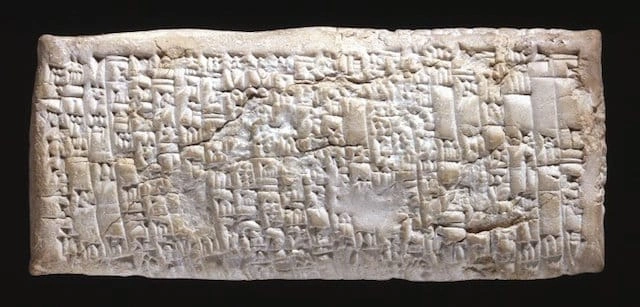
The British Museum exhibits theearliest known written complaint — etched on a clay tablet in Mesopotamia nearly 4,000 years ago.
The Earliest Recorded Written Complaint
A man called Nanni penned the message around 1750 B.C. after receiving inferior copper ingots from a trader named Ea-nasir.
Take a moment to dig up that seventh-grade history memory.
And since I checked Wikipedia for context, here’s a quick refresher: copper ingots are blocks of copper ore. Nanni would have been buying raw material for craftsmen of his day to fashion tools, cookware and other artifacts you see in museums.
Ea-nasir had guaranteed top-quality copper, but when Nanni’s servant turned up with payment, he judged the metal “not good.”
Rather than fixing the issue with an apology or offering a free supply on a future delivery, Ea-nasir brusquely told the servant, “If you want to take them, take them; if you do not want to take them, go away!”
The poor treatment enraged Nanni so much he produced this tablet, carved with adetailed complaint.
What do you take me for, that you show someone like me such contempt?
Consider the human effort behind issuing this grievance!
Someone like Nanni wouldn’t be scratching out the characters himself. So at minimum one scribe was needed to inscribe the tablet.
That scribe had to be literate, which was rare in Mesopotamia. He also needed a clay tablet, which weren’t wildly scarce but certainly not items you grabbed at a neighborhood shop.
It’s likely someone tried to dissuade Nanni from squandering resources and labor. But he was simply fuming.
Nanni dictated, a scribe wrote — covering both the front and back, incidentally. Then someone had to deliver it.
This isn’t a monumental stone tablet by any means. It measures about 4.6 inches tall and roughly 2 inches wide. Think of a thick phone plastered with cuneiform script.
But it still demanded at least one person, perhaps a horse and maybe a small cart for transportation. I picture a rider in a cart making last-minute scratches on the tablet en route, not watching the path ahead.
That adds up to at least three people and a horse to bring this message to the merchant. And there’s no record of a reply from Ea-nasir.
That should help you keep perspective next time your go-to café’s review page takes a few extra seconds to load.
You can take comfort in knowing you’re in good company: dissatisfied customers’ grievances have been ignored by the likes of Big Copper for thousands of years.
Your Turn: Have you ever sent a written complaint about customer service?
Dana Singh is a staff writer at Savinly. She’s contributed to HuffPost, Entrepreneur and other outlets, aiming for humor whenever possible (and occasionally where it isn’t).