- What Is the FAFSA and Why Should I Fill it Out?
- New FAFSA Rules: FAFSA Simplification Act
- Key FAFSA Deadlines and Dates
- A Note on Student Loan Forgiveness
- Preparing to Fill Out the FAFSA Form
- Find Your State’s Deadline
- Gather Your Documents and Materials
- Brace Yourself With the Federal Student Aid Estimator Tool
- First Timers, Do the FAFSA on the Web Worksheet
- Sign Up for Your FSA ID
- Set Expectations About Your Student Aid Index
- How to Fill Out the FAFSA Form, Step by Step
- Overview of FAFSA Steps for 2023-24 School Year
- Student (That’s You) Information Questions (2023-24 School Year)
- Parental Questions (2023-24 School Year)
- Overview of FAFSA Steps for 2024-25 School Year
- After You Submit Your FAFSA Form
- Fill Out the FAFSA Fast With These Tips
- Frequently Asked Questions (FAQ) About the FAFSA
Completing the Free Application for Federal Student Aid — commonly called the FAFSA — is a milestone for both prospective and current college students, whether attending a local trade program or traveling cross-country for a bachelor’s degree.
Financial aid matters: the Education Data Initiative estimates the average annual cost of college per student at $36,436. The Associated Press notes that some top-tier institutions could cost up to $95,000 in the upcoming academic year.
There’s some relief amid rising costs: sweeping updates to the FAFSA have made applying for aid simpler. That means securing the financial support students need is more accessible than before.
The 2024-25 FAFSA form launched in late December 2023 — roughly three months later than usual — because of major overhauls to the process. Deadlines differ by state, so submit as soon as possible; earlier filers generally have better chances to secure more federal aid.
Don’t worry if you haven’t applied for the 2023-24 cycle yet: that form remains open until June 30, 2024.
The revamped form is significantly easier to navigate. In recent cycles, applicants could rely on prior tax records instead of estimates and later corrections. For 2024-25, the FAFSA has been shortened to 36 questions from 108. Even so, completing a financial aid application isn’t exactly entertaining.
That’s where this guide comes in. Consider this your comprehensive walkthrough for tackling the FAFSA: what it is, why everybody pursuing higher education should fill it out, how to complete the form, and tips to move through it more quickly.
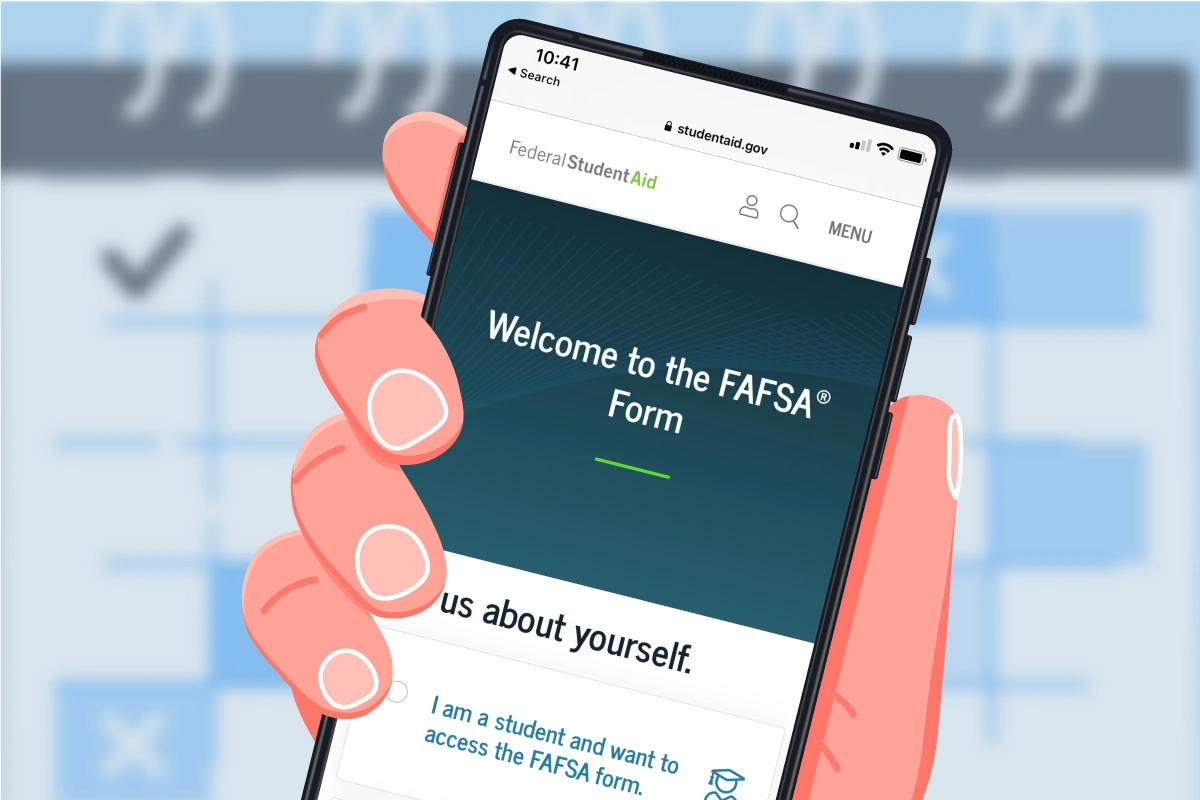
What Is the FAFSA and Why Should I Fill it Out?
The Free Application for Federal Student Aid (FAFSA) is managed by the U.S. Department of Education’s Office of Federal Student Aid. Current and future college students use the FAFSA to determine eligibility for federal assistance — including grants, scholarships, federal loans and work-study positions — for each academic year.
Colleges and universities often rely on FAFSA data when awarding institutional scholarships and other forms of aid. In short, the FAFSA isn’t only relevant for need-based federal aid, so you should file it every year — even if you assume your family’s income disqualifies you.
New FAFSA Rules: FAFSA Simplification Act
The FAFSA Simplification Act, passed in December 2020, led to notable changes. Its primary aim was to streamline the FAFSA, reducing it from more than 100 questions to just 36 beginning with the 2024-25 cycle.
Besides the shorter form, other important adjustments took effect. Prior drug convictions no longer disqualify applicants from federal aid, and male applicants aren’t required to be registered with the Selective Service System to be considered.
Other key changes for 2024-25 include:
- Student Aid Index: The old “Expected Family Contribution” (EFC) label is now the “Student Aid Index” (SAI). The term EFC often misled families into thinking they were obligated to pay that amount; SAI is intended to reduce that confusion while serving the same role as an aid eligibility indicator.
- Expanded Pell Grant eligibility: Since July 1, 2023, incarcerated students enrolled in prison education programs can receive Pell Grants, which do not require repayment. The method for determining Pell Grant amounts is being adjusted for 2024-25 to make it easier for students to see if they qualify for minimum or maximum awards. The maximum Pell Grant for 2024-25 remains $7,395.
- No extra advantage for multiple children: Families with several children in college at once no longer receive additional aid benefits based on that factor under the new FAFSA rules.
- Custodial parent requirement: Instead of either divorced parent completing the parent section, only the custodial parent — the one the student primarily lives with — must provide the information.
- Reporting farms and small businesses: Families that own farms or small businesses will now need to report the net worth of those entities, which could reduce aid eligibility for affected students.
Key FAFSA Deadlines and Dates
FAFSA timelines can be confusing because the application window for a single academic year covers nearly two calendar years. That means there can be two active FAFSA cycles at the same time:
- The 2023-24 FAFSA opened Oct. 1, 2022, and is due June 30, 2024.
- The 2024-25 FAFSA became available Dec. 31, 2023 (later than usual because of the overhaul) and is due June 30, 2025.
To file accurately before tax season, the FAFSA now allows use of the prior year’s tax information. For example, applicants could complete the 2023-24 FAFSA using 2021 tax returns. For 2024-25, you can use your 2022 tax return to speed up submission.
You can import tax data automatically with the IRS Data Retrieval Tool. Under the simplification law, the agency will eventually pull tax data automatically, reducing the need for applicants to use the tool in later years.
Keep in mind: using older tax returns can be an issue if your family’s financial situation changed since the taxes were filed. If that’s the case, contact your school’s financial aid office to discuss options. You’ll still submit the FAFSA with the tax information on file.
Federal FAFSA deadlines are typically June 30 following the academic year. But financial aid is awarded on a first-come, first-served basis, and state and institutional deadlines are often much earlier, usually the spring before the school year starts. So it’s best to apply as early as possible.
A Note on Student Loan Forgiveness
Student loan forgiveness remains a politically charged topic. President Biden proposed a major forgiveness plan in 2022, but the Supreme Court overturned that effort in 2023. At present, it’s uncertain whether broader forgiveness will be implemented in the future. Don’t rely on potential loan forgiveness when taking out new loans.
The White House has since announced additional measures to offer some debt relief and borrower support. Read more about the administration’s current actions here.

Preparing to Fill Out the FAFSA Form
Getting your financial aid organized might feel overwhelming, but we’ve broken down the process into manageable steps. Here’s what to review before beginning the FAFSA.
1. Find Your State’s Deadline
When is the FAFSA due? While the federal deadline for the 2024-25 FAFSA is June 30, 2025, states impose their own timelines. Because the 2024-25 form was released later than usual, some states may offer flexibility, but always check your state’s rules.
Verify your state deadline and note any special requirements for state programs.
2. Gather Your Documents and Materials
Don’t start the FAFSA without your paperwork in order. If you pause on the application to find details like a parent’s Social Security number, you risk timing out and losing progress.
Have these items ready before you log in:
- Social Security numbers for you, your parents or your spouse. (If parents lack SSNs, they can’t complete the online portion and must use paper forms.)
- If you’re not a U.S. citizen, your Alien Registration Number.
- A copy of last year’s tax return in case IRS data transfer isn’t available.
- Your income from the prior year, even if you didn’t owe taxes.
- Your driver’s license number, if applicable.
- Amounts of money you received outside employment or payments made on your behalf the prior year (for example, contributions from parents or payments into a 529 plan).
- The names of schools to which you’ve applied or plan to apply. You can search for institutions in the online system. You may list up to 10 schools on older forms; newer forms allow up to 20.
- Your Federal Student Aid (FSA) ID and password if you’re returning. If not, see the section below on creating an FSA ID.
Note: For the 2024-25 FAFSA, some information may be pulled directly from IRS records, reducing the amount you must enter manually.
3. Brace Yourself With the Federal Student Aid Estimator Tool
Try the Federal Student Aid Estimator to get an early sense of potential federal aid. The calculator doesn’t provide definitive eligibility, but it mirrors the questions you’ll see on the real FAFSA.
If you and your family are unfamiliar with the process, this tool is a low-pressure way to practice. It takes about 10 minutes and works best if you have basic tax and income details handy.
4. First Timers, Do the FAFSA on the Web Worksheet
If you’re new to FAFSA, the FAFSA on the Web Worksheet previews the questions you’ll face online.
Print it and complete a draft in pencil. Keeping the worksheet nearby while you fill out the online form helps you navigate tougher items and identify which tax records you’ll need for yourself, a spouse, or your parents.
Note: This applies to the 2023-24 cycle. The 2024-25 form has been simplified and the worksheet is not relevant for that year.
5. Sign Up for Your FSA ID
If you’re filing a FAFSA for the first time, create a Federal Student Aid ID. The FSA ID is your username and password for the federal student aid site; it allows you to apply for aid, save progress, and sign the FAFSA electronically.
To create an FSA ID, you’ll need your Social Security number, a mobile phone, and an email address.
If your parents’ information will be included, they must create personal FSA IDs as well. The Social Security Administration verifies the details used for FSA IDs. Parents without an SSN cannot create an FSA ID or sign online; they’ll need to print, sign, and mail the appropriate FAFSA sections and use 000-00-0000 where an SSN is requested.
Keep your FSA ID handy for future FAFSA renewals and to access previously entered data.
6. Set Expectations About Your Student Aid Index
Starting in 2024-25, the SAI replaces the EFC. While the calculation has only modest changes, the rebranding aims to reduce the misconception that families are obligated to pay that exact amount.
The SAI can range lower than the old EFC, with the new minimum being -$1,500 to better account for expenses not included in a school’s listed cost of attendance. Note that families no longer receive extra breaks simply because multiple children are in college simultaneously.
Remember, an EFC or SAI is an indicator for Pell Grants, work-study, and federal loans, but you may also be eligible for scholarships and merit awards to cover remaining costs. The number is not a final bill — so don’t panic.
How to Fill Out the FAFSA Form, Step by Step
With preparation complete, the FAFSA itself is manageable. Below is a breakdown of what to expect on the application so it feels less formidable.
The FAFSA Web Worksheet and last year’s application are good references for what the 2023-24 FAFSA looks like. If you’re doing the 2024-25 form, celebrate: it has only 36 questions.
The 2023-24 application spans about 10 pages with over 100 items, though many pages are instruction-heavy; only around six pages contain questions. Not everyone answers every question — parental sections are only required for dependent students.
Overview of FAFSA Steps for 2023-24 School Year
Here’s a simple overview of the seven main steps. Detailed subsections follow.
- Steps 1–3: focus on the student’s financial picture.
- Step 4: collects parental financial data (skipped by independent students).
- Step 5: covers household details for independent applicants.
- Step 6: requests the names of colleges and their FAFSA school codes.
- Step 7: is where signatures are provided; parents sign separately if required.
The form uses color-coding and splits the steps into student and parental categories. Here’s more detail.
Student (That’s You) Information Questions (2023-24 School Year)
Student-focused questions and the list of prospective schools are distributed throughout the FAFSA. Depending on early answers, you may skip some subsequent items.
Steps 1–3 ask about your finances, demographics, and marital status. Your responses determine whether you must include a spouse’s or parents’ tax information.
If you’re dependent, parental details follow. Independent students proceed to step 5 to enter their own tax and income data.
Step 6 asks you to list the colleges where you want to be considered for aid. You can use institution codes from an online searchable database or provide full school names and addresses.
Step 7 is the signature section, where you certify the accuracy of your answers.
Documents you’ll need for the student section include:
- Social Security or Alien Registration number
- Tax forms and income documentation (including non-taxable income) and spouse tax info if married
- A list of schools (with institutional codes or full addresses)
If you have these ready, the student section can often be completed in 15 minutes or less.

Parental Questions (2023-24 School Year)
If your answers in step 3 indicate dependency, you and your parents will need to complete step 4, which requests parental tax, income, and demographic information.
Because of the nature of these questions, it’s advisable to complete them together. Parents will still need to sign separately — electronically via their FSA IDs or physically if they lack SSNs — so have them nearby when you fill out the form.
Documents required for the parental section include:
- Parents’ Social Security numbers (or 000-00-0000 if none)
- Parents’ tax returns and income documentation
- Records of untaxed income such as retirement benefits, government assistance, child support, etc.
Overview of FAFSA Steps for 2024-25 School Year
The simplified FAFSA reduces the number of steps and required inputs. Here’s a concise rundown:
- Log in or choose “Start New Form” on the FAFSA site.
- List the colleges or career schools you’re applying to (up to 20).
- Answer dependency status questions.
- Provide parent and/or spouse information as needed.
- Authorize the IRS data transfer to import financial details.
- Sign and submit the form.
After You Submit Your FAFSA Form
Well done — you submitted your FAFSA.
Within a few days you’ll get a Student Aid Report (SAR) that summarizes your FAFSA and confirms completion. For 2023-24 you’ll see an EFC on the SAR; for 2024-25 it will display the SAI. These numbers are estimates — don’t panic.
Review your SAR and correct any errors online through your FSA account. When colleges send admissions decisions, they’ll also send financial aid award letters. Schools may request additional verification, in which case the financial aid office will contact you directly.
Keep the documentation you used to file handy, because some institutions ask for independent verification of the data you provided.
Fill Out the FAFSA Fast With These Tips
Here are practical ways to minimize the time needed to complete the FAFSA.
- Get your documents ready. Collect tax forms, income records, addresses, emails, driver’s license numbers, and Social Security numbers for you, your spouse, and/or your parents. Having untaxed income documentation ready is especially helpful. Preparing these items ahead of time makes completing the FAFSA much faster.
- Decide on your schools early. Know at least one school to list for aid. Gather institutional codes in advance from the database so you don’t need to type multiple addresses during the session.
- Create FSA IDs for everyone involved. If you and your parents have SSNs, set up FSA IDs early. Electronic signatures speed processing and eliminate the need to mail signed paper forms, which can delay processing by days or weeks.
- Schedule a FAFSA session with your family. Since parents or a spouse may need to participate, pick a time when everyone can be present (in person or via video). Working together prevents back-and-forth delays and allows you to answer questions promptly.
With proper preparation and these tactics, you can often finish the FAFSA in about an hour.
Frequently Asked Questions (FAQ) About the FAFSA
Here are answers to common FAFSA questions.
Every current and prospective college student should complete the FAFSA, even if they believe they won’t qualify. Many schools use FAFSA data to award merit scholarships and other institutional aid. Returning students should file annually to reflect any changes in income, dependency, or marital status. After your first FAFSA, subsequent filings become easier.
The FAFSA for the 2023-24 year opened Oct. 1, 2022, with a federal submission deadline of June 30, 2024. Many states set earlier deadlines, and federal aid is distributed on a first-come, first-served basis, so applying early is advantageous.
The 2024-25 FAFSA became available Dec. 31, 2023, and the federal deadline is June 30, 2025. This version incorporates changes from the FAFSA Simplification Act.
If you’re well-prepared with the necessary documents, completing and submitting the FAFSA can take as little as one hour. Gathering tax and income documentation before you begin is the most time-consuming step and will speed up the filing process.
The FAFSA Simplification Act aimed to make filing quicker and easier. Passed in December 2020, the law reduced the FAFSA to 36 questions, expanded eligibility for need-based grants, and lessened the burden of providing IRS documentation by enabling easier data exchange.