While many shoppers now order groceries online and opt for contactless drop-offs, grocery delivery involves more than just filling a virtual cart and picking a time slot.
Which grocery delivery platforms include unlimited free deliveries? Which let you order alcohol? Which provide speedy drop-offs and competitive prices compared with in-store costs?
Keep in mind that grocery delivery services occasionally adjust things like minimum orders or delivery charges. Some services have exited markets (for example, Peapod no longer operates nationwide), while others — such as Kroger delivery — have expanded into regions where they don’t have brick-and-mortar locations, including areas dominated by other chains like Publix in Florida.
Earn Fast Cash to Cover Your Grocery Delivery
Having groceries brought to your home instead of making the trip yourself can save significant time and gas. But it’s not a feasible option for everyone. If you want to start using grocery delivery but are unsure how to afford membership or fees, consider a few simple ways to earn extra cash quickly.
6 Top Grocery Delivery Services, Compared
There are plenty of grocery delivery choices, so you’ll want to pick the one that best matches your routine and budget.
However, researching prices, restrictions, delivery windows and other details across multiple retailers can be time-consuming. It’s also easy to get carried away ordering impulse items like leeks or chips through an app without considering your grocery budget.
To help you cut through the promotional language, we’ve summarized the key facts about the leading grocery delivery services available around the country.
*Pricing and policies may change.

1. Instacart
What: Instacart connects you with many local grocery stores in your ZIP code — plus drugstores, pet retailers and, in certain areas, liquor shops.
Where: Instacart operates across all 50 states and Washington, D.C. See the full list of available markets.
Product pricing: Instacart lists each retailer’s pricing policy. Many stores offer “everyday store prices,” while others note that using Instacart’s convenience may mean paying higher prices than shopping in person.
Membership: You don’t need a membership to use Instacart, but if you’d like to avoid delivery fees you can join Instacart+. For $99 per year or $9.99 monthly, members get free delivery on orders over $10 and protection from peak pricing during busy times. New users can try Instacart+ free for two weeks. Instacart+ U.S. members may also receive a Peacock Premium subscription at no extra cost (Peacock’s ad-supported tier valued at $79.99/year).
Delivery fee: Service fees are applied to grocery and retail orders under $10, and to Costco and eligible restaurant orders below $35.
Coupon policy: Instacart generally does not accept in-store sale prices or manufacturer coupons. Instead, it runs promotions visible in your account; when you meet the promotion’s requirements, the discount is applied automatically.
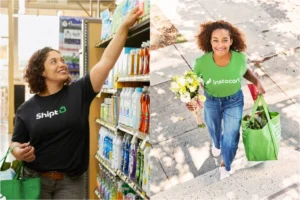
2. Shipt
What:Shipt delivers from a variety of grocery retailers. Alcohol delivery is available in select markets.
Where: Shipt is operational in many U.S. locations.
Product pricing: Shipt’s pricing tends to be slightly higher than in-store: “Our members can expect to pay about $5 more using Shipt than they would on a $35 order purchased in the store themselves,” notes the company’s pricing explanation.
Membership: Shipt memberships cost $99 per year or $10.99 per month for unlimited free delivery on orders of $35+. Students can pay $4.99 per month while enrolled (up to four years). All memberships include a 14-day trial.
Delivery fee: Free delivery requires a $35 minimum order for members. Orders under $35 incur a $7 delivery charge. Alcohol purchases may also carry a $7 fee. Gratuities are allowed.
Coupon policy: Shipt provides in-app deals but does not accept manufacturer or store coupons.
3. Walmart Grocery
What: Walmart provides multiple grocery options. In many areas you can have groceries delivered to your home, while in most locations you can place an order for curbside pickup where staff load your groceries into your car. Some stores even accept EBT for eligible purchases.
Where: Same-day delivery is offered in most states, and pickup reservations are available nationwide.
Product pricing: Pickup orders are free and priced the same as in-store, though there is a $35 minimum. Home delivery fees for non-members are $7.95 or $9.95; Walmart+ members are not charged the delivery fee for orders of $35 or more. Members placing orders under $35 pay $6.99.
Delivery fee: Express Delivery adds a $10 fee on top of the $7.95–$9.95 delivery charge (non-members). The $10 Express Delivery fee is currently not waived for any shoppers, including Walmart+ members. Express Delivery typically arrives within two hours. Walmart removed the $35 minimum for Express Delivery in recent updates.
Walmart+ subscriptions make same-day delivery more likely if you find a good timeslot. Walmart+ costs $98 per year (about $8.17/month) or $12.95 monthly, and includes a 30-day free trial.
Walmart+ members only pay the $10 Express Delivery fee (not the extra $7.95–$9.95). For non-grocery items shipped from Walmart, members get free shipping with no minimum for next-day, two-day and standard shipping in many cases.
Coupon policy: Walmart does not accept coupons for pickup or delivery orders.
4. Hungryroot
What:Hungryroot is a subscription service that curates and ships a box of healthy foods to your door each week, covering most weekly meal needs except pantry staples like milk and bread.
Where: Hungryroot delivers to most ZIP codes in the continental U.S., excluding Alaska and Hawaii.
Product pricing: You design a plan based on how much food you want and prices are tailored to your selections.
Membership: Meal costs vary depending on the meals you choose.
Delivery fee: Shipping is free for plans totaling $70 or more.
Coupon policy: Because Hungryroot delivers many of its own branded items, you’ll need brand-specific coupons. Watch for promotions offering free products like Ancient Grain Pancake Mix, Superfood Almond Butter or cookie dough.
5. Thrive Market
What:Thrive Market is a subscription-based service delivering organic and non-GMO groceries. It caters to special diets and allergies — vegan, vegetarian, gluten-free, nut-free, dairy-free, kosher, keto and more — and offers pantry items, prepared foods and frozen proteins. It does not carry fresh produce.
Where: Thrive ships via ground to the 48 contiguous states.
Product pricing: Thrive promises a “low price guarantee” — if you find a lower price elsewhere, they will refund the difference as credit.
Membership: Membership costs $5 per month (or $60 billed annually). Monthly billing is $12/month. Annual members can cancel within 30 days for a full refund. Qualifying students, teachers, military, veterans, first responders and low-income families can apply for a complimentary one-year membership via Thrive Gives.
Delivery fee: Shipping is free for orders over $49. Orders below $49 incur a $5.95 charge. Frozen orders under $120 ship for $19.95. Wine ships free over $79, or $13.95 if under $79.
Coupon policy: Members occasionally receive coupons for discounts on orders. You can also earn store credit for referrals, product reviews and buying promotional items.

6. Kroger
What: Kroger provides multiple fulfillment options — Delivery (powered by Instacart), Ship and Pickup — so you can choose same-day delivery of perishables, scheduled delivery, home shipping for nonperishables, or curbside pickup.
Where: Kroger Ship ships across the continental U.S., including P.O. and APO/FPO addresses. Delivery and Pickup availability varies by store.
Product pricing: Prices shown on Kroger’s site reflect the store you’ve selected and may change with in-store promos, delivery/pickup day or other factors. Kroger Ship runs separate promotions but doesn’t offer wholesale pricing.
Membership: No membership is required, though creating an account unlocks fuel points, discounts and digital coupons. A Boost membership includes free grocery delivery for orders of $35+.
Delivery fee: Ship is free for orders over $35; orders under $35 incur a $4.99 standard shipping fee. Pickup is free for orders over $35 and carries a $4.95 service fee under $35.
Coupon policy: Kroger Delivery accepts digital coupons you clip online; they’re applied automatically. Kroger Ship does not accept coupons.
Other Regional Delivery Options

Many strong grocery delivery options serve only certain cities or regions, so check local retailers in your area.
Some notable services include:
- FreshDirect: Delivers fresh produce, meat and wines/spirits in New York, New Jersey and Connecticut, plus seasonally to the Hamptons and Jersey Shore.
- Safeway: Popular on the West Coast, Safeway offers online ordering for pickup or delivery.
- Amazon Fresh: Open to the general public, Amazon Fresh offers fresh produce and grocery delivery. Prime members placing orders over $100 often avoid fees, while two-hour deliveries carry a $6.95 service fee for $50–$100 orders and $9.95 for under $50. Non-Prime shoppers face $7.95–$13.95 based on order size and delivery window.
- Publix: Select Southeastern locations provide delivery and curbside pickup via Instacart; some stores also support in-store pickup.
How to Choose the Best Grocery Delivery Service for You
Each leading grocery delivery service offers different advantages depending on your household’s needs. When picking a service, consider:
- Is the service available where you live?
- Do you need fresh produce and meats delivered, or only shelf-stable items?
- Do you prefer shopping local stores or large national chains?
- Do you like browsing multiple stores or sticking with one go-to retailer?
- Do you follow any special diets?
- Does a service cover all your grocery necessities or only a subset?
- Are you looking for curated meal boxes, meal kits, or individually selected groceries?
If a single service doesn’t meet every need, you can mix and match providers — just monitor the cost: multiple subscriptions can quickly add up and offset any savings.
Michael Redding is a personal finance enthusiast and content creator focused on practical money-saving tips and income ideas. His work also appears on The Smart Wallet, FinanceBuzz, Yahoo! Finance and JoyWallet.