Like many clever inventions — electricity, bifocals and even swim fins — Ben Franklin is often linked to one of the earliest examples of group purchasing.
In 1752 he assembled a small cohort of property owners to jointly purchase fire insurance. More than two centuries later, collective buys still benefit businesses, employers and co-ops — as well as just two cousins splitting the cost of a pressure washer or colleagues pooling funds for shared jigsaw puzzles.
No long-term contracts or memberships are needed when a few people team up and combine resources to buy shared items. People have long done this for vacation homes or boats, but the idea of group buying applies equally well to more modest purchases.
Below are some instances of group buys that can put items you thought were out of reach within your grasp.
Shared Recovery
Stephanie Dyer and three friends jog together at dawn in St. Petersburg, Fla., four or more mornings a week. Each covers about 45 miles weekly and averages two marathons a year. To recover and keep their legs in tip-top shape, the women aim for a 30-minute session with a physical therapist each week. They slip into “boots” that extend from toes to knees and attach to a pump that rhythmically compresses and releases pressure to stimulate circulation.
“Ideally, we’d use them once a week,” Dyer said. “We’d have a 30-minute session for $30.”
When the COVID-19 outbreak arrived, it naturally became more difficult for them to visit a physical therapist’s office for treatments.
They checked the price of owning a NormaTec Leg Pulse recovery system and discovered it retails for $1,000.
“We ran the numbers and if each of us pitched in $250, we’d recoup that expense in five weeks, saving $30 a week compared to the therapist,” she explained. “So we bought it and will rotate it among us as needed.”
Having the device at home gives them full flexibility on when to use it and removes the hassle and cost of scheduling appointments at a clinic.
Expensive Jigsaw Puzzles
When five former flight attendants gathered for a girls’ weekend in White Lake, N.C., one guest brought along a jigsaw from Liberty Puzzles.
These puzzles, produced from chunky wood, represent the high end of the jigsaw market, starting around $105 apiece. They feature intricately cut pieces shaped like palm trees, dancers or long-tailed cats. Several pieces form mini-scenes that then fit into the larger picture.
“It’s a puzzle within a puzzle. We became hooked,” said Susan Jackson, who hosted the weekend. “I could never go back to ordinary cardboard puzzles now.”
The group didn’t complete the puzzle of red-painted flowers that weekend, but when Jackson finished it later she mailed it to one of the five friends in Millburn, N.J. That friend then forwarded it to another in Falmouth, Maine.
Anticipating lots of downtime at home when quarantines began, the friends decided to pool funds to purchase more puzzles to share. They quickly ordered roughly a dozen from Liberty’s site and hunted for gently used puzzles on eBay.
“We ended up with 49 puzzles that we now circulate among the original five and some additional friends and relatives,” Jackson said.
Luckily they moved fast and scored bargains because they weren’t the only puzzle fans preparing for extended time at home. Liberty’s stock thinned as staff were sent home and prices on eBay climbed.
“One puzzle we bought for $100 was later selling on eBay for $1,500. We couldn’t believe it,” Jackson said.
Tools for Occasional Use
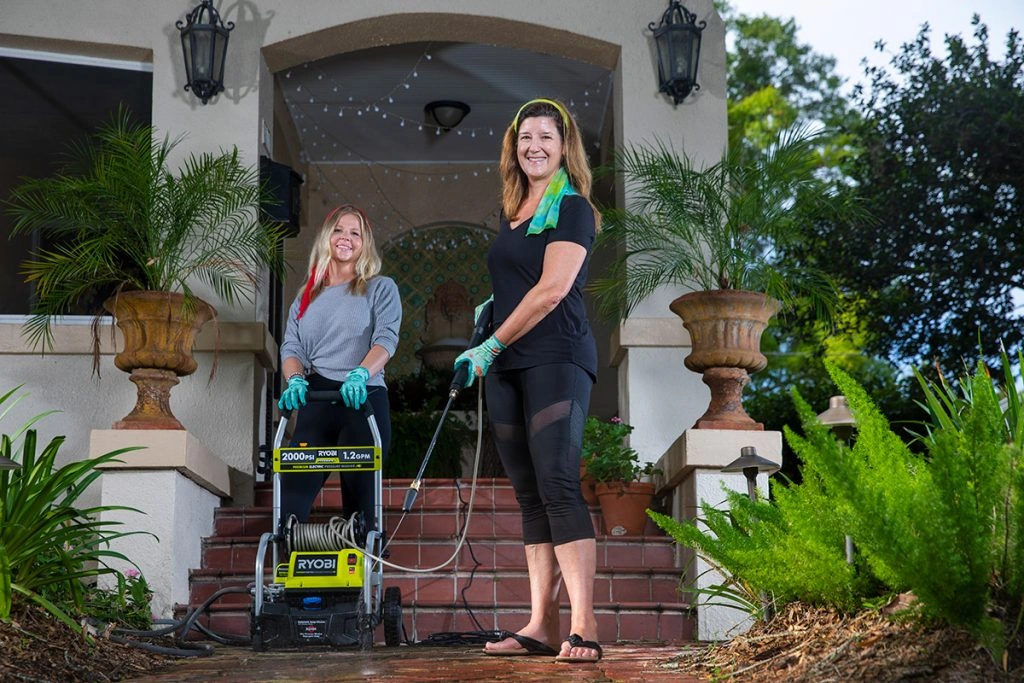
Deann Coop found herself renting a pressure washer from Home Depot for about $50 every six months or so when her front walk got slippery with moss and grime.
Her cousin, Dena McKenna, was frequently borrowing a neighbor’s pressure washer and felt she was imposing too often. The two women in St. Petersburg, Fla., decided to split the cost of purchasing one for $250 total.
“So we have joint custody of a pressure washer,” Coop chuckled. “It’s not like we ever need it at the same time.”

She now finds herself pressure washing more frequently, and believes her property looks cleaner and better maintained.
“It’s so satisfying when you blast away really dirty sidewalks or plant stains,” she said. “It’s the one chore I actually enjoy.”
Shared Interactive Mysteries
Sophie Wiltshire, a pre-med student at Northeastern University in Boston, is hooked on the podcast My Favorite Murder. So the crime-solving subscription Hunt a Killer made a perfect Christmas gift. It’s similar to cracking an escape room or investigating a cold case. Subscribers receive six months’ worth of boxes filled with clues — autopsy notes, fingerprint records, timelines, recovered letters, character profiles and other materials sent every 30 days.
While crime doesn’t pay, this hobby isn’t inexpensive. Hunt a Killer costs $180. When Wiltshire’s mother and stepfather gifted her the game for Christmas last year, they anticipated she’d share it with other aspiring sleuths once she’d worked through the case.
Wiltshire brought all the packages home when classes went remote, and her family binge-played Hunt a Killer.
“When I was home during quarantine we finished all the boxes together in two nights and had my stepsister joining via Zoom,” Wiltshire said. “Now we pass the boxes along to other relatives.”