You don’t have to sign up for a costly fitness club to keep in shape. Materials to craft weights and other exercise tools are often available at your neighborhood hardware store, grocery market or even in your kitchen pantry.
“You really can use anything from weighted vests to soup cans to gallon jugs,” said Max Cicero, general manager and performance coach at Diesel Fitness in Tampa, Florida. “You can increase resistance using your own body weight to make movements more challenging.”
Below are ways to fashion your own dumbbells and boost your workouts — all from the comfort of your home.
How to Build Homemade Weights and Other Workout Equipment
Here are several ideas to construct your own fitness tools or locate suitable stand-ins.
Dumbbells
Fill two gallon containers with sand, pebbles or water. Secure them to either end of a metal rod with socks or strong tape. Swap in half-gallon jugs to adjust the load.
Hand weights
Fill single water bottles with sand or water for simple handheld weights.
Lift full wine bottles before you empty them.
Straight-from-the-can soup or bean cans also make effective hand weights.
Ankle and wrist weights
Stuff knee-high socks with stones, dried beans or sand and tie them around your wrists or ankles when walking or doing leg and arm routines.
Added weights
Pack a backpack with bricks or books wrapped in a towel for cushioning. Wear it while doing squats or step-ups.
Jump rope
A handy length is about twice the distance from your feet to your armpit. Cut a nylon rope to the length you prefer and use short PVC pipe pieces for grips.
You can also repurpose plastic grocery bags: make loops, tie several together into three long strands, braid them tightly to the desired length and wrap the ends with duct tape to form handles.
Water flow bar
A partially water-filled PVC pipe forces your core to work harder. Hold the bar level and lift it in different directions while preventing the water from sloshing between ends. Use it for deadlifts, during crunches or even while walking.
Medicine ball
The same loaded backpack can serve as a medicine ball for lifts or side-to-side movements during crunches.
Tire
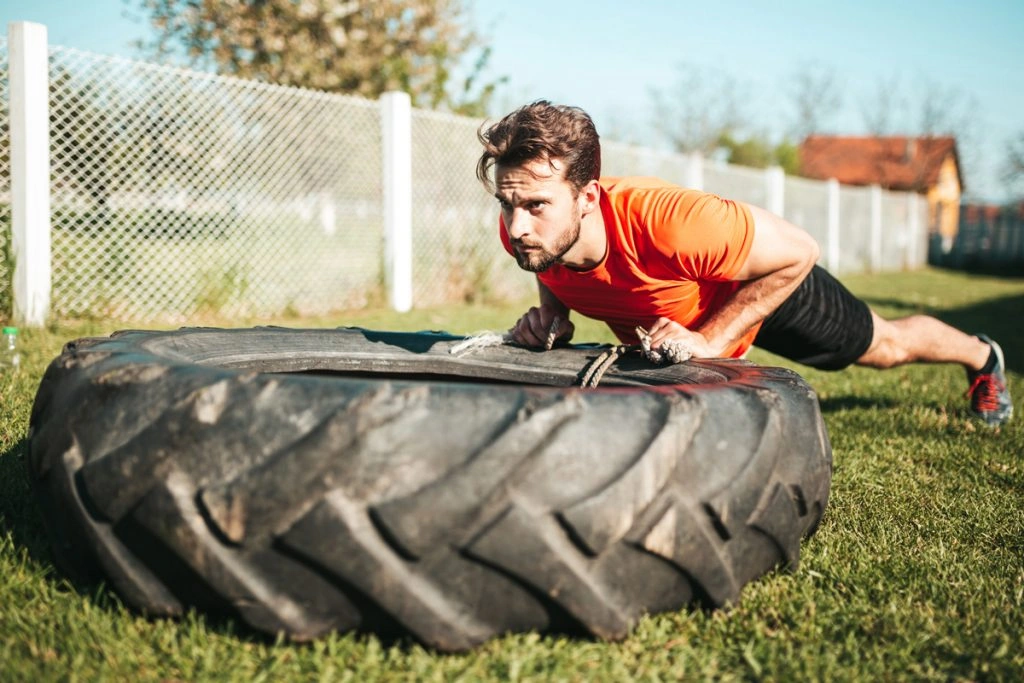
Auto shops often sell damaged tires for $20 and up. They double as free weights, a cardio step, an obstacle to jump over or something heavy to flip for strength training.
Yoga mat
A bath mat with a rubberized bottom that resists slipping and offers extra cushioning can substitute for a yoga mat.
No-slip socks with rubber grips on the soles allow you to practice yoga safely without a mat.
Stacking two or three towels is a simple alternative that produces a softer surface.
Resistance bands
Tie a pair of tights or pantyhose into an oval about 20 inches long to use as ankle resistance bands.
Stand on the middle of another pair and pull up on each leg to create resistance for arm exercises.
Cicero also recommends these tactics to intensify exercises when weights aren’t available:
Slow it down. Rather than doing squats with a one-second descent and a one-second ascent, increase difficulty by counting slowly to four on the way down. Apply the same principle to push-ups.
Isometric holds: Pause and hold your position for a few extra seconds during moves like leg lifts, push-ups or squats.
Add tension: Grip a broom handle, lacrosse stick or a small tree limb overhead with both hands and squeeze it firmly while performing lunges or squats. That added tension engages the core and upper body more effectively.
Jordan Lake is a senior writer for Savinly.