Having the government help foot the bill for your child’s private school tuition might sound far-fetched, but it’s becoming more common as an increasing number of states roll out school voucher initiatives. Even with public support, though, is private school tuition truly affordable for your household?
Below we’ll examine how voucher systems operate, what these public education dollars typically cover and who qualifies to use taxpayer-funded assistance for private schooling.
What Are School Vouchers?
A school voucher initiative directs money usually intended for public education to individual students or families who want to enroll in a private or faith-based school. In certain states, vouchers can also be applied toward homeschooling expenses.
Public and charter schools are funded through taxpayer money and are part of the public education network. Private school choice options provide an alternative for lower-income families who wish to allocate some of those public resources toward private schooling.
How Do School Vouchers Work?
Understanding how to use vouchers in your state can be tricky because states vary widely in how much funding they provide and under what conditions. Keep in mind that some states prohibit using vouchers at religious schools.
In some places, education savings accounts (ESAs) exist alongside or in place of voucher programs. ESAs load public funds onto a government-issued debit card that families can spend on private school tuition, online courses, tutoring, community college and other educational services and supplies.
There are also scholarship programs funded differently than state budgets. Tax-credit scholarships are funded by private contributions; donors receive tax credits in return rather than direct state disbursements.
Who Is Eligible for School Vouchers?
Voucher eligibility depends heavily on your state. Some states award vouchers when students live in districts with chronically underperforming schools. Others limit vouchers to students with special needs or other disadvantaged groups.
With tuition tax credits, certain states base scholarship eligibility on academic performance or standardized test results.
Do Vouchers Cover the Cost of Private School Tuition?
No matter the eligibility criteria or program structure, one point is consistent: vouchers rarely pay the full cost of private school tuition.
Per the Education Data Initiative, the average yearly cost to attend one of the 22,440 private K–12 schools in the U.S. is $12,350 per year, with religious schools typically charging less than nonsectarian institutions. The U.S. Census Bureau reports that private school tuition represents roughly 18% of the average household income.
States That Offer Voucher Programs to Pay for Private Schools
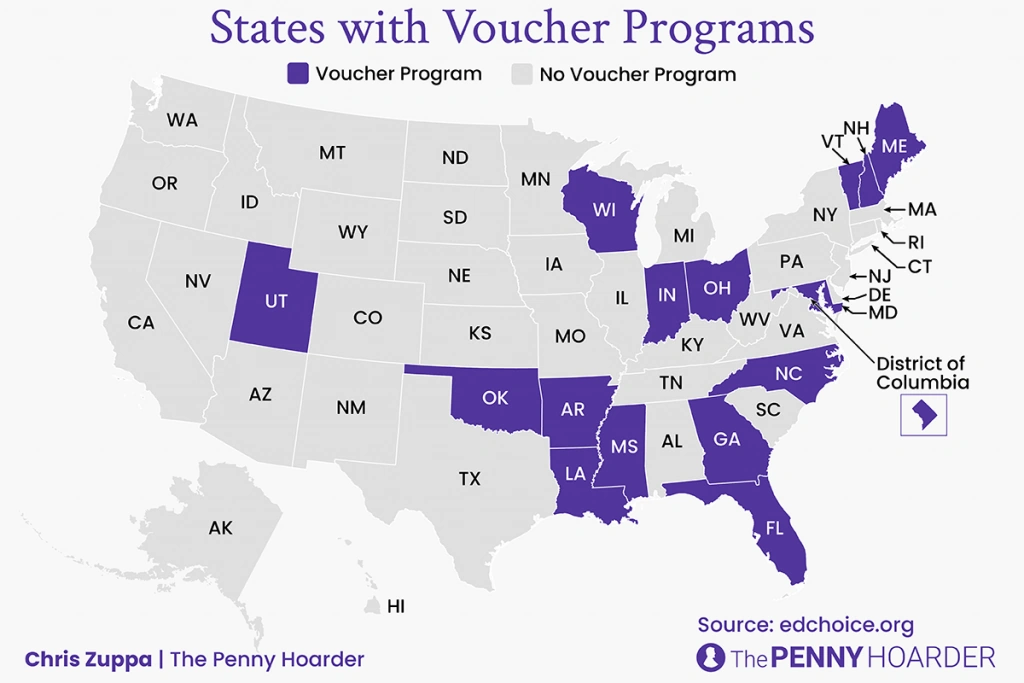
Fifteen states plus the District of Columbia currently operate some kind of school voucher program. Five of these are limited to special needs students. Meanwhile, three voucher programs in New England restrict eligibility to small towns that lack public schools.
That leaves just seven states with traditional voucher programs available to lower-income students. Still, the list of voucher states is likely to grow as more education choice measures advance. Funding amounts vary and are frequently determined by family income and need.
Private School Voucher Programs
| State | Program | Funding | Eligibility | |
|---|---|---|---|---|
| Arkansas | Succeed Scholarship | $7,000+/year | Kids with disabilities, in foster care, military | Learn more |
| Florida | Empowerment Scholarship | $6,500+/year, $750 transportation grants | Low and middle income, students with disabilities | Learn more |
| Georgia | Special Needs Scholarship | $5,000+/year | Students with disabilities | Learn more |
| Indiana | Choice Scholarship Program | $5,000+/year | Low and middle income families | Learn more |
| Louisiana | School Choice Program | $2,500+/year | Students with disabilities in eligible districts | Learn more |
| Maine | Town Tuitioning Program | Variable | Students who live in towns without public schools | Learn more |
| Maryland | BOOST Program | $3,000+/year | Low-income students | Learn more |
| Mississippi | Nate Rogers Scholarship, Dyslexia Therapy | $5,500+/year | Students with speech therapy or dyslexia | Learn more |
| New Hampshire | Town Tuitioning Program | $11,000+/year | Students in towns without a public school | |
| North Carolina | Opportunity Scholarship | $4,000+/year | Low-income students | Learn more |
| Ohio | Educational Choice Scholarship | $5,000+/year | Lower income, disabilities, low-performing schools | Learn more |
| Oklahoma | Lindsey Nicole Henry Scholarships | $7,000+/year | Students with special needs on IEP or ISP | Learn more |
| Utah | Carson Smith Special Needs Scholarship Program | $5,500+/year | Students with special needs | Learn more |
| Vermont | Town Tuitioning Program | $15,000+/year | Students who reside in towns with no public school | Learn more |
| Wisconsin | Private School Choice Programs | $8,000+/year | Low-income students | Learn more |
| District of Columbia | D.C. Opportunity Scholarship Program | $10,000+/year | Low-income students | Learn more |
States That Offer Education Savings Accounts to Cover Private and Religious Schools
Although few states feature traditional voucher systems, a larger number provide tax-credit scholarship programs or flexible education savings accounts (ESAs) to help families offset private school expenses.
Private & Religious School Voucher Programs
| State | Program | Funding | Eligibility | |
|---|---|---|---|---|
| Arizona | Empowerment Scholarship Accounts | $7,000+/year | All Arizona students | Learn more |
| Florida | Family Empowerment Scholarship | $10,000+/year | Students with special needs | Learn more |
| Indiana | Education Savings Account Program | $7,500+/year | All K-12 students starting 2023-2024 school year | Learn more |
| Mississippi | Equal Opportunity for Students with Special Needs | $6,500+/year | Students with special needs | Learn more |
| North Carolina | Personal Education Student Accounts | $9,000+/year | Students with special needs | Learn more |
| Tennessee | Individual Education Account Program | $7,000+/year | Students with disabilities | Learn more |
| Utah | Utah Fits All Scholarship | $8,000+/year | All K-12 Utah students starting 2024 | Learn more |
| West Virginia | Hope Scholarship Program | $4,500+/year | All K-12 West Virginia public school students | Learn more |
5 Hidden Costs of Attending Private Schools
Before you rely on vouchers in your state, consider some of the additional expenses tied to private education. Even if state help covers a portion of tuition, private schools often come with other ancillary costs.
1. Transportation
Most private schools expect families to handle transportation. That not only means paying for gas but also setting aside time for the daily drive or carpool routine.
2. School Uniforms
Many private institutions eliminate dress code hassles by mandating uniforms. While some parents see uniforms as cost-effective compared with everyday clothing, there’s still an added expense to factor in.
3. Computers and Other Equipment
Unlike many public schools that provide student devices, private schools frequently anticipate that pupils will have access to their own computers or tablets at home.
4. Books
Public school curricula have moved many resources online to keep textbook costs low or free, whereas private schools may depend more on printed textbooks — costs that can be passed on to parents.
5. Field Trips
Public school field trips are often local and inexpensive, but private schools may offer more elaborate and pricier excursions. And if you opt for boarding schools, you’ll also be paying for room and board.
School Voucher Frequently Asked Questions (FAQ)
While private school tuition itself is not tax deductible, you can use education savings vehicles like a 529 Plan to withdraw up to $10,000 tax-free for certain education expenses, which can include private school tuition and related costs.
A handful of states allow tax deductions for some homeschooling expenses. States with such provisions include Illinois, Indiana, Louisiana, Minnesota and Iowa. Louisiana offers one of the most generous options with a standard deduction of up to $5,000 per student for homeschooling families.
Yes — several national groups award scholarships or grants to families. The Children’s Scholarship Fund helps low-income K–12 students, and the Jack Kent Cooke Foundation has scholarships for private high school attendance. Also check with the private school you’re considering for local aid opportunities.
If you’re concerned about policies that stigmatize students over unpaid lunch balances, you may also want to learn about school lunch shaming and related protections and resources.
Jordan Marks is a contributing education writer at Savinly covering family finances and schooling options. Jordan has reported on education policy, personal finance and community issues for several years.