If you’re anything like us, there’s a drawer overflowing with lotions and creams that aren’t doing much for parched hands and feet. It’s one of life’s little puzzles.
But as much as we crave relief, we don’t want to blow a lot of money on products that might not deliver.
We consulted dermatologists to learn what truly helps dry, fissured skin and to pinpoint the best inexpensive moisturizers. (Hint: many of them are available at drugstores.)
Moisturizer, Lotion, Cream: What’s the Difference?
These words aren’t entirely interchangeable, even if people often use them that way. A moisturizer is a blend of water and oil-soluble elements that work on the skin’s outermost layer. Common components include petroleum-based products, mineral oils and waxes. Lotions tend to be more fluid and contain numerous ingredients. The greater the water content, the higher the chance bacteria can get in, so preservatives such as parabens, salicylic acid and benzyl alcohol are usually added. For that reason, lotions are best used on less sensitive areas of the body. (Avoid using them on your face.) Cream refers to a thicker moisturizer made for very dry zones like elbows and heels.
Practices and Habits to Adopt
Use these straightforward habits to keep your skin better hydrated.
Put It On at the Right Moment
The lotion, cream or moisturizer you pick won’t help if you slather it onto dry skin, explains James Beckman, a board-certified plastic surgeon and founder of Therapon Skin Health. Beckman recommends applying while your skin is still damp — after showering but before you towel off — so the product spreads evenly.
He also advises applying moisturizer at least 20 minutes before heading outdoors to permit optimal absorption.
Skip Vegetable Oils
Avoid products that rely on vegetable or mineral oils, Beckman warns.
“These merely sit on the surface of the skin and wash away easily,” he says.
Price Doesn’t Equal Quality
“I tell patients that the gap between a pricey and an inexpensive moisturizer/lotion/cream often comes down to the branding and marketing rather than the actual ingredients,” says Vikram Rajkomar, a dermatologist with Pall Mall Medical.
The important thing is to choose a formula that your skin tolerates, because individual responses vary.
Ingredients to Seek
Susan Bard, a New York-based board-certified dermatologist, recommends humectant-rich moisturizers that draw water into the skin, such as glycerin or hyaluronic acid, without leaving a greasy finish.
“Thick emollient products often include occlusives like dimethicone, beeswax and lanolin, which help stop moisture from escaping,” Bard says. “However, they can feel sticky and may clog pores, causing folliculitis or miliaria on certain body areas.”
Humectants alone aren’t enough, says Fayne Frey, a dermatologist and founder of FryFace. She prefers moisturizers that combine humectants and occlusives. Strong occlusives include petrolatum, mineral oil and silicone derivatives such as simethicone, while effective humectants include glycerin, hyaluronic acid and propylene glycol.

Best Affordable Moisturizers: Experts’ Picks
Many of the following options are available at neighborhood drugstores.
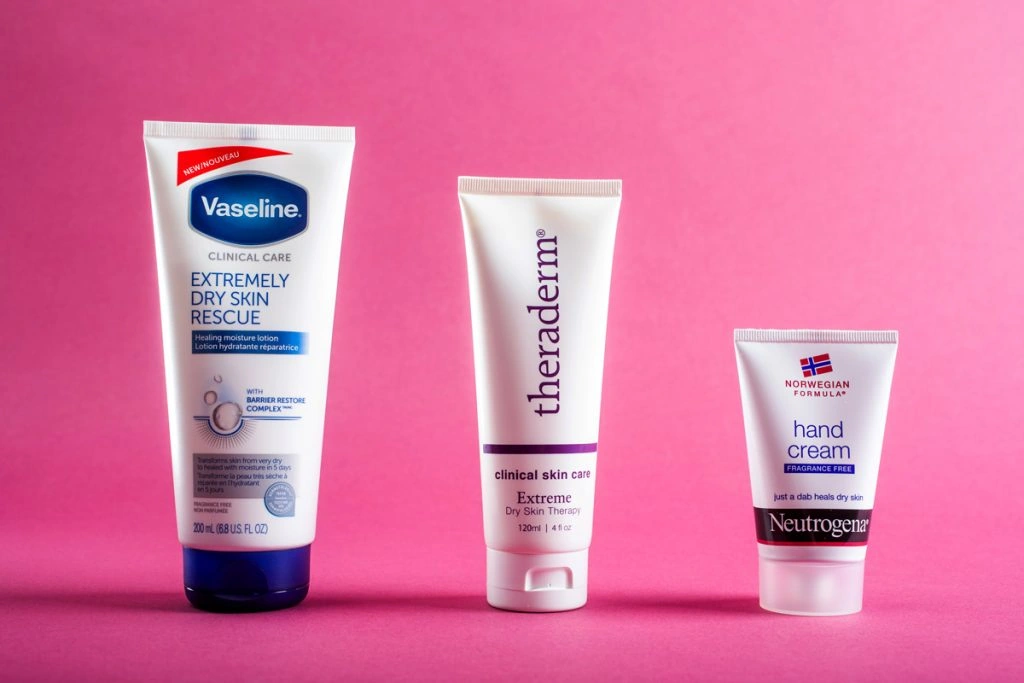
Beckman recommends Theraderm Extreme Dry Skin Therapy ($16.95 at Theraderm.net) and Theraderm Body Restoration Creme ($16.95 at Theraderm.net) for winter. “They’re formulated to restore function as well as texture, replenishing missing skin oils with natural lanolin — a genuine skin oil derived from sheep’s wool,” Beckman says.
Bard’s top choices for dry hands include Neutrogena Norwegian Formula hand cream ($3.99 at Target), O’Keeffe’s Working Hands ($6.99 at Bed Bath & Beyond) and Aveeno Eczema Therapy Itch Relief Balm ($16.56 at VitaCost).
Petroleum jelly — commonly known as Vaseline — is the benchmark occlusive, blocking about 98 percent of water loss from skin to the environment, Frey notes. Many find it greasy, but “it works,” she admits.
Other Ways to Ease Dry Skin
A Harvard Medical School report updated in 2019 outlines some no-cost strategies for managing dry winter skin. First, lower your thermostat since warm air tends to be drier than cool air. Then, run a humidifier to add moisture to indoor air.
Although it may feel soothing, extremely hot showers strip away the oily substances in your skin that help lock in moisture. Opt for warm showers instead. When bathing, close the bathroom door to trap humidity and keep showers brief, around 5 to 10 minutes. Pat your skin dry rather than rubbing, and apply moisturizer right after toweling off.
Wear loose-fitting garments — tight clothes can rub and dehydrate the skin — and bundle up to shield yourself from cold, gusty weather. As much as it pains us to say, the American Academy of Dermatology recommends avoiding prolonged exposure to fires or fireplaces, since they can dry out your skin further.