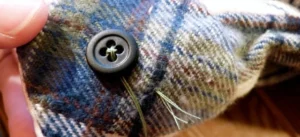
Louise Weaver is astonished when people bring garments to an alterations shop and hand over $5 to $10 just to have a button reattached. She’s equally surprised when others simply toss a pair of shorts because a button fell off.
“Sewing is really a basic skill. It’s not difficult to mend a torn seam or sew on a button,” said Weaver, who resides in St. Petersburg, Florida. “I buy pieces I truly like and keep them for years because I know how to repair them.”
Weaver isn’t a couture designer or runway aspirant. She owns a simple Singer sewing machine and a well-ordered sewing kit. Most of her stitching is practical — taking in a dress, replacing a button or mending a ripped pillow, the latter often done without a machine.
Being able to do a handful of fundamental stitches will prolong the life of your clothing, which helps you economize. You’ll also avoid paying for alterations.
Additionally, knowing how to sew helps resourceful shoppers snap up bargains at thrift stores or retail sales when items don’t quite fit or need a little attention. Perhaps that Lucky Brand sundress is reduced from $80 to $29 because the straps hang too low on anyone shorter than six feet, or that J. Crew tie is discounted to $14 because the keeper loop is loose on one side.
Shoppers who can fix these small flaws have an advantage.
Below are several primers on essential sewing techniques with links to useful demonstration videos. Learning these skills will make your wardrobe dollars go further.
How to Thread a Needle
1. Trim the end of the thread with scissors so it isn’t frayed.
2. Hold the thread between the thumb and forefinger of one hand so about a quarter-inch protrudes. Grip the needle in the other hand between thumb and forefinger.
3. Align the thread with the needle’s eye and push it through until about an inch appears on the other side. You can dampen the thread tip with your mouth to stiffen it slightly, which can make threading easier.
4. Pull roughly 18 inches of thread through the eye and draw it down along about 18 inches of thread coming from the spool, then cut the thread at the spool.
5. Hold the two ends together and form a knot by creating a small loop and pulling the tail through it. You can repeat this to make two knots stacked together.
You can also use a threader. A threader is a slim, flat metal tool with a small wire loop—often included with needle packs or available in two-packs for about $2.
How to use a threader:
1. Slide the needle’s eye down over the wire loop end.
2. Push the thread through the loop until about two inches come out the other side.
3. Slide the needle off the loop so it goes over the thread. Continue sliding the needle along the thread until about 18 inches emerge.
4. Then follow steps 4 and 5 from the needle-threading instructions above.
How to Sew on a Button
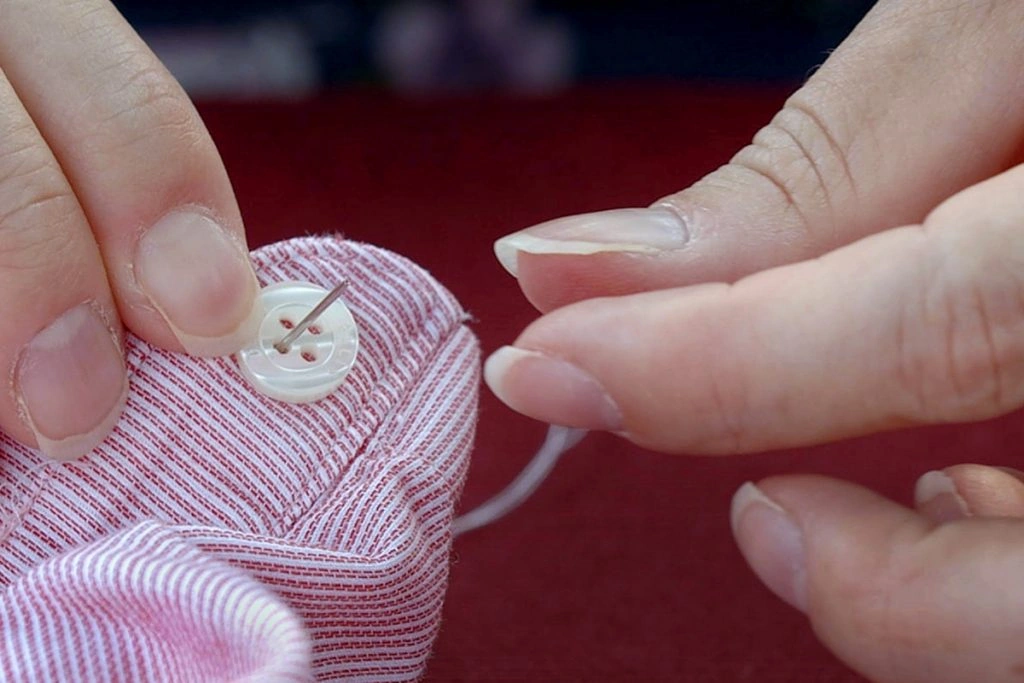
1. Insert the needle halfway through the fabric where the button should sit.
2. Place one of the button’s holes over the needle, then pull the needle and thread all the way through the hole until it’s secured by the knot on the fabric’s underside.
3. As if making a U-turn, push the needle down through a different button hole, then pull it through from the underside until the thread is taut. If the button has four holes, pass the needle through the hole diagonal to the first.
4. After drawing the thread fully through that hole, push it back down through the fabric via the initial hole.
5. Continue sewing between those two holes about five times, then bring the needle up through one of the other holes and through the remaining hole. Repeat five times.
6. After the fifth pass through the final pair of holes, when the needle is beneath the fabric, form a loop with the thread and pass the needle through the loop to create a knot. Repeat this three times, then trim the thread leaving about two inches.
7. Tie several knots in the remaining two-inch thread tail.
How to Sew a Running Stitch
This multipurpose stitch is useful for repairing pockets, resealing seams, attaching appliqués and patches, and reaffixing belt loops.
You can also use the running stitch to take in a skirt, blouse or dress. Turn the garment inside out and pin along a new seam line to improve fit. Mark the line with tailor’s chalk between the pins, then stitch along the chalk line.
How to perform a running stitch:
1. Bring the needle and thread up through the fabric, then insert it back down about a quarter-inch ahead.
2. Continue this pattern across the fabric.
How to Fix a Hem
The slip stitch is ideal for repairing hems or making fixes that are nearly invisible on the garment’s front side.
1. To hem a garment, push a pin horizontally through the fabric at the desired length.
2. Measure to the garment’s bottom and space pins about three inches apart around the hem, ensuring they’re the same distance from the edge.
3. Trim excess fabric, leaving roughly two inches below the pins (if feasible).
4. Fold the raw edge under about a half-inch and pin to secure. Then press it flat with an iron.
5. Fold the hem up again along the line marked by the pins at the desired length. Remove fold-line pins as you go and pin the hem in place through the folded edge you previously ironed so the inside finish is smooth.
6. With the hem pinned and pressed, use the hem stitch as follows:
- Push the needle through the top folded fabric, called the hem allowance. Then use the needle to pick up a few threads or fibers just above the hem.
- Next, push the needle back into the hem allowance about a quarter-inch further along.
- Again pick up a couple of threads from the garment above the hem.
- Repeat this stitch around the entire hem.
The same technique can secure a tie label at the back of a tie or reattach a loose zipper. The key is to catch only a few threads of the outer fabric and make the stitches tight and close together.
More Sewing Tips for Beginners
Here are additional general sewing pointers to help you keep garments in good condition.
1. Use thread that matches the fabric color. For prints, choose the dominant hue.
2. When stitching through multiple layers, use a heavier needle and a thimble to push it through.
3. Always work in good lighting.
4. Use scissors that are sharp and durable.
5. You will need an iron, though a towel on a kitchen counter can serve as a makeshift ironing board.
6. Some tears can be mended by ironing a patch onto the fabric’s underside — no stitching required.
Katherine Waters is an independent reporter and editor in St. Petersburg, Fla., and author of Rules for the Southern Rulebreaker: Missteps and Lessons Learned.