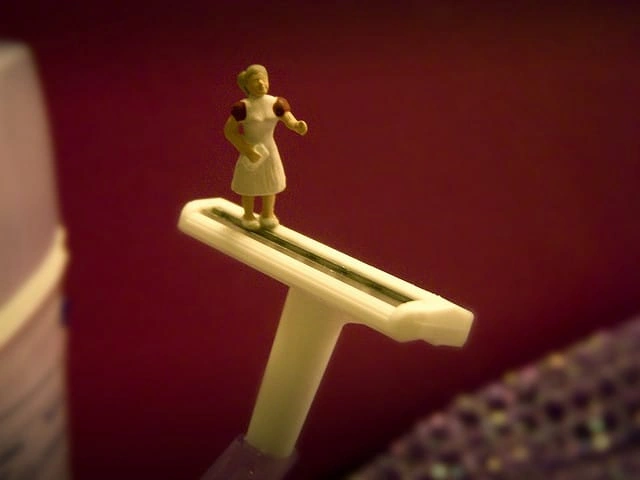
The pink tax refers to a subtle, often not immediately obvious price increase for women’s versions of products that are essentially the same as those marketed to men, such as razors and shampoos.
Listen Money Matters gathered numerous instances where products aimed at women (“pink items”) are priced higher than equivalent items aimed at men. The Tumblr Woman Tax (available only in French, unfortunately, though you don’t need to know the language to understand the photos) is also collecting more examples.
How much extra have you paid because of the pink tax?
What’s the Pink Tax Worth?
Many pink items carry higher price tags than otherwise identical men’s products. The difference per item is frequently only a few quarters or a couple of dollars, but it can add up to over $1,300 annually.
Sometimes the price gap seems somewhat justifiable. Women’s shirts can cost more to press than men’s because many industrial pressing machines are sized for larger garments, so women’s shirts may need hand finishing. As writer Amanda Oliver mentions on Groundswell, though, why not buy a smaller or unisex press?
Yet some of these price differences are astonishing. Why would Excedrin Complete Menstrual be more expensive at Walgreens than Excedrin Extra Strength when both contain the identical active ingredients? Why do pink razor blades sometimes cost more than blades in traditionally “male” colors? It’s unclear, except that many companies appear to believe they can charge a premium. (To clarify, in these cases prices were set by retailers, not manufacturers. Still, whatever the source, women shouldn’t be overcharged.)
Can You Dodge the Pink Tax?
A simple fix is to purchase the “men’s” version of an item, if you don’t mind a different color or scent.
But that option isn’t always available. Womenoften pay more for auto repairs than men, although the study found that when both genders had a ballpark sense of what the repair should cost, that gender gap disappeared. (And women who were assertive and asked for a discount were more likely to receive one than men — so don’t hesitate to negotiate!)
What about games and mobile apps? Even a12-year-old spotted the gender biasin a favored game app and raised the issue in a Washington Post op-ed. Many free-to-play games offer bonus content that can be unlocked through gameplay or by paying; as Madeline Messer observed, developers often charge money for female playable characters while male characters are free. The typical cost to purchase a female avatar was $7.53 in her examples, and one Disney title charged nearly $30 for its sole female character.
The upside is that, following Messer’s critique, her favorite game’s co-creator is introducing a free female character, and Disney lowered the price for its female avatar.
For now, aside from buying the men’s option, there’s little else you can do to sidestep the pink tax. You might look for products certified as feminist, but only a handful of companies — such as L’Oreal and IKEA — have received such certification.
The most effective way to fight the pink tax is to work to eliminate it. Don’t just vote with your purchases; call out companies when you spot pricing inequalities. Ask them why women’s items are priced higher than men’s. Expose these discrepancies on Twitter or other social channels.
The pink tax isn’t a new phenomenon, but it’s well past time for it to vanish. Learn more about how companies overcharge women at Listen Money Matters.
Your Turn: Have you run into the pink tax while shopping? What’s the worst case you’ve encountered?
Alexa Rivera may or may not be a collection of energetic hamsters pretending to be one person in a long coat.